

Lesson 5

Now that we have done the letter i, we are ready for the letter t. But the letter t is a little bit deceptive, and it also contains something that we are going to encounter for the first time, and that is going up onto a line and then drawing onto the same line on the way down. In cursive, we do this quite a lot: we redraw over a line. And of course, when you do that, you need to draw on that line and not somewhere else.
So how are we going to do this? I will describe how we begin. We start the same way we started with an i: light up. And then we take our stroke up to the line, and we keep going. The letter t is quite tall. You haven't thought about this before, but it's actually quite a tall letter. And you can make it taller, but whatever you do, do not make it too short.
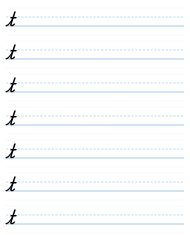
So you take your line and you go up, up, up, and then you come straight down on top of it. So your first line goes up, and then it curves up and goes straight, and then you draw a straight line down, all the way down to the bottom line, and then tick away. It actually looks like an l, because it's so tall, before it has the cross on it. And your brain will tell you you've drawn an l, but you have not. You've just drawn the upright for a t. And then you cross it on the upper line.
So let's do that. Light up, dark down, flick away. And then cross it on the line. Then you leave a space and draw another one next to it.
Check with a ruler that the angles are the same. Check that the heights are the same. What will probably start happening is that they will get shorter and shorter and shorter, or they might get taller, and the slopes might change. They might start falling forwards, or they might start falling backwards. This is what you need your ruler for: to check that you've got it the same.
If you've got it wrong, draw a line through it. Actually, get another colour and draw a line right through your letter, and make it longer than your letter. And then you can see for sure if the angle's right. Because for a very short line, you can't always see that the angle is wrong. But if you extend it to make it longer, get a pencil, put the ruler on the angle of the letter and draw a line through it, you will see that your angles are wonky. And they probably will be wonky. Be quite hard on yourself, and get it right.

Cursive — Part One: The Small Letters · Evan Millner · Published by Abecedaria Press