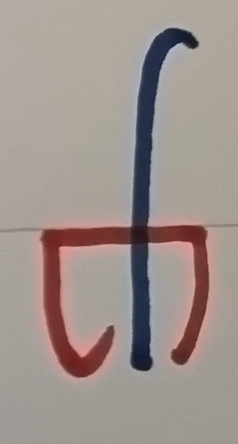
When you are writing by hand, you can take shortcuts that you cannot take when a book is being printed on a machine. And what we have here are connections of letters that come together in Igbo.
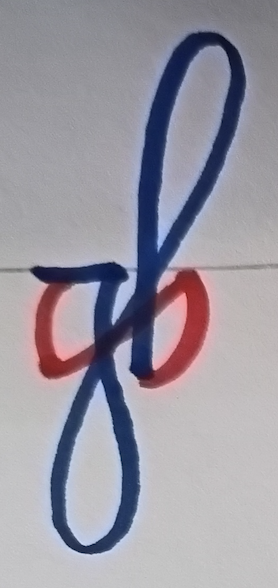
The gb Ligature
The first is g and b. And we do this in two strokes of the pen.
Firstly, we start off as though we're going to make a g, as we've made a g before. We go across on the line, we come down, we bring the curve up, we cross across, and we keep going up above the line, we loop down and come down straight and stop.
Then we pick up our pen and we make the a shape inside the g as always, but instead of stopping at the line, we keep going all the way across, up to the line, and bring it down to the bottom to form the b.
And that's the gb ligature.
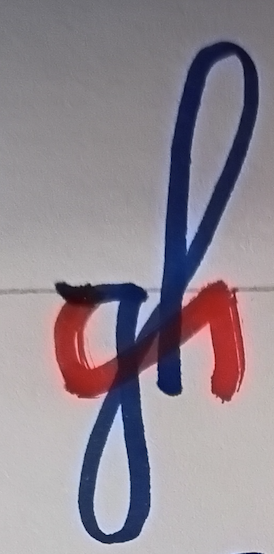
The gh Ligature
In this, we have the gh ligature, or the g and h connected to each other, and it's formed the same way as the gb.
So we start off as though we're going to make a letter g. We go across on the line, we go down, and then we make the loop, which then touches at the bottom of the a, keeps going up, crosses at the line above (make sure it crosses on the line), keeps going up, loops around, and then comes down straight as the upstroke of the h, and then we stop.
Then you pick up your pen, and you make the belly of the g, just like an a shape. So we do the little bracket shape, and then we go up on a diagonal, straight across, hit the line, and then a little bracket down to make the leg of the h.
So it's done in two strokes of the pen.
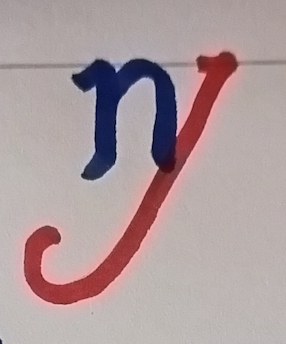
The ny Ligature
The next two letters that are connected are n and y.
So we start off by making an n like we always do, just like you learned before.
Then you pick up your pen, and a short distance away, you make a little tick. You come down on the diagonal and give it a little loop. Make sure that it touches the right-hand leg of the n.
And that's your ny ligature.
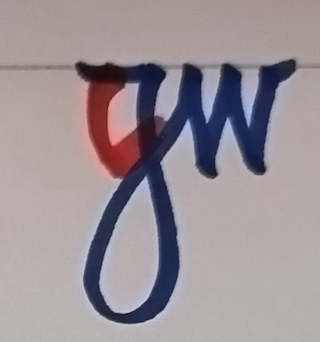
The gw Ligature
Our next two connected letters are g and w. This can also be done with only two strokes of the pen.
So we start off making a g as always. We go across on the line, we come down, we loop up, and then we cross the line and keep going up to the line, and then we just form our w as normal, with a little tick away at the end.
Pick your pen up, and then put the little a shape inside the g to give it the belly.
And then we have the gw ligature, formed in two strokes.
The kw Ligature
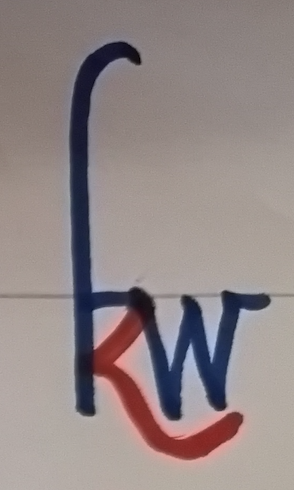
Here we have the kw ligature, and it's formed with three strokes.
We make the vertical for the k. So, starting at the top, it'll curve, then come down straight.
Then we pick up our pen and we go across on the horizontal a short distance, just enough as it would be for the top of the k. And then we do our w straight off that, and give it a little tick off the end.
Then pick up your pen and go back and fill in the rest of the k, as you can see here with the little red line.
So it's three strokes, and you can give the k a little tail that goes underneath the w, and it looks quite pretty.
The kp Ligature
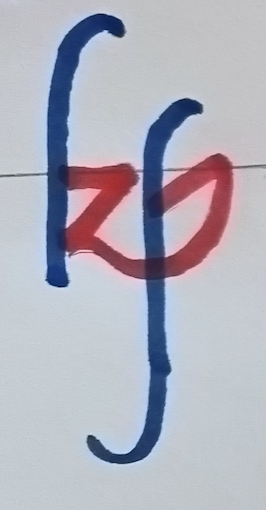
kp can also be done with three strokes, and this is how we do it.
Firstly, we make the vertical stroke of the k, as usual.
Then we leave some space for what would be the k, and, starting above the line, we make the vertical stroke for the p: a little curve, straight down, and then give it a nice walking-stick tail at the bottom.
Then you pick up your pen and go back, and on the horizontal you make the k shape. But at the bottom, the k crosses through the line of the p, and then it goes up in a little semi-curve, touches the line, and then you bring it back on a sharp angle to touch the line again, giving us the belly of the p.
So that is a curious shape. It'll take a bit of practice to get it right. The z slides across and then becomes the body, or the belly, of the p. Three strokes.
The nw Ligature
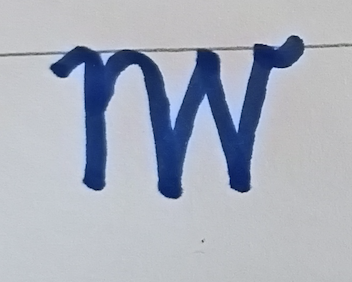
nw can be made with two strokes.
So firstly, we start off with the first stroke of the n, as usual.
Then we make the n shape. But when we hit the bottom of the leg of the n, we go up and make the w, and tick away.
So that's nw joined together as a ligature.
The sh Ligature
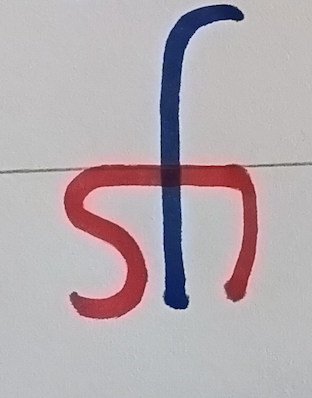
The ligature sh can be formed in two strokes. It will take a little bit of practice.
We start off, firstly, with the vertical stroke of the h. As normal, we start off with a little curve at the top, and we come down straight.
Then pick up your pen and go to the right. And this time we start at the bottom of the h. So we curve upwards till we hit the line, and then we make a straight line towards the left. And then, when we are far enough away, we just make our s shape. So it starts on the right, the red line, goes up, goes across, and then you keep going and make your s.
It'll take a bit of practice, because it's an unusual shape. That's the sh ligature.
The ch Ligature
And now we have the ch ligature, which is formed in a very similar way to the sh ligature.
We start off with the vertical, a little walking stick. We bring it down straight and stop.
Then we pick up our pen, move to the right, and make the little bracket shape until we hit the line. Then we go towards the left on the line until we're far enough away to have room for a c, and we bring it straight down and make the little tick at the bottom for the c.