

Abecedaria Press · Memorising for Latin
Part One
This book uses the memory room described in Methods to Remember. Here it is again, step by step.
Sit with your back to the fireplace, or to a wall of your room. Pick a square room that has four walls: you will be imagining yourself sitting with your back against one of those walls. Every time you imagine yourself in this room, you will be sitting in the same place.
Imagine the floor is divided into nine squares, three squares to a row. This is like a big game of noughts and crosses (tic-tac-toe) laid out on the floor in front of you, covering the whole floor of the room. The square furthest away from you, on the left, is square number 1. Then comes square number 2, and on the right-hand side, furthest away from you, square number 3. The middle row is 4, 5, 6, and the row right where you are is 7, 8, 9. You are sitting in square number 8.
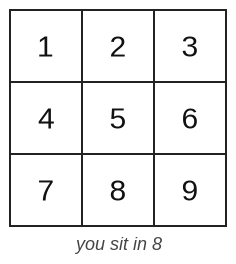
These nine are the nine squares in the middle of the diagram.
The wall on your left is the first wall. Divide it, too, into nine squares, with another noughts-and-crosses board, and number them the same way, starting from the top left-hand corner of the wall as you turn to face it: 1 to 9.
You will notice that we have gone 1 to 9 on the floor, and then back to 1 to 9 on the wall, which is not particularly useful. So, on the ceiling, directly above the 2 of this wall, imagine one more square, sticking up above the board. That square is 10. Everything on this wall is in the tens: its 1 is really 11, its 2 is 12, its 3 is 13, and so on until we get to 19.
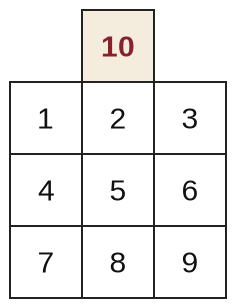
Now compare the wall with the floor, and note the consistency: the wall is numbered exactly like the floor. Don't remember the wall as 11, 12, 13, but as plain single digits, with the 10 placed just above the wall, on the ceiling. Everything below the 10 is in the tens.
Then do the same for the remaining walls. The wall in front of you is the second wall: above it, on the ceiling, is 20, and its squares are 21, 22, 23, up to 29. The wall on your right is the third wall, with 30 above it: 31 to 39. The wall behind your back is the fourth wall, with 40 above it: 41 to 49.
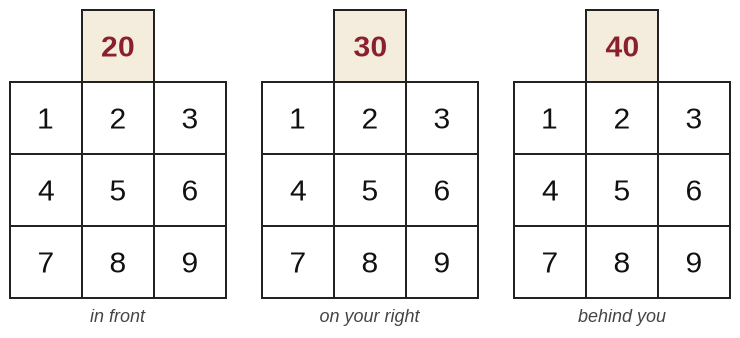
Right in the middle of the ceiling, where the light or lamp would be, place one more square. Sometimes in the middle of a ceiling there is a beautiful plaster ceiling rose with the lampshade hanging from it; sometimes it is just a lamp. That is square number 50, right in the middle of the ceiling above your head.
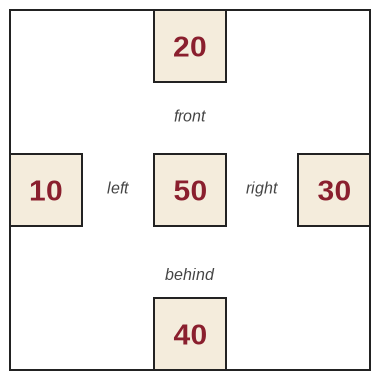
So we have fifty places, or loci, in this room.
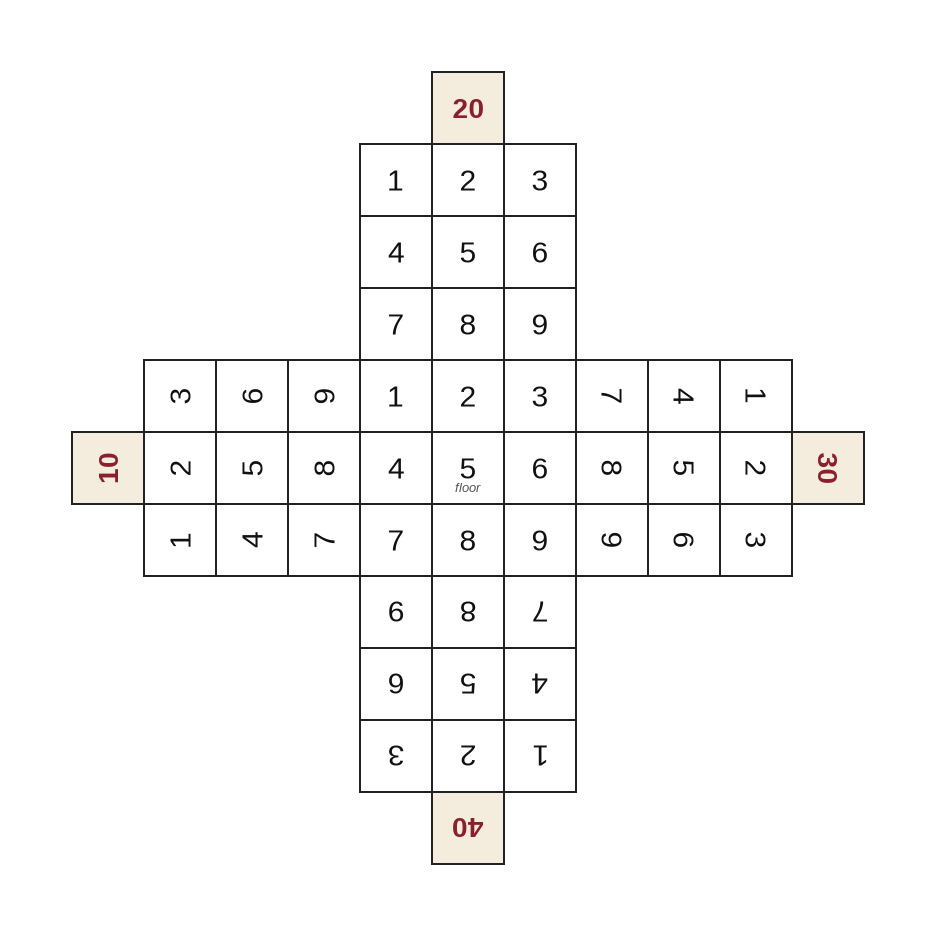
Examine the diagram. If you cut it out and folded it up, with the numbers on the inside, you would have your room: the floor in the middle, the four walls folded up around it, and the 10, 20, 30 and 40 on the ceiling above their walls. Drawing the diagram out on a large sheet of card and making the cube can also be of assistance.
Or find an old cardboard box. Draw the noughts-and-crosses board on the inside of the bottom of the box for the floor, and then on the inside of each wall. Cardboard boxes usually have folding leaves that close to make the lid: draw the 10, 20, 30 and 40 on the inside of those. Draw on the inside of the box, not the outside.
Take some time to get this pattern firmly into your head. I would spend a good ten minutes running over it in your mind's eye.
Once this room is finished, we can imagine ourselves opening a door in the wall and going into another room, and after that room into yet another. The important thing is to remember which room comes after which. The first room holds the numbers 1 to 50, the second 51 to 100, and so on. You can put one of these memory rooms in every room and closet in your home.
Setting this system up in your head requires a small investment of time. Once you have it, you will have it with you for life.
The memory room comes from Gregor von Feinaigle's New Art of Memory (1812), as set out by Francis Fauvel-Gouraud in Phreno-Mnemotechny (1845).

Memorising for Latin — Book Two: Adjectives · Evan Millner · Published by Abecedaria Press