

Abecedaria Press · Memorising for Latin
Part Seven
An adjective agrees with its noun in gender, number and case. But it does not take the noun's endings. Each keeps its own declension. So when you put a noun and an adjective together, you say two rhymes at once: one for the noun, and one for the adjective.
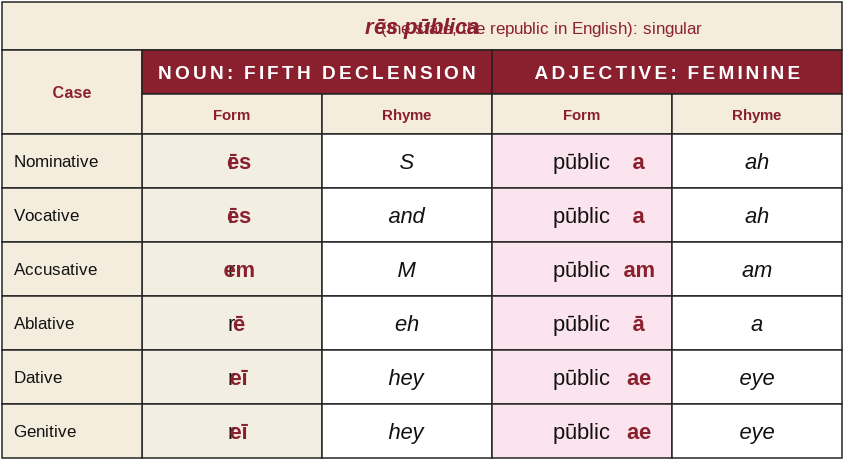
The best example is one you already know from English: rēs pūblica, the state, the republic. Rēs is a feminine noun of the fifth declension. Pūblica is an adjective of the first family, in the feminine. So rēs follows S and M, eh, hey, hey, while pūblica follows ah, ah, am, a, eye, eye.
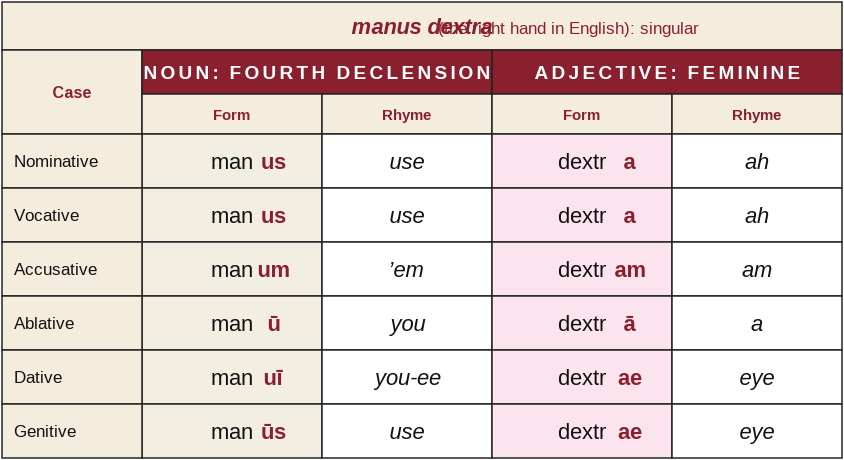
Here is a noun of the fourth declension, manus, with the feminine of dexter, dextra, dextrum: the right hand.
And here is a masculine noun of the fifth declension with an adjective of the third declension: diēs fēlīx, a lucky day.
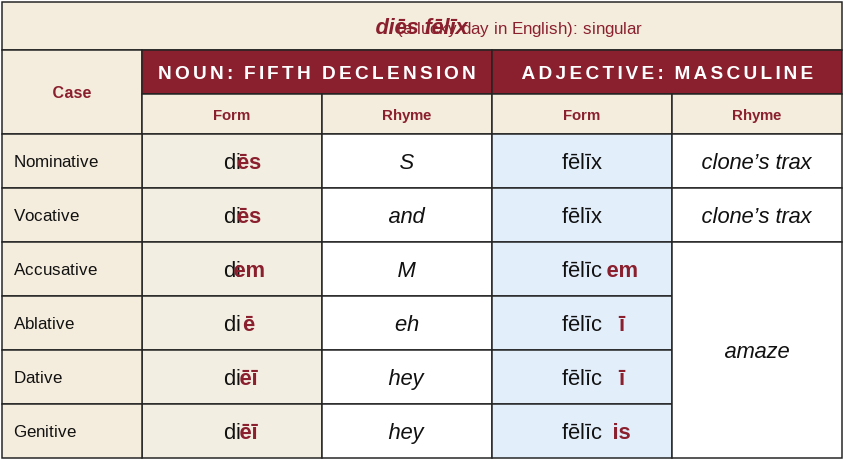
In each pair, the noun and the adjective agree, but they do not rhyme. That is why you need both rhymes, and why it matters so much to know the gender of every noun.

Memorising for Latin — Book Two: Adjectives · Evan Millner · Published by Abecedaria Press