

Abecedaria Press · Methods to Remember
Part Two
The Major System is a number code: it turns numbers into words. Why is this useful? Because we speak in words, and words are easy to remember. It is very easy to remember a short poem, a sentence, or someone's name. A long row of numbers is much harder to remember, and much easier to forget. With the code, you can remember numbers that are very, very long.
The idea is simple. Each number from 0 to 9 has its own sound. To turn a number into a word, you take the sounds for its numbers and put vowels (a, e, i, o, u) between them. For example, in the Major System m is 3, t is 1 and r is 4. So the number 314 can become the word motor, or meteor, or mother. You will learn all ten sounds in this part of the book.
Pi is the number you get when you divide the distance round a circle (its circumference) by the distance across it (its diameter). It begins 3.14159, and it never ends. People have learnt thousands of its decimal places by heart. How many decimal places of pi can you remember? Set yourself a challenge, and see how far you can go. (The word motor already gives you the first three numbers: 3, 1, 4.)
The code is useful every day. You can use it to remember the PIN for your bank card, the code for a door, a telephone number, or an important date. Never write your PIN on your card: keep it in your memory instead.
Today we need many passwords to stay safe online. A good password is long, and it is different for every account. A password made of a long number and some words is very hard to break. But a long password is also hard to remember.
The memory system gives you both the numbers and the words. The code turns a long number into words, and the words back into the number. The room keeps your passwords in order, one in each square. Because you can make your passwords long quite easily, they are easy for you to remember, and very hard for anyone else to break.
Before we learn the code, let us meet the man who made it famous.
Mr Gouraud was a Frenchman. His full name was François Fauvel-Gouraud, and he was born in 1808. He was a man of great learning, and he spoke five or six languages.
As a boy, Mr Gouraud had a very bad memory for numbers. He could not remember the dates of history, and he could not even remember the date of his own birthday, although he had learnt it a hundred times. His parents wanted him to become an officer in the navy, and for that he needed to be good at mathematics. So they sent him on a long voyage around the world, on his uncle's ship, with a teacher of his own. The teacher showed him a memory system that changed numbers into words. The boy loved it. He used it to remember dates and numbers in his hours of study, and even in his free time. Soon he began to look for ways to make the system simpler and better.
In 1839 Mr Gouraud went to America. He was a pupil of Louis Daguerre, the Frenchman who invented one of the first kinds of photography, and he was one of the first people to show photography in America. Later he travelled from city to city, giving lectures on memory. In 1844 and 1845 he published his books on the art of memory, including a dictionary that gives words for thousands of numbers. His lectures and books made him very famous, and many people learnt his system. He died in New York in 1847, when he was only 39 years old.
Mr Gouraud did not invent the system. People had been changing numbers into letters for more than two hundred years before him. But he made it simpler and easier to use, and he taught it to a great many people. The code you will learn here is the one Mr Gouraud taught.
Here is the code. Each number from 0 to 9 has its own sound. Learn this table by heart before you go on. The last column gives you a small help for remembering each sound.
| Number | Sound | To help you remember |
|---|---|---|
| 0 | s, z, and c when it sounds like s (as in city) | z is the first sound of zero |
| 1 | t, d, th | t has one stroke down |
| 2 | n | n has two strokes down |
| 3 | m | m has three strokes down |
| 4 | r | r is the last sound of four |
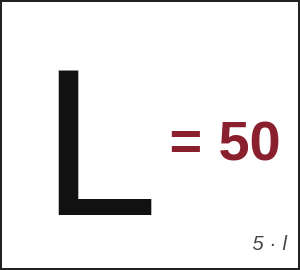
| 5 | l | L is the Roman number for 50 |
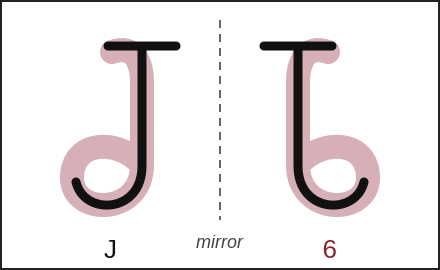
| 6 | j, sh, ch, and g when it sounds like j (as in gem) | a J turned round looks like a 6 |
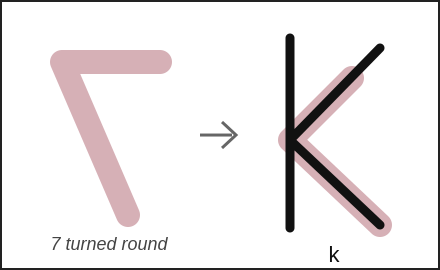
| 7 | k, q, and c or g when they are hard (as in cat and go) | a K can be made from two 7s |
| 8 | f, v, and ph | a written f has two loops, like an 8 |
| 9 | p, b | a P turned round looks like a 9 |
The vowels, a, e, i, o and u, have no number. Nor do the letters w, h and y. You can put them anywhere you like, to help you make a word.
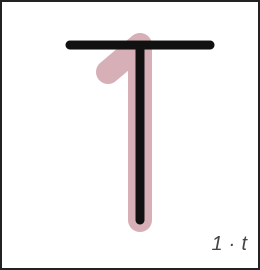
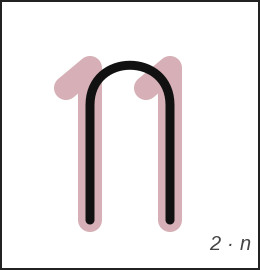
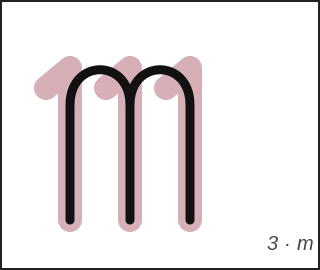
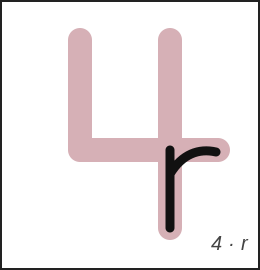
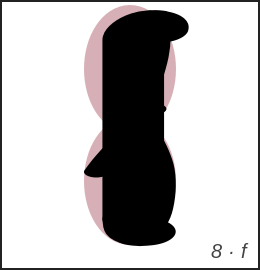
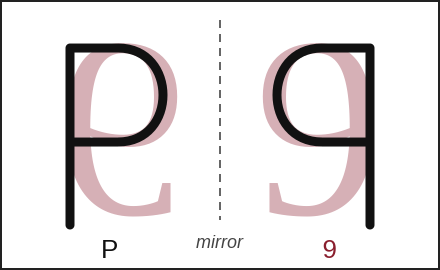
Here is more help for remembering each sound. In each drawing the number is pale red, and the letter is drawn over it in black.
1 is t. A t has one stroke down, like the number 1.
2 is n. An n is two 1s, joined at the top by an arch.
3 is m. An m is three 1s, joined by two arches.
4 is r. The r is the last sound of the word four. Now look at the open 4, the way many people write it by hand. At the bottom right, where the two lines cross, they make a right angle. That is where the r is.
5 is l. In Roman numbers, L is 50.
6 is j. Look at a J in a mirror, and it becomes a 6.
7 is k. A k is a long line, with a 7 turned round and leaning against it.
8 is f. A handwritten f, with a loop above and a loop below, looks like an 8.
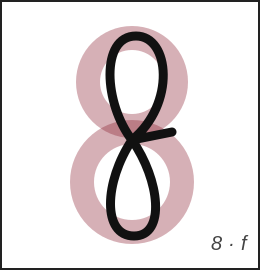
Here is the f from the cursive alphabet in our handwriting books. It has the same two loops.
9 is p. Turn a P round, as in a mirror, and it looks like a 9.
To turn a number into a word, take the sound for each number, in order, and put vowels between them. In each little table below, the numbers are on top and the word is underneath. The letters that give the numbers are in bold.
| 1 | 2 |
| tin | |
We hear t and n: 1 and 2. The i is a vowel, so it has no number. Listen to the sounds, not the spelling.
| 2 | 5 |
| nail | |
We hear n and l: 2 and 5. The a and the i are vowels, so they have no number. It is the sounds that count, not the letters.
| 9 | 1 |
| bed | |
We hear b and d: 9 and 1. Sound, not spelling.
| 7 | 3 |
| game | |
The g in game is hard, as in go, so it is 7. The m is 3. The e at the end is not spoken, and it is a vowel, so it has no number. Always listen to the sound.
The code works by the sound of a word, not by the way it is written. Here are the rules.
A double letter makes only one sound, so it counts only once. In the word letter there are two t's, but we hear only one t. We do not say "let-ter", we just say "letter".
| 5 | 1 | 4 |
| letter | ||
Two t's, but only one t sound: l, t, r, so 5, 1, 4. Count what you hear, not what you see.
Do not use words with letters that are written but not spoken, like the k in knee or the b in comb. The b has a number of its own, and a letter like this can confuse you later. Choose words where every letter that has a number is a letter you can hear.
What counts is the sound you hear. In phone, the ph sounds like f, so it is 8. In rose, the s sounds like z, so it is 0.
| 8 | 2 |
| phone | |
Two letters, ph, but one sound, f, so it is 8. Then n is 2. Count the sounds, not the letters.
| 4 | 0 |
| rose | |
The s in rose sounds like z. Both s and z are 0, so rose is 40. It is the sound that counts.
Sometimes more than one word can come out of the same number. Take 314:
| 3 | 1 | 4 |
| motor | ||
m, t, r: 3, 1, 4. The o's are vowels, so they have no number. Listen to the sounds, not the spelling.
| 3 | 1 | 4 |
| meteor | ||
Meteor has more vowels than motor, but vowels have no number, so the number is the same: m, t, r, 3, 1, 4. Sound, not spelling.
| 3 | 1 | 4 |
| mother | ||
The th in mother is two letters, but one sound, and it counts as t: 1. So mother is m, th, r: 3, 1, 4.
All three words give the same number, 3 1 4. Choose the word that is easiest for you to remember.
Pi begins 3.14159. Split the numbers into two groups, 314 and 159, and make a word from each:
| 3 | 1 | 4 |
| motor | ||
Again, only the sounds count: m, t, r, 3, 1, 4.
| 1 | 5 | 9 |
| tulip | ||
We hear t, l and p: 1, 5 and 9. The u and the i have no number. Listen to the sounds.
Motor tulip: two words, and you have the first six numbers of pi.
Today we use the internet for almost everything: for banking, for shopping, for email, and for talking to our friends and family. Each of these needs a password.
Now that artificial intelligence can look into websites, it has become more important than ever to keep your passwords safe. Every password you have, for every site, must be different. Then, if one site is broken into, your other accounts are still safe. And you should not keep your passwords saved anywhere, for reasons of security. Keep them in your memory instead.
We also advise you to use two-factor authentication whenever a site offers it. This means that, as well as your password, the site asks for a second proof that it is really you, for example a code sent to your telephone. If you have a smartphone, then, when the option is available, use an authenticator application: a small program on your phone that makes a new code every few seconds.
This sounds hard, but the Major System makes it easy. In this chapter we will give you some methods for making passwords that are long, different for every site, and easy for you to remember.
Take the name of someone in your family. Let us say that your mother is called Margaret Fisher, and your father is called Peter Jones.
First, write the names down. Then find the number for each name, using the code. Remember: we listen to the sounds, not the spelling.
| 3 | 4 | 7 | 4 | 1 |
| Margaret | ||||
The g in Margaret is hard, as in go, so it is 7. Then r is 4, and t is 1. The vowels have no number. Sound, not spelling.
| 8 | 6 | 4 |
| Fisher | ||
The sh in Fisher is two letters, but one sound: 6. Count the sounds, not the letters.
| 9 | 1 | 4 |
| Peter | ||
We hear p, t and r: 9, 1 and 4. Listen to the sounds.
| 6 | 2 | 0 |
| Jones | ||
The j is 6 and the n is 2. The s in Jones sounds like z, and z is 0. It is the sound that counts.
Now put the names and the numbers together. That is your password:
Margaret34741Fisher864
Peter914Jones620
These passwords are long, and they mix capital letters, small letters and numbers, so they are very hard to break. But you do not need to remember the numbers at all. You only need to remember the names, and the code gives you the numbers again whenever you need them.
Take a line from a poem that you know well. For example:
Humpty Dumpty sat on a wall
Now work out the numbers for each word, just as before. Remember: we listen to the sounds, not the spelling.
| 3 | 9 | 1 |
| Humpty | ||
The h has no number, and neither has the y. We hear m, p and t: 3, 9 and 1.
| 1 | 3 | 9 | 1 |
| Dumpty | |||
We hear d, m, p and t: 1, 3, 9 and 1. The u and the y have no number.
| 0 | 1 |
| sat | |
We hear s and t: 0 and 1. A number may begin with 0. That is fine.
| 2 |
| on |
We hear only n: 2. The o is a vowel, so it has no number.
The word a is only a vowel, so it has no number at all.
| 5 |
| wall |
The w has no number. Two l's, but only one l sound: 5. Count what you hear, not what you see.
Now put the line and the numbers together. There are three ways to do this.
The best way: word, number, word, number. Write each word, and after it put its number: Humpty and its number, Dumpty and its number, sat and its number, on and its number. The word a has no number. Then wall and its number.
Humpty391Dumpty1391Sat01On2AWall5
This is the way we recommend. It is the easiest, because you work one word at a time: you write the word down, then you turn that word into its number, and then you go on to the next word. You never have to hold much in your head at once.
Another way: the whole line, then all the numbers. Write the whole line first, and then all the numbers together, in one row.
HumptyDumptySatOnAWall39113910125
A third way: only the numbers. You can also use just the numbers, without the words.
39113910125
This is shorter, and so it is less secure. It is better to keep the words.
The first two passwords are 33 letters and numbers long. They are extremely hard to break, and they are easy for you to remember, because you already know the line, and the code gives you the numbers.
This method works in any language. The line does not have to be in English. The code works by sound, and a sound is the same sound in any language.
For a password, we start with words and turn them into numbers. With a bank PIN we go the other way. The bank gives you the numbers, and you find a word for them. Then you only have to remember the word, and the word gives you back your PIN.
Here are four PINs that a bank might give you, and a word for each one.
| 9 | 5 | 2 | 1 |
| planet | |||
We hear p, l, n and t: 9, 5, 2 and 1. The vowels have no number. Sound, not spelling.
| 1 | 4 | 7 | 5 |
| trickle | |||
The ck in trickle is two letters, but one k sound: 7. The e at the end is not spoken, and it is a vowel. Count the sounds, not the letters.
| 8 | 4 | 3 | 5 |
| formal | |||
We hear f, r, m and l: 8, 4, 3 and 5. Listen to the sounds.
| 7 | 3 | 1 | 0 |
| comets | |||
The c in comets is hard, as in cat, so it is 7. Then m is 3, t is 1, and s is 0. It is the sound that counts.
If you cannot find one word for your PIN, use two short words, one for each half. For 2963:
| 2 | 9 |
| nap | |
We hear n and p: 2 and 9.
| 6 | 3 |
| jam | |
We hear j and m: 6 and 3. So nap jam gives you 2963. Sound, not spelling.
Sometimes the bank lets you choose your own PIN. Then you can start with a word. Choose a word that you like, with exactly four sounds that have numbers. Turn it into numbers, and that is your PIN.
| 7 | 4 | 1 | 2 |
| garden | |||
The g in garden is hard, as in go: 7. Then r, d and n: 4, 1 and 2. So your PIN is 7412.
| 5 | 3 | 2 | 1 |
| lemonade | |||
We hear l, m, n and d: 5, 3, 2 and 1. The vowels have no number, and the e at the end is not spoken. So your PIN is 5321.
Do not choose a PIN that is easy to guess, such as 1234, or the year you were born. A word gives you a number that nobody else can guess, and that you will never forget.
Nowadays a lot of people do not know any telephone numbers. Some people do not even know their own. But it is useful to know telephone numbers. You cannot always have your phone with you, and its battery can run out just when you need it. It is good to know a few important numbers by heart, and the emergency numbers above all.
The same method helps with other long numbers too, such as the postcode where you live, if your country uses a long postcode made of numbers.
Learn the emergency number for the country where you live. In many countries, including all of Europe, it is 112. In the United Kingdom it is 999, and in the United States and Canada it is 911.
| 1 | 1 | 2 |
| today now | ||
We hear t, d and n: 1, 1 and 2. The w and the y have no number. Sound, not spelling.
| 9 | 9 | 9 |
| pop-up | ||
We hear three p sounds: 9, 9 and 9. Listen to the sounds.
| 9 | 1 | 1 |
| beat it | ||
We hear b, t and t: 9, 1 and 1. The vowels have no number.
Here is a made-up telephone number from London:
020 7946 0152
There are different ways to make words for it. Choose the one that works best for you.
Telephone numbers are usually written in groups. Find a word, or two short words, for each group.
| 0 | 2 | 0 |
| snooze | ||
We hear s, n and z: 0, 2 and 0. The s and the z are both 0. The e at the end is not spoken. It is the sound that counts.
| 7 | 9 | 4 | 6 |
| copper shoe | |||
The c is hard, as in cat: 7. Two p's, but one p sound: 9. Then r is 4, and sh is one sound: 6. Count the sounds, not the letters.
| 0 | 1 | 5 | 2 |
| stolen | |||
We hear s, t, l and n: 0, 1, 5 and 2. Listen to the sounds.
So the number is snooze, copper shoe, stolen. A strange little story is easy to remember: someone was asleep, and their copper shoe was stolen.
You can also split the number into pairs, and find a short word for each pair. Short words are quick to find.
| 7 | 9 |
| cap | |
The c is hard: 7. The p is 9.
| 4 | 6 |
| rush | |
We hear r and sh: 4 and 6. Two letters, sh, but one sound.
| 0 | 1 |
| suit | |
We hear s and t: 0 and 1. The u and the i have no number.
| 5 | 2 |
| lion | |
We hear l and n: 5 and 2. Sound, not spelling.
If you already know the first part of a number, such as 020 for London, you only need words for the rest: cap, rush, suit, lion gives you 79 46 01 52, and the number is 020 7946 0152.
Try it with the numbers that matter to you: your own number, your family's numbers, and a friend you could call in an emergency.

Methods to Remember — The Memory Room and the Major System · Evan Millner · Published by Abecedaria Press