

Abecedaria Press · Memorising for Latin
Part Three
At the end of Book One we learned that every Latin noun has a gender: feminine, masculine or neuter. Now we see why this matters so much. An adjective must agree with its noun. It takes the same case, the same number, and the same gender. So an adjective needs a feminine form, a masculine form and a neuter form. But the adjective does not always have the same ending as its noun. It matches the gender of the noun, not the look of its ending:
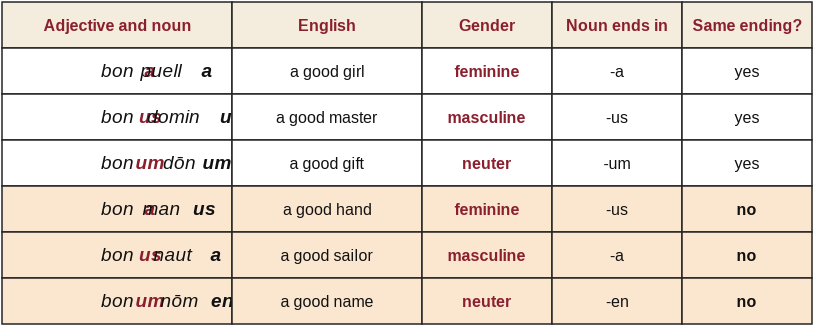
In the first three, the adjective and the noun end in the same way. In the last three they do not: manus ends in -us but is feminine, nauta ends in -a but is masculine, and nōmen is a neuter of the third declension.
This is why you need to know the true gender of every noun, and why the diminutive of Book One is so useful: nautulus tells you that a sailor is bonus, not bona.
The adjective changes its ending to match the gender of the noun. So before we look at the adjectives themselves, let us revise the rhymes, and look again at a feminine, a masculine and a neuter noun of each kind.
Say the singular rhyme:
Ah, ah, am, a, eye, eye,
(M)us-e-um, ohw, ohw, ee,
Clone's trax, clone's trax, amaze,
Use, use, 'em, you, you-ee, use,
S and M, eh, hey, hey!
And the plural rhyme:
I 'as 'is arm,
'E 'os 'is arm,
Easy bosom,
Use ye bosom,
Easy boserum.
In Book One every model noun was feminine or masculine. The neuter is a variation of the same forms, with one simple rule:
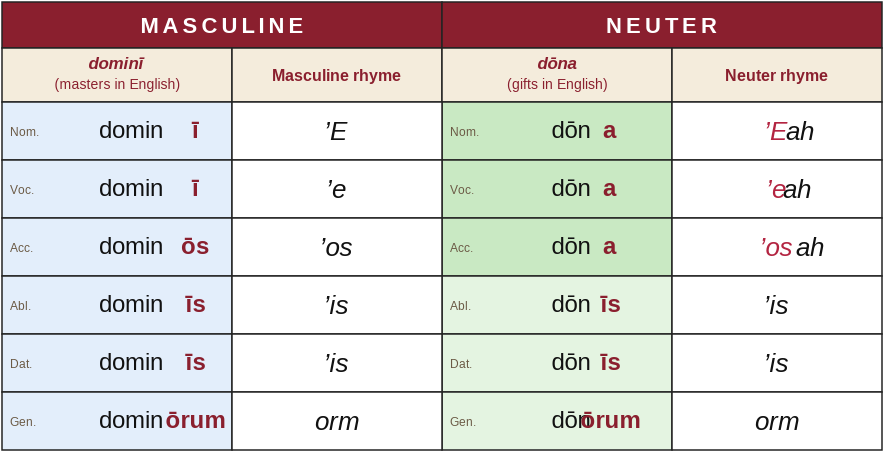
In the neuter, the nominative, the vocative and the accusative are always the same. In the plural, these three end in -a.
This is the reason why, when we memorise the declensions, we put the nominative, the vocative and the accusative one after the other. In the neuter, these three form one block.
The Latin word neuter means "neither": ne-uter, not either of the two. The neuter is neither the masculine nor the feminine. It is something else: a third gender.
And this gives us the rule of three. Why are the first three the same? Because it is the third gender. Third gender: the first three are the same. That is an easy way to remember it.
Only the second and the third declensions have neuters that we need here. (The fourth declension has a few, like cornū, a horn, but no adjectives follow them.)
We do not make a new rhyme for the neuter. The neuter is a variation of the masculine, so we use the same rhyme, and simply strike out what changes.
In the second declension singular, the masculine rhyme is (m)us-e-um. Strike out the us and the e, and you are left with um: so the neuter has -um, -um, -um. The rest of the rhyme, ohw, ohw, ee, stays the same.
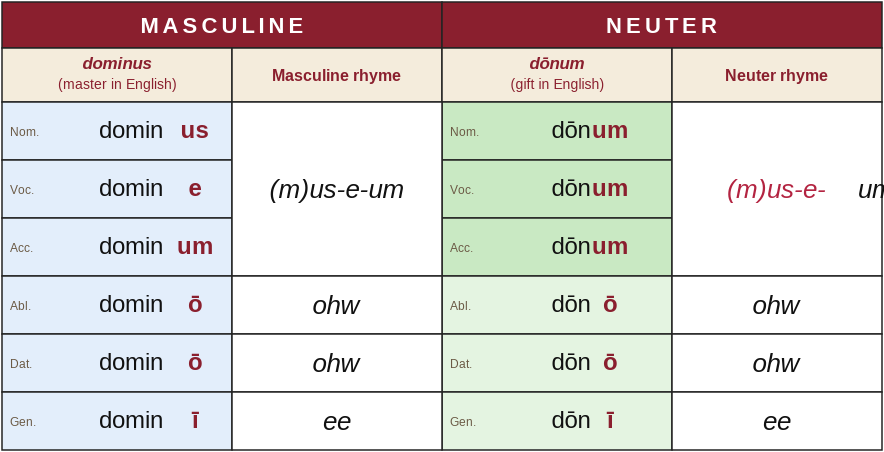
In the plural, the first three become -a. Strike out 'E, 'e, 'os and say ah instead. The rest, 'is, 'is, orm, stays the same.
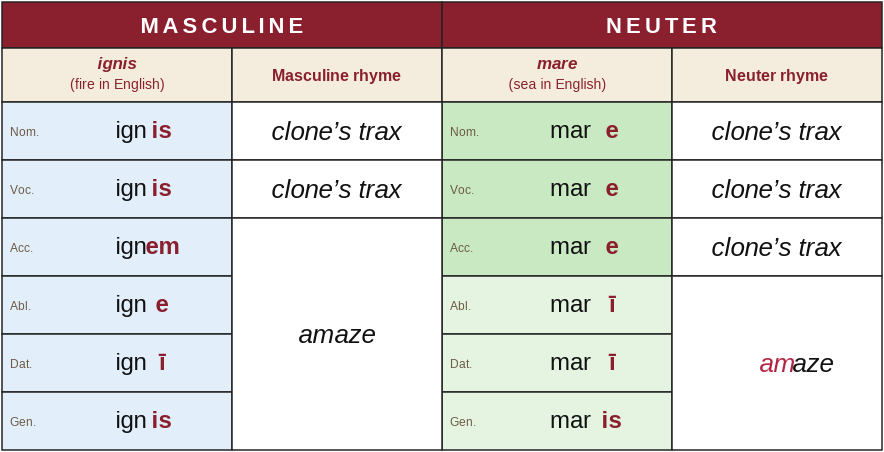
The third declension works in the same way. In the singular, the accusative is the same as the nominative, so we say clone's trax three times; and from amaze we strike out the am, which leaves aze for the last three. In the plural, strike out ease, ease, ease and say ah; the rest, ee-bus, ee-bus, um, stays the same.
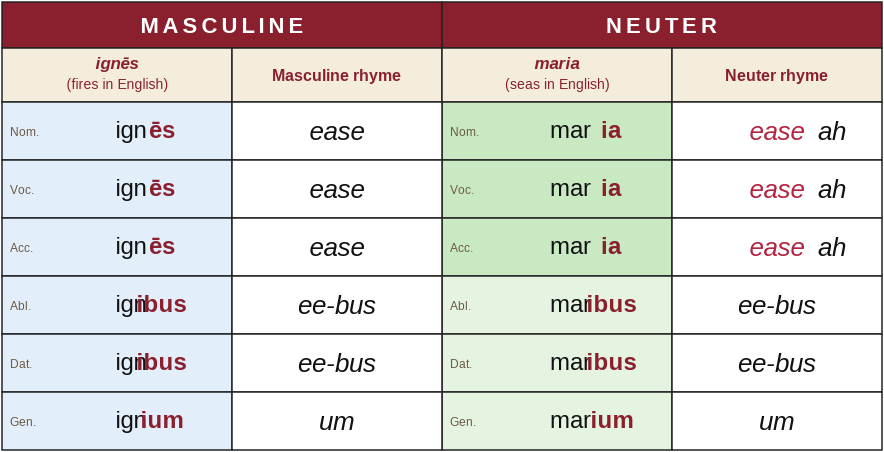
So there is nothing new to learn by heart. You already know the rhyme. For the neuter you only need to remember the rule: the first three are the same, and in the plural they end in -a.
Many adjectives decline like bonus, bona, bonum: in the feminine like puella, in the masculine like dominus, and in the neuter like dōnum (gift in English). Here are the three nouns again, with their genders.
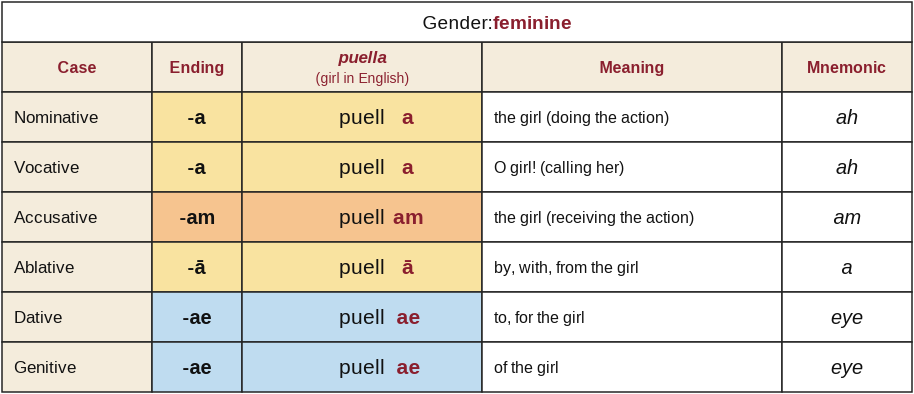
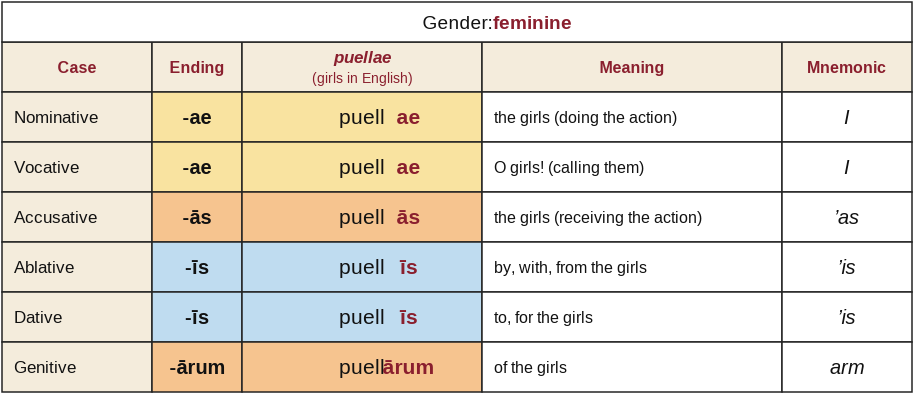
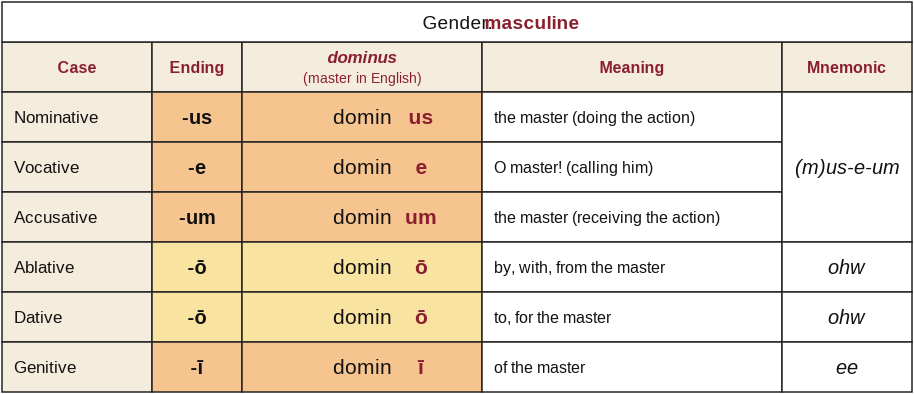
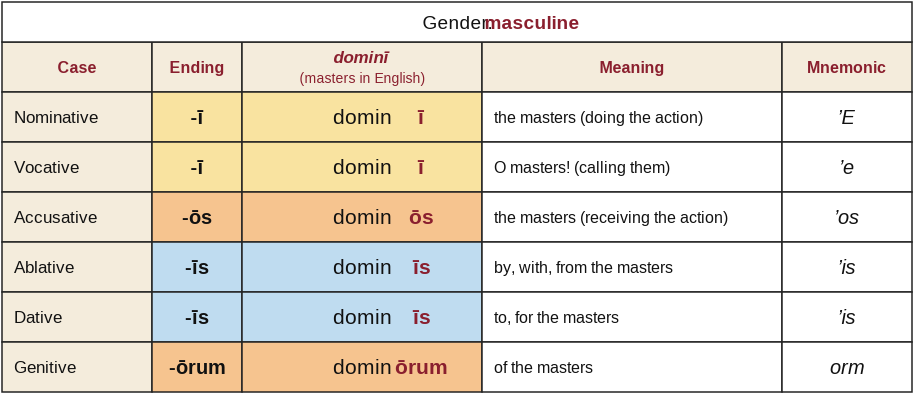
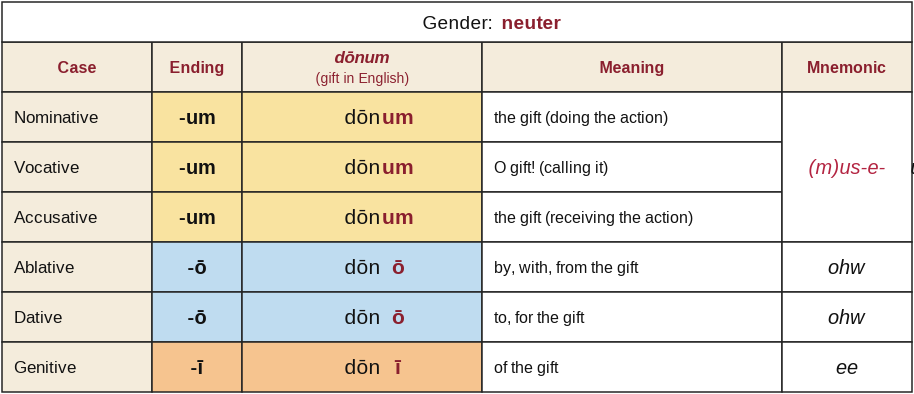
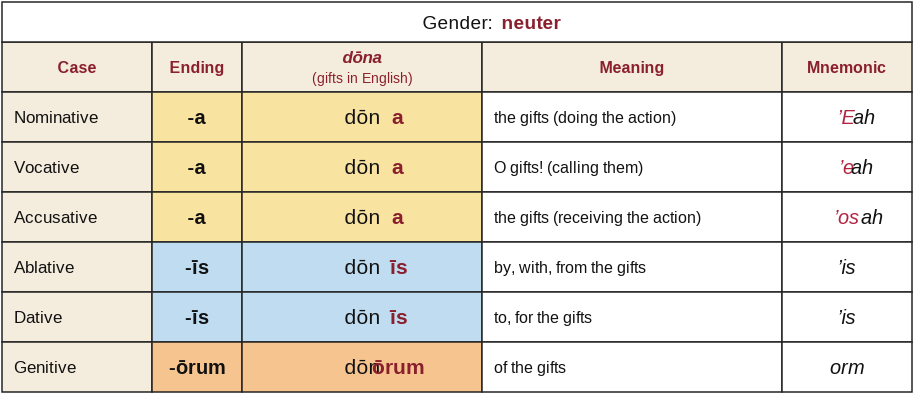
Compare dōnum with dominus. Only the first three endings are different: dōnum, dōnum, dōnum in the singular, and dōna, dōna, dōna in the plural. Everything else is the same.
Many other adjectives belong to the third declension, like omnis, omne (every, all). They decline like the third-declension nouns nāvis (ship, feminine), ignis (fire, masculine) and mare (sea, neuter).
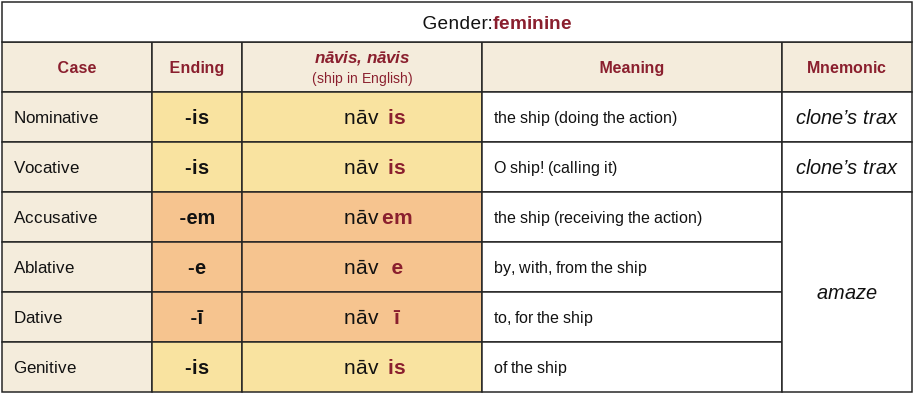
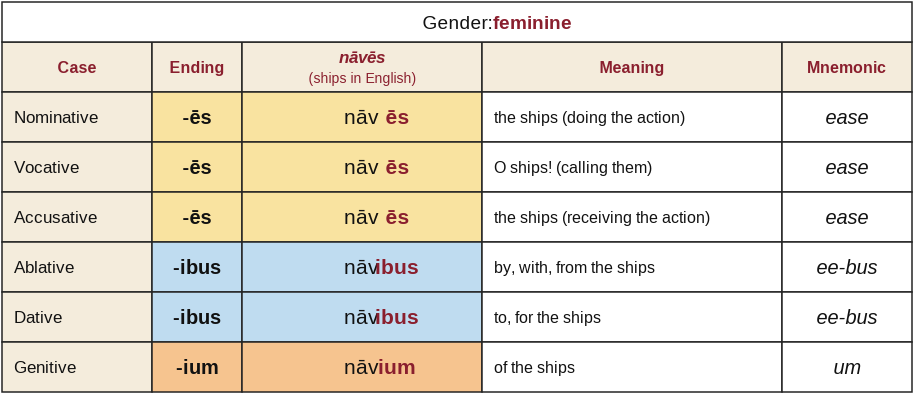
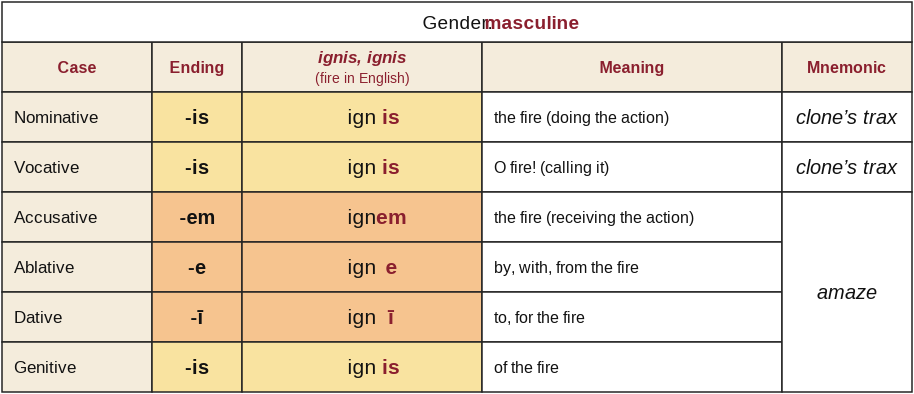
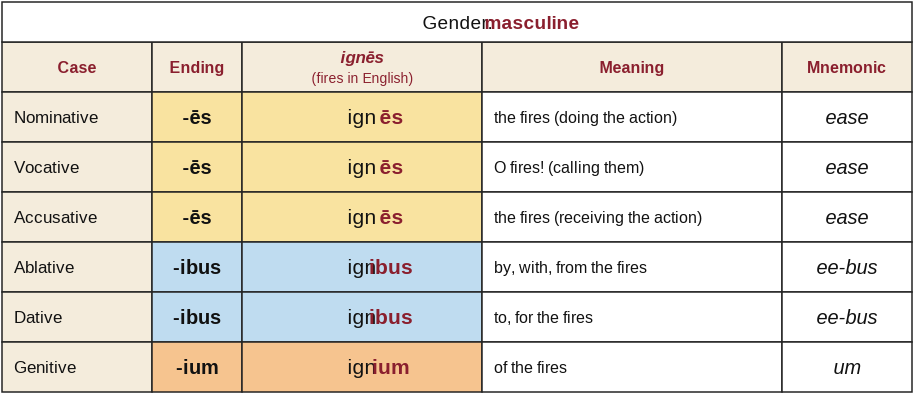
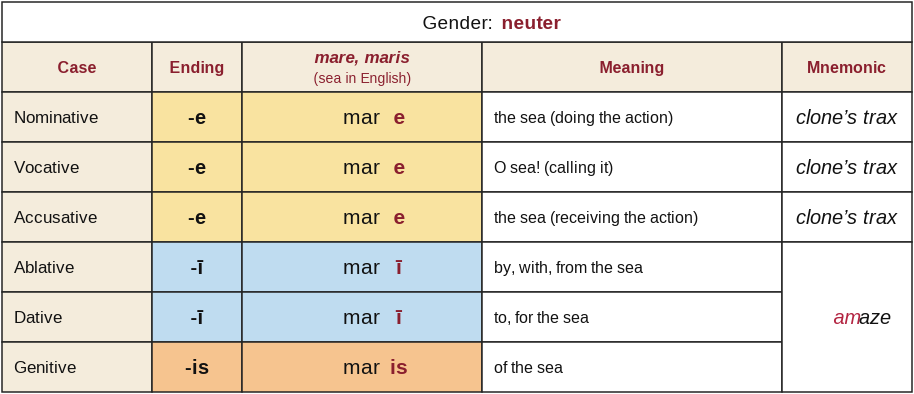
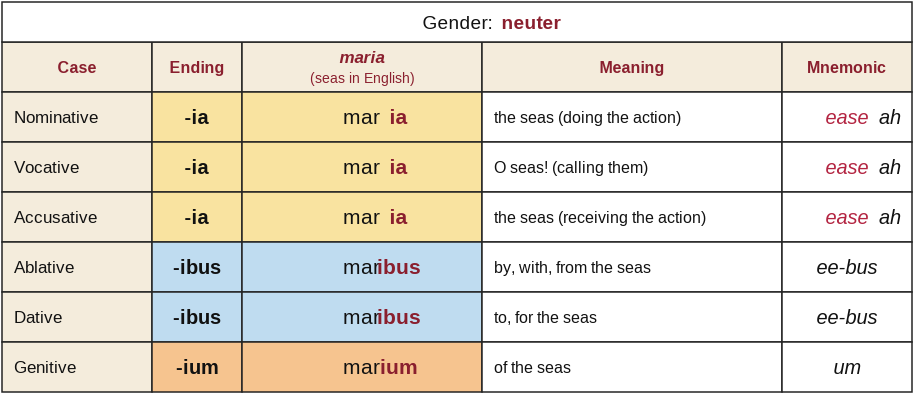
These nouns follow the same rhymes, clone's trax, clone's trax, amaze and easy bosom, with a few small differences of spelling that you learn from the tables. The genitive plural ends in -ium, not -um: ignium, nāvium, marium. In mare the ablative is -ī, marī, and the neuter plural is -ia, maria. You will see these same spellings again in the adjectives: omnī, omnia, omnium.
Notice too that the feminine nāvis and the masculine ignis have exactly the same endings. In the third declension, the feminine and the masculine are the same. Only the neuter is different.

Memorising for Latin — Book Two: Adjectives · Evan Millner · Published by Abecedaria Press