

Abecedaria Press · Memorising for Latin
Part Four
Latin adjectives fall into two families.
In the dictionary, an adjective is given with its forms for the three genders: bonus, bona, bonum. This tells you at once which family it belongs to.
The tables below are set out as in the grammar books: the cases go down, the genders go across. But in our order, and with the rhyme beside each gender. The neuter block of three is shaded.
Every grammar book puts the genders in the same order: masculine, feminine, neuter. We think this is wrong, and in this book we put them in a different order: feminine, masculine, neuter.
There are two reasons. The first is about learning. The neuter is a variation of the masculine: they share most of their endings, and the neuter only changes the first three. So the masculine and the neuter belong side by side. If the feminine stands between them, it breaks the connection. With the feminine first, the masculine and the neuter sit next to each other, and the relationship between them is obvious at a glance.
The second reason is that the old order put the masculine first for no good reason of grammar or of teaching. It is a habit, and a prejudice. Here the feminine comes first, as the primary gender, then the masculine, then the neuter.
The dictionary still gives an adjective in the old order, bonus, bona, bonum, and you need to know it in that form to look it up. But in the tables, and when you learn it, the feminine comes first: bona, bonus, bonum.
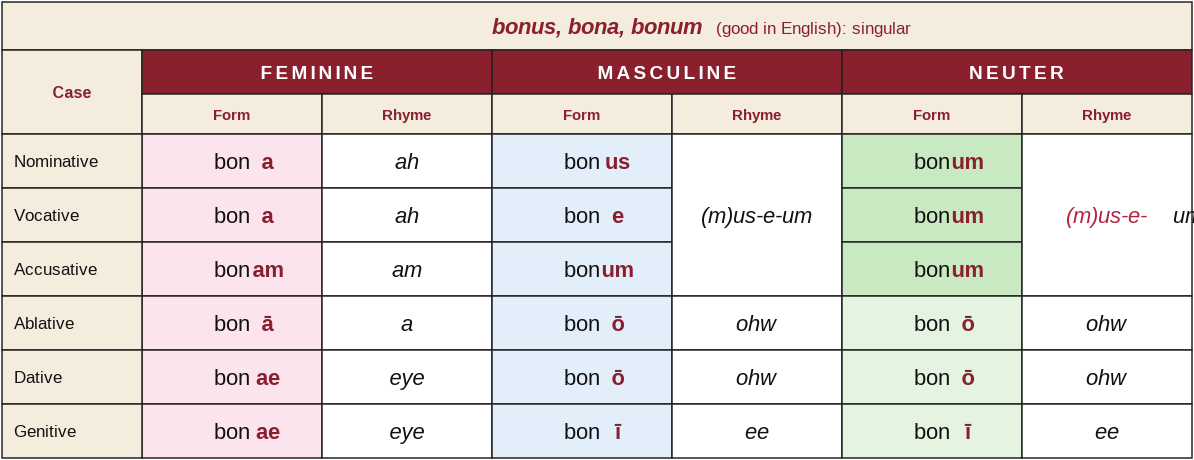
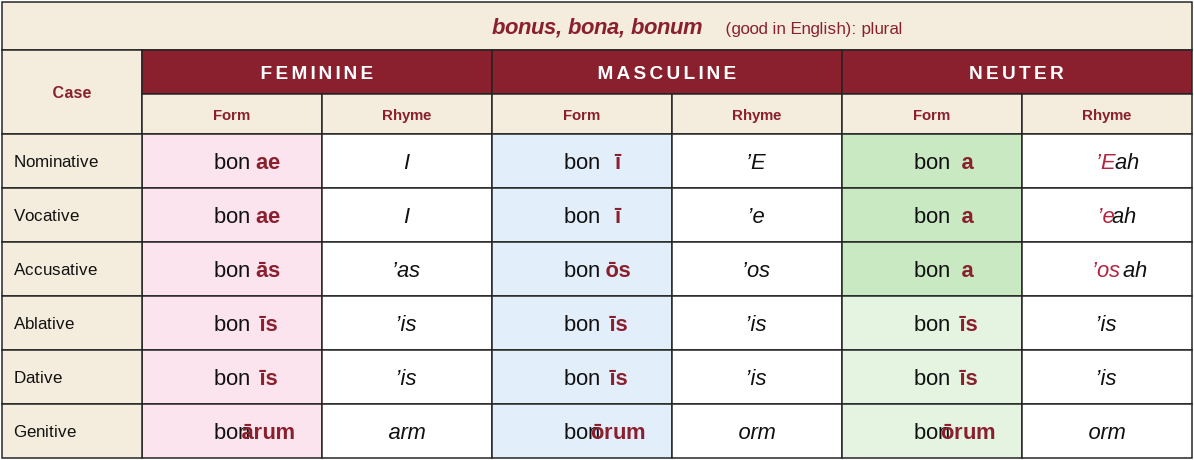
There is nothing new here. The feminine is puella, the masculine is dominus, and the neuter is dōnum. You already know all three rhymes.
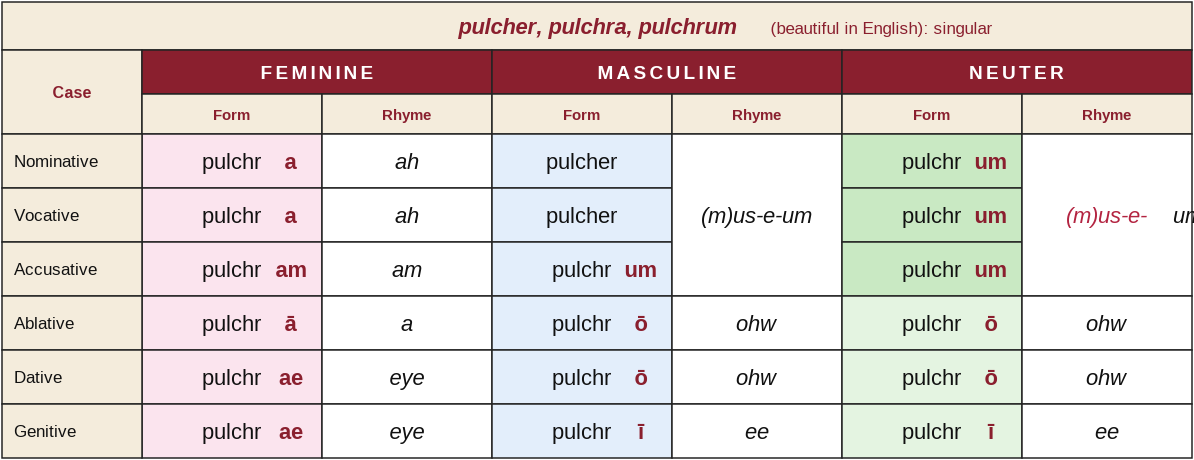
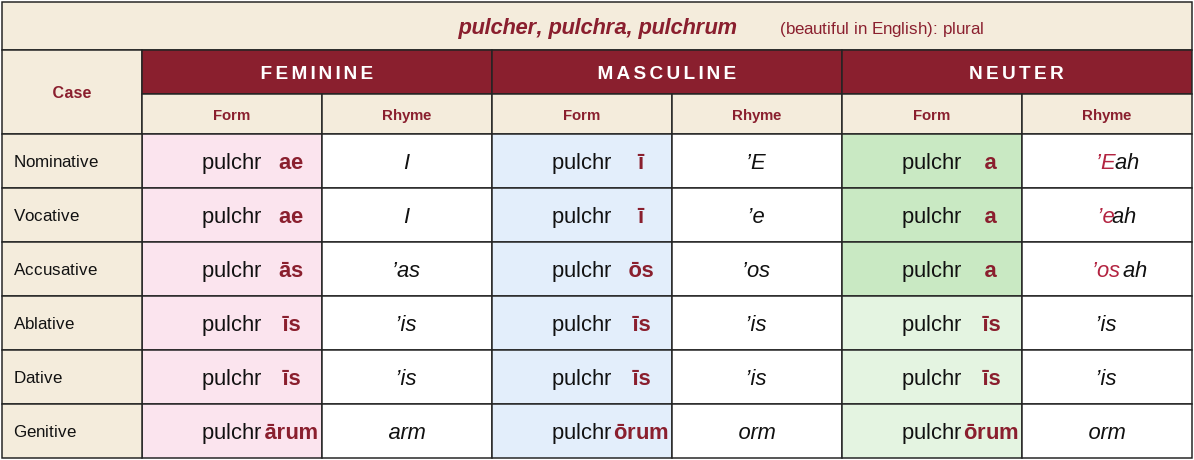
Some adjectives of this family end in -er in the masculine nominative, like pulcher, pulchra, pulchrum (beautiful in English). Only the nominative and the vocative masculine are different: pulcher. After that, the e drops out, and everything goes like bonus: pulchrum, pulchrō, pulchrī.
We do not change the rhyme for these. The masculine still goes with (m)us-e-um, ohw, ohw, ee, even though the nominative and the vocative end in -er, not -us and -e. You just have to remember this: pulcher is still in the same class of noun adjective as bonus, and the -er is only an exception.
Some adjectives in -er keep the e all the way through: miser, misera, miserum (wretched in English), līber, lībera, līberum (free in English). The dictionary shows you which kind it is: pulchra has lost the e, misera has kept it.
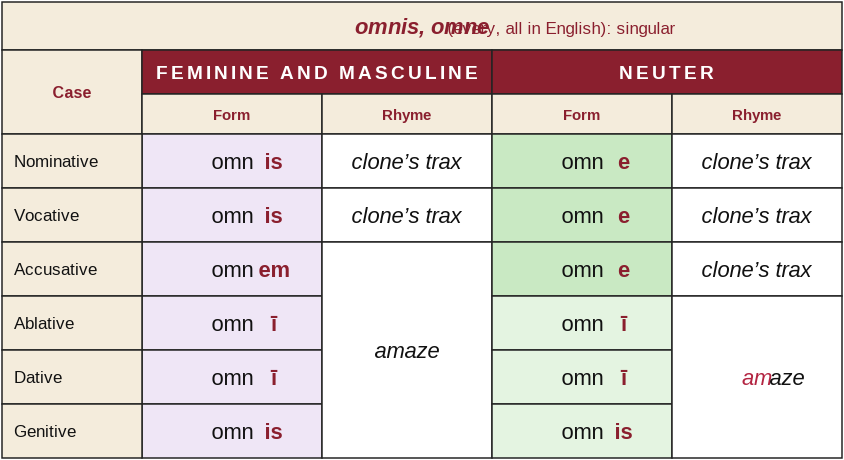
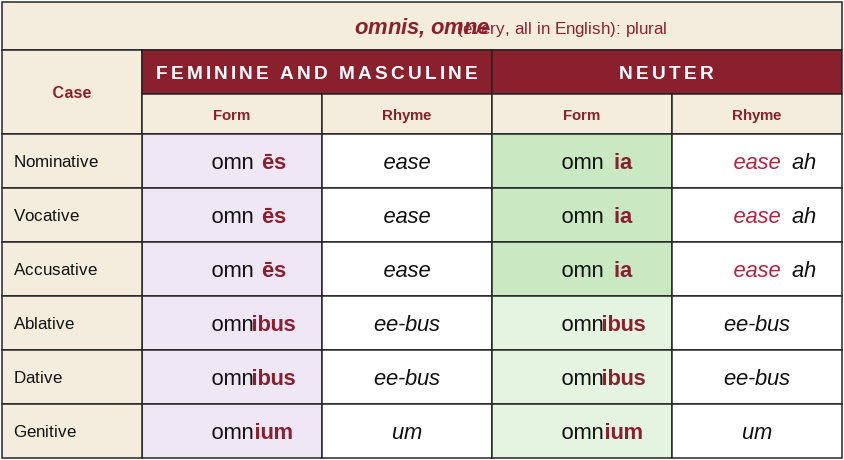
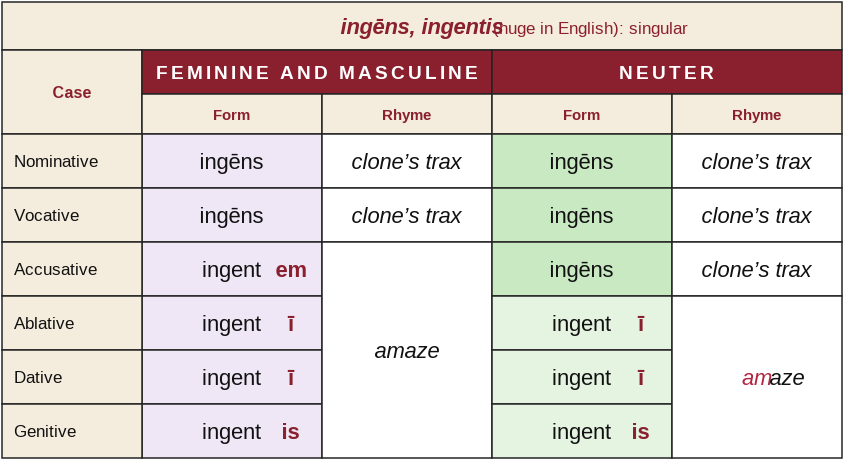
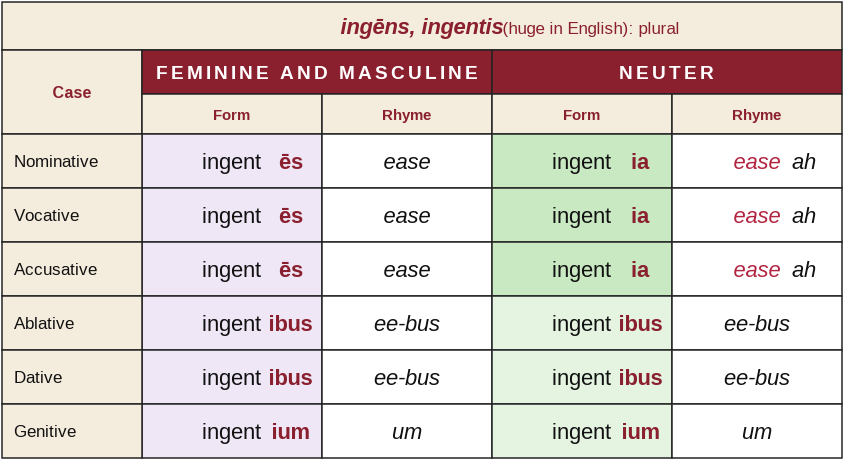
These adjectives follow the third declension, and the rhymes clone's trax, clone's trax, amaze and easy bosom. As with ignis and mare, there are a few small differences of spelling, which you learn from the tables:
Some of these adjectives have three forms in the nominative, one for each gender: ācer, ācris, ācre.
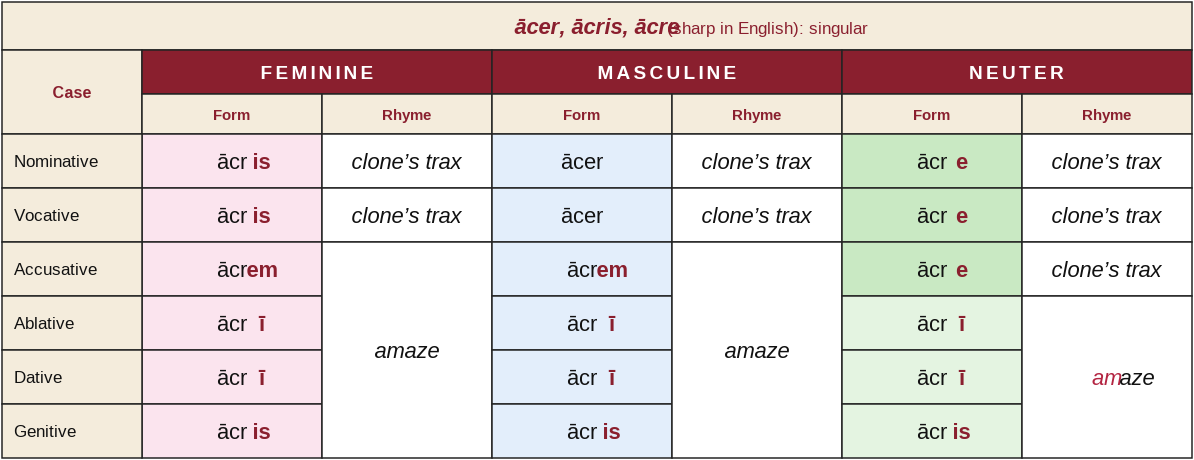
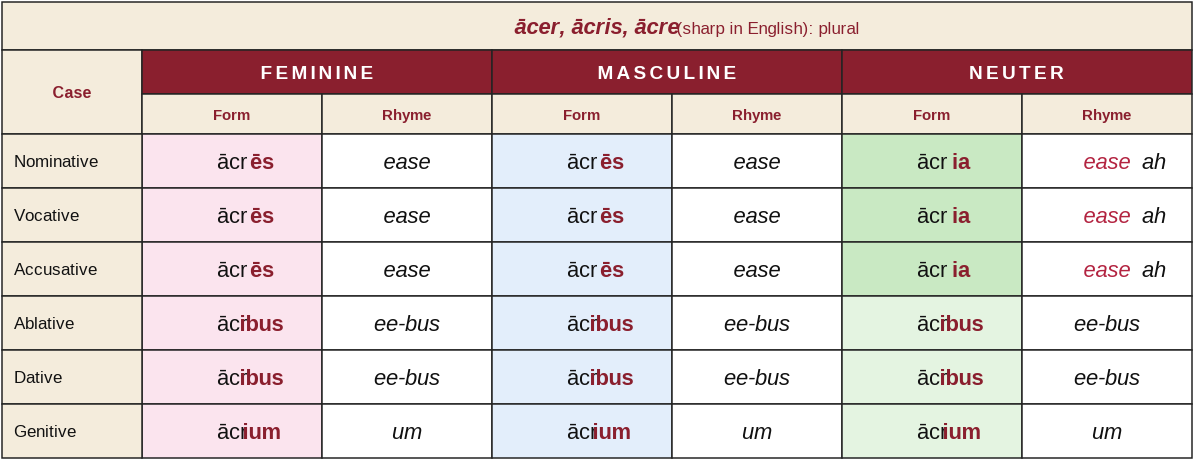
Most have two: one for the feminine and the masculine together, and one for the neuter, like omnis, omne. Remember from the nouns: in the third declension, the feminine and the masculine are the same.
And some have only one form in the nominative for all three genders, like ingēns. For these, the dictionary gives the genitive, ingentis, which shows you the stem ingent-. Notice that in the neuter singular, the block of three is all ingēns: the rule of three again.

Memorising for Latin — Book Two: Adjectives · Evan Millner · Published by Abecedaria Press