

Abecedaria Press · Memorising for Latin
Part Two
This book gives you two short rhymes: one for the singular and one for the plural. If you memorise these two rhymes, and then do the practice exercises at the end of the book, you should have a reasonable command of all the endings of all the nouns in Latin in one single day.
Many students spend months, or even years, suffering over these endings. You do not need to. With the rhymes you learn the basic outline very quickly. Then, through the exercises, you fine-tune your knowledge and your skill.
Grammar books usually give the cases in the order nominative, genitive, dative, accusative, vocative, ablative, or nominative, vocative, accusative, genitive, dative, ablative. Here we use a different order:
nominative, vocative, accusative, ablative, dative, genitive
In this order, endings that are the same, or nearly the same, come next to each other. So the endings can be said in one breath, like a chant. Just say each line, one after the other, and then write them down.
This order is not only easier to memorise. It also has a logic of its own.
We begin with the nominative: the word itself, the name of the thing. This is the form you find first in the dictionary. Next comes the vocative, the form you use when you call someone or speak to them. The nominative and the vocative are very closely related, and in most words they are the same.
Then comes the accusative. This is the natural next step. When I say I see the book, or I have the book, the book is in the accusative. It is as if an arrow shoots out from the action and strikes the object of the action.
Next in our order comes the ablative, which is quite simple. Then comes the dative, which is used in slightly more complex ways.
At the very end of the sequence comes the genitive. This is the other form that the dictionary gives you: a dictionary usually gives a noun in the nominative and the genitive, for example dominus, domini. The genitive tells you which declension the word belongs to. So the two forms that you find in the dictionary stand at the two ends of the chant. It is right and good that the genitive comes at the end: your eye needs to fall on it at once, and you need to know it, because you will see it in the dictionary.
Tables like these are not new. The Roman grammarian Varro (116–27 BC), in Book 10 of his work On the Latin Language (De Lingua Latina), set out the forms of words in rows, some going across and some going down, "as on a board" (ut in tabula), like the squared board of a Roman board game. Going across, he put the cases of one word: albus, albi, albo. Going down, he put its genders: albus, alba, album. So when we put Latin forms into squares, we are doing something that the Romans themselves did.
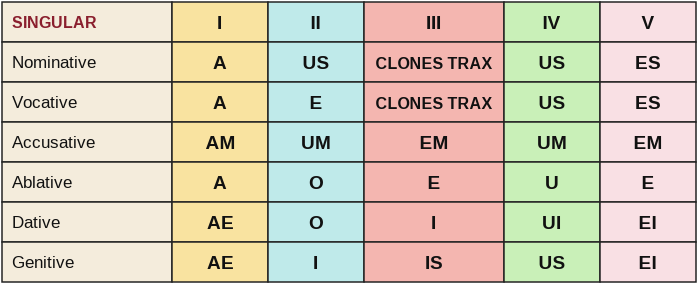
In the third declension the nominative and vocative singular have many different forms. The letters of CLONES TRAX give most of them. Look at the third-declension nouns in a grammar book, and you will see that their nominatives end in these letters: lac (c), consul (l), leo (o), nomen (n), mare (e), civis (s), caput (t), pater (r), poema (a), rex (x).
Now learn these chants. The words in brackets are rough sound-alikes that help you remember.
Now say the whole singular mnemonic, like a little poem:
Ah, ah, am, a, eye, eye,
(M)us-e-um, ohw, ohw, ee,
Clone's trax, clone's trax, amaze,
Use, use, 'em, you, you-ee, use,
S and M, eh, hey, hey!
Here is the first declension in the singular, with a model word, puella, a girl. In the dictionary you will find it as puella, puellae: the nominative and the genitive, the first and the last lines of the table.
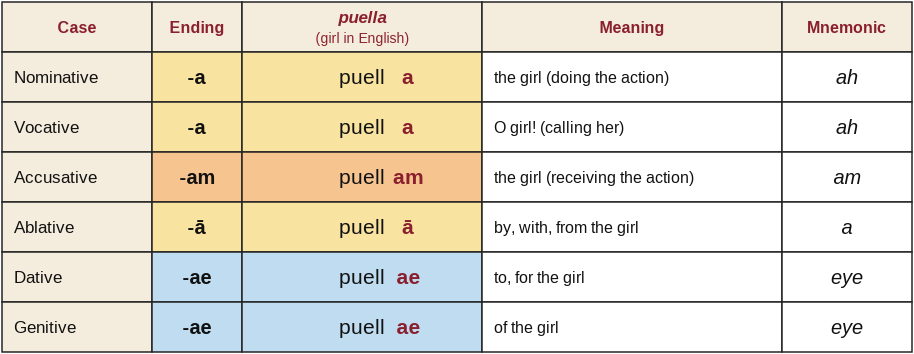
Look at the colours. The nominative, the vocative and the ablative all end in -a (yellow). In the ablative the a is long, puellā, but it is written the same in most books. The dative and the genitive both end in -ae (blue), and the mnemonic says eye twice, once for each. Only the accusative, -am (orange), stands alone.
The model word is dominus, a master. In the dictionary: dominus, dominī.
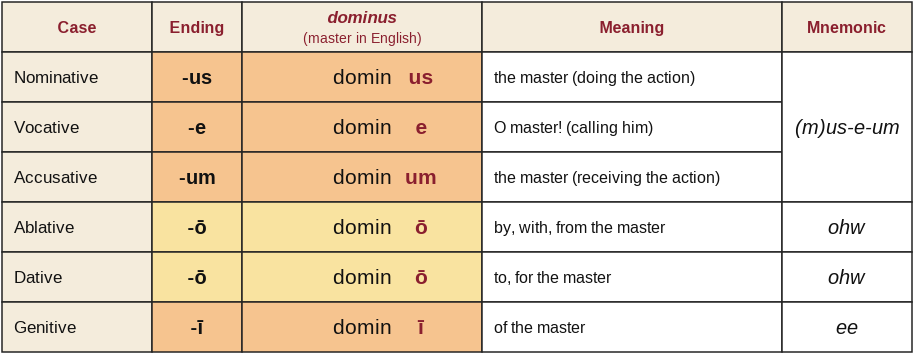
The first three endings, -us, -e, -um, are the three sounds of the word museum, written here as (m)us-e-um: the m is only there to help you remember. Then the ablative and the dative both end in -ō (yellow), so the mnemonic says ohw twice. The genitive ends in -ī: ee.
The model word is rex, a king. In the dictionary: rex, rēgis. Here you can see why the genitive matters so much: the nominative is rex, but all the other cases are built on rēg-, which you only learn from the genitive.
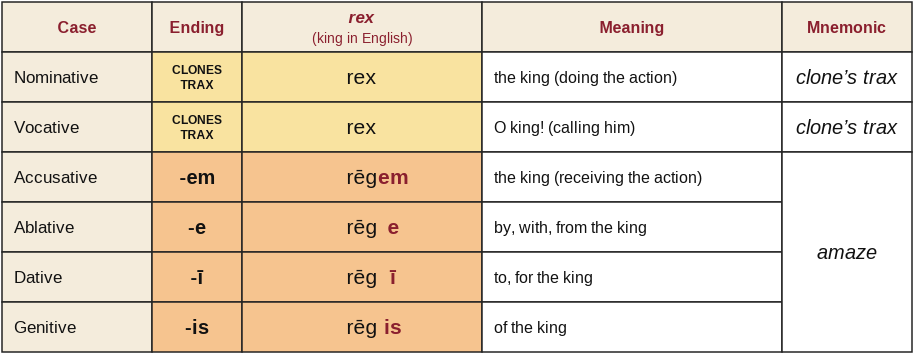
The nominative and the vocative are the same (yellow), and they can end in many ways: the letters of CLONES TRAX. After that, the endings are -em, -e, -ī, -is, which run together in the mnemonic as amaze.
The model word is manus, a hand. In the dictionary: manus, manūs.
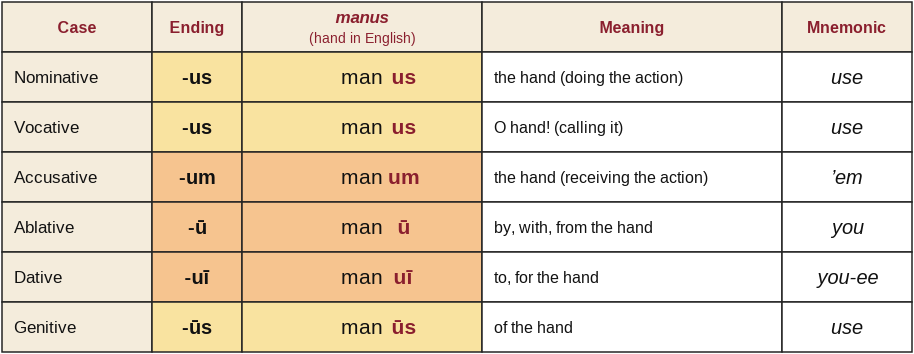
The nominative, the vocative and the genitive all end in -us (yellow), so the mnemonic says use three times. In the genitive the u is long, manūs. The others are -um, -ū and -uī: 'em, you, you-ee.
The model word is diēs, a day. In the dictionary: diēs, diēī.
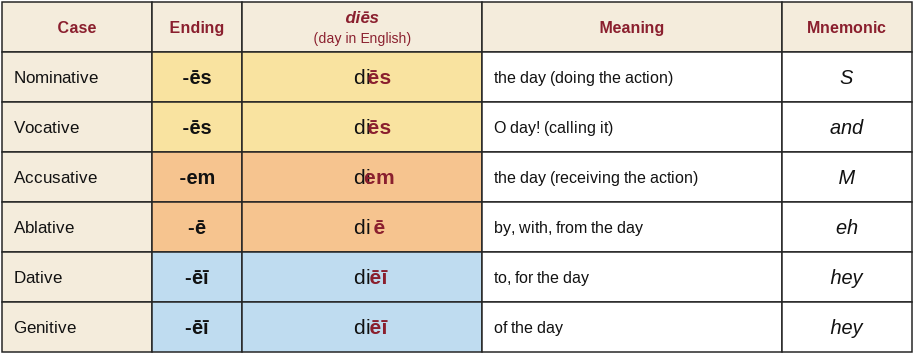
The nominative and the vocative both end in -ēs (yellow), and the dative and the genitive both end in -ēī (blue), so the mnemonic says hey twice. In between come -em and -ē: M and eh.
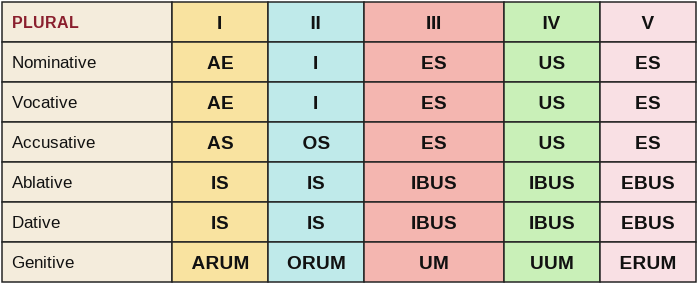
Notice that in the plural the dative and the ablative are always the same, and in this order they stand side by side.
Now say the whole plural mnemonic, like a little poem:
I 'as 'is arm,
'E 'os 'is arm,
Easy bosom,
Use ye bosom,
Easy boserum.
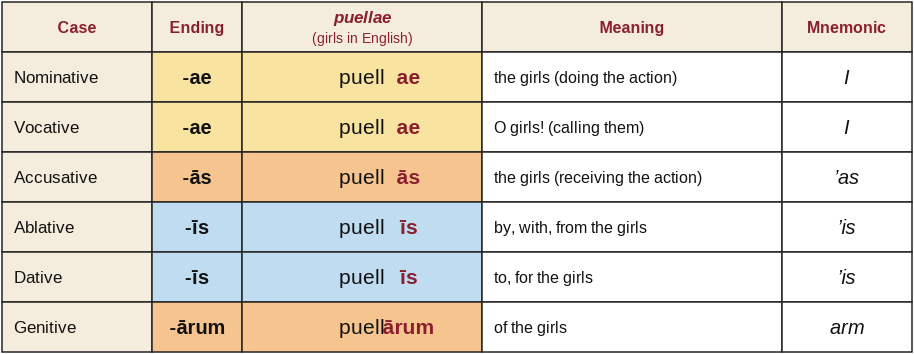
The nominative and the vocative are the same, -ae (yellow), and so are the ablative and the dative, -īs (blue). The accusative -ās and the genitive -ārum stand alone. Notice that the nominative plural, puellae, is the same as the genitive singular.
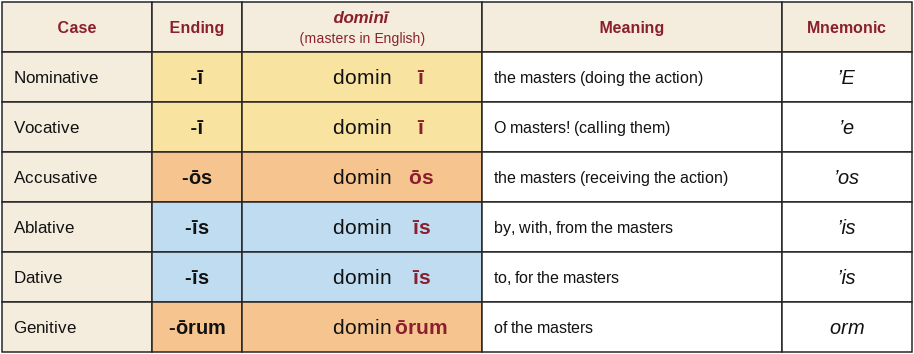
Again the nominative and the vocative are the same, -ī, and so are the ablative and the dative, -īs. The accusative is -ōs, and the genitive -ōrum.
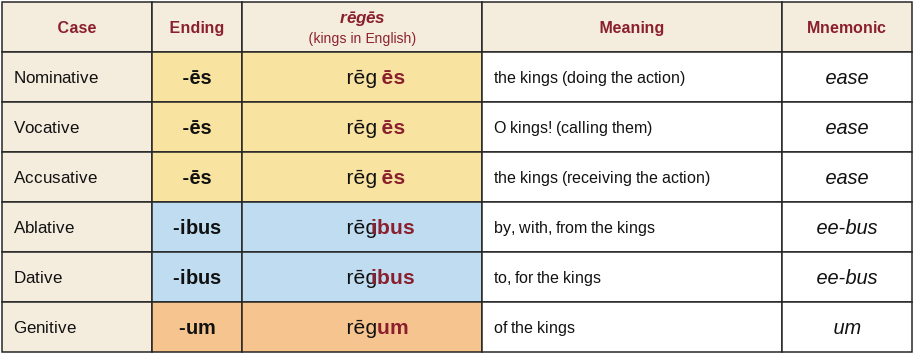
The nominative, the vocative and the accusative are all -ēs (yellow): three in a row. The ablative and the dative are both -ibus (blue). The genitive is -um.
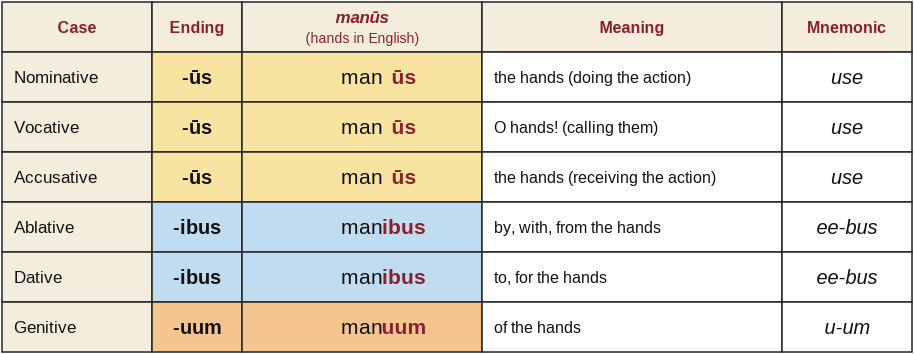
The fourth declension follows the same pattern as the third: three the same, -ūs, then two the same, -ibus, then the genitive, -uum.
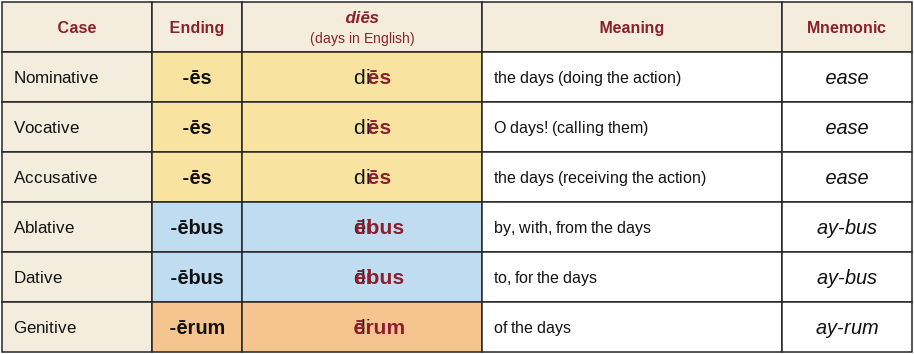
And the fifth follows the same pattern again: -ēs three times, -ēbus twice, and the genitive -ērum.
Look at the five plural tables together. In every declension, the ablative and the dative are the same. In every declension, the nominative and the vocative are the same, and in the third, fourth and fifth declensions the accusative is the same as them too. So in the plural you only need to learn three or four endings for each declension, not six.
However, if you just learn the little rhymes, you don't have to worry about how many nominatives and how many vocatives are the same, and how many of these and how many of those. You just need to memorise the rhymes.

Memorising for Latin — Book One: Nouns · Evan Millner · Published by Abecedaria Press