

Abecedaria Press · Memorising for Latin
Part Three
This is an unusual method. Most textbooks teach one declension, with lots of exercises, and then the next declension, with lots of exercises, and so on. Here we learn all five declensions at once, in one go. So you need plenty of practice with all five together, and that is what these exercises give you.
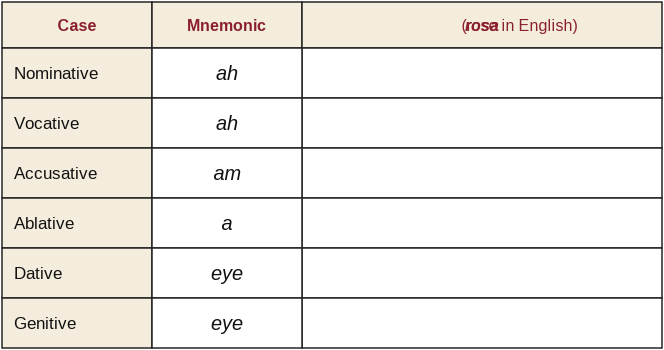
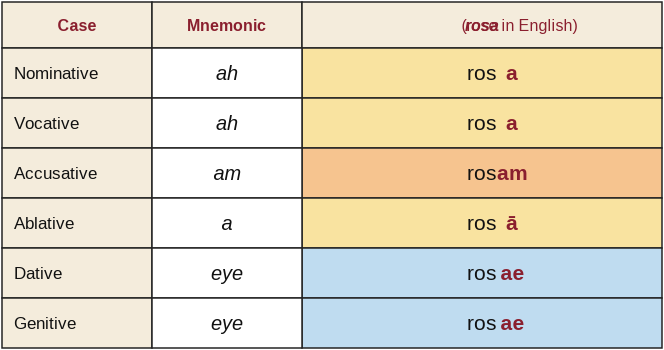
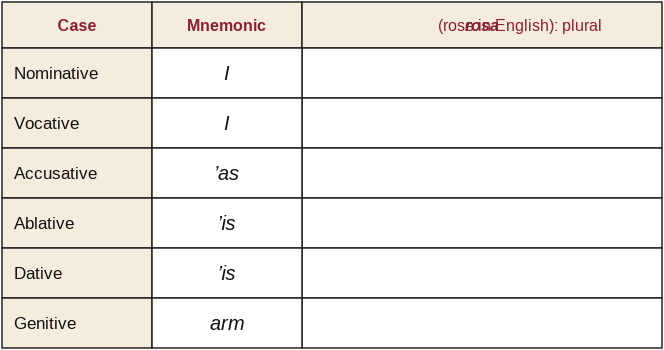
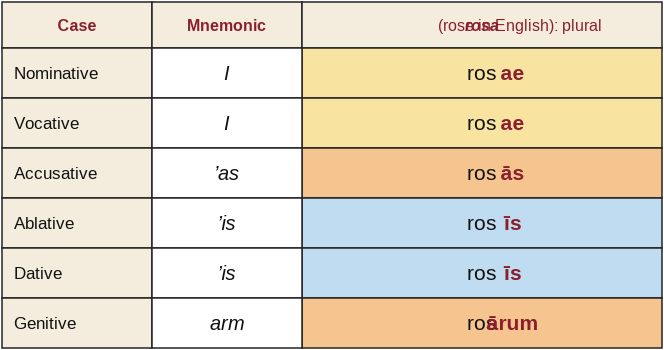
Now we are going to do some exercises. In each exercise you are given the mnemonic and a Latin word in the nominative. Write out the forms of the word in the empty table. Then check them in the table below it, which is filled in correctly.
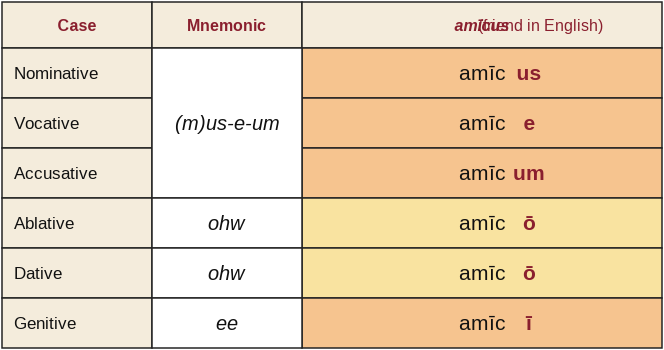
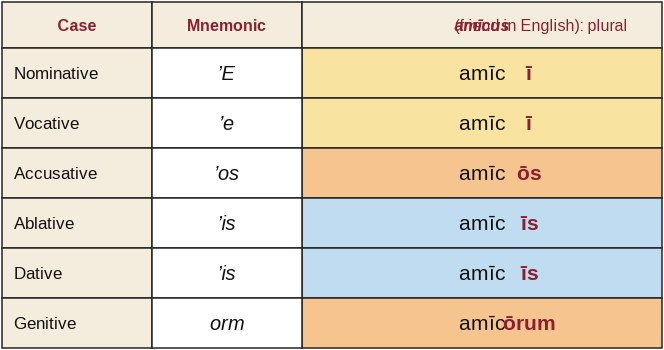
Write the macrons as well. A macron is the line above a vowel, as in ā or ō. It shows that the vowel is long by nature, which means that it is pronounced long. A macron is part of the ending, so when you check your answers, check the macrons too.
Before you look at the filled-in table, fill in the empty one yourself. It helps to cover the lower table with a sheet of paper.
Mnemonic: ah, ah, am, a, eye, eye. Word: rosa (rose in English).
Check your answers:
Mnemonic: I, I, 'as, 'is, 'is, arm. Word: rosa (rose in English).
Check your answers:
Mnemonic: (m)us-e-um, ohw, ohw, ee. Word: amīcus (friend in English).
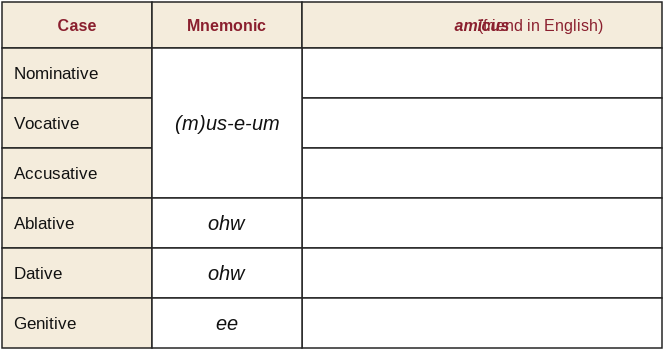
Check your answers:
Mnemonic: 'E, 'e, 'os, 'is, 'is, orm. Word: amīcus (friend in English).
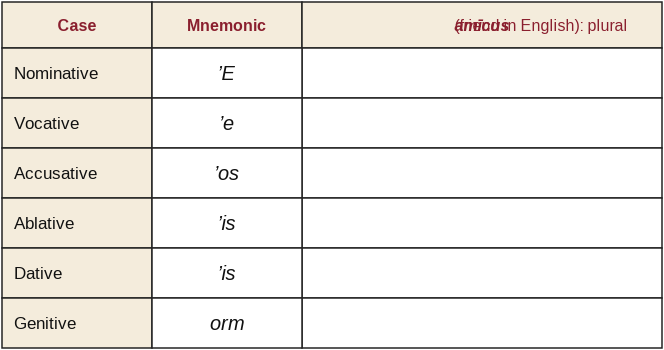
Check your answers:
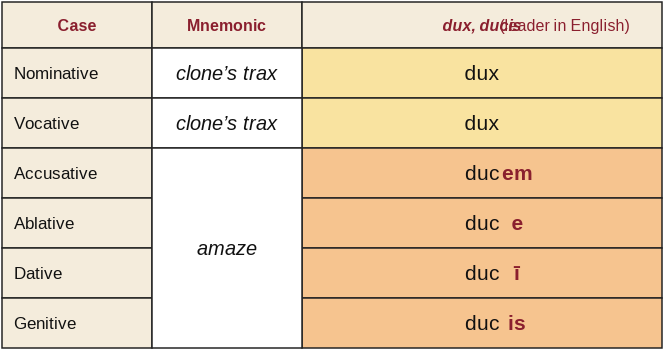
Mnemonic: clone's trax, clone's trax, amaze. Word: dux, ducis (leader in English).
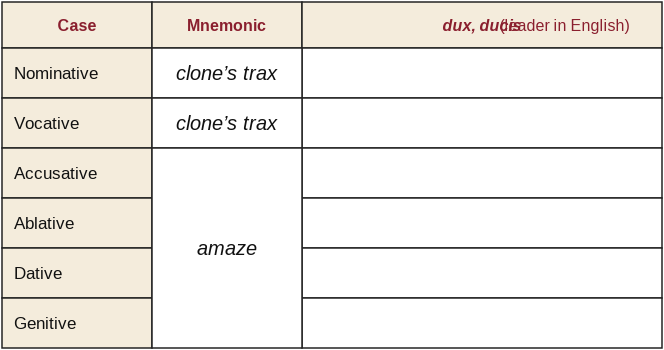
In the third declension you also need the genitive, ducis, because it gives you the stem duc-. The nominative alone does not tell you this.
Check your answers:
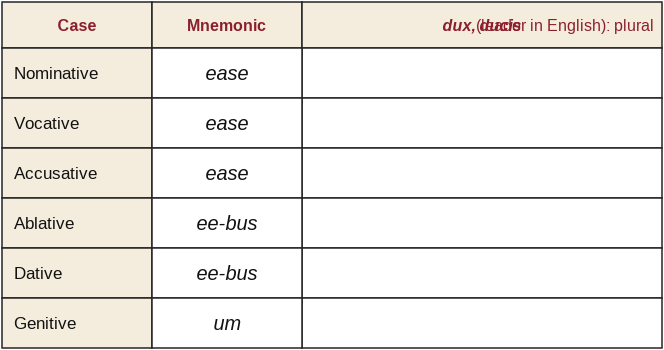
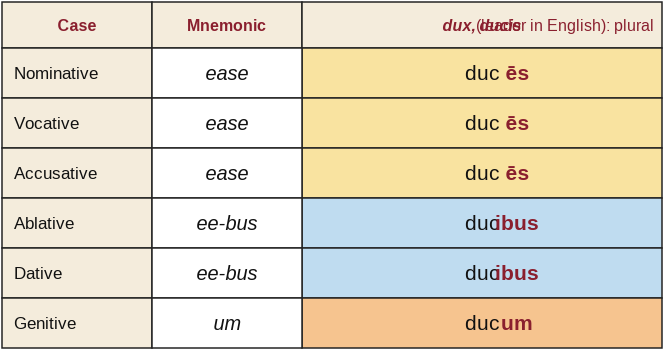
Mnemonic: ease, ease, ease, ee-bus, ee-bus, um. Word: dux, ducis (leader in English).
Check your answers:
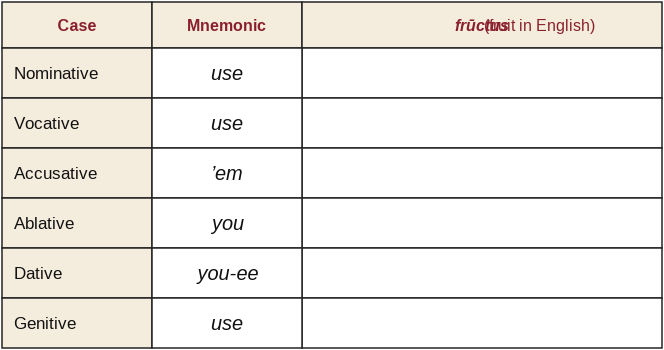
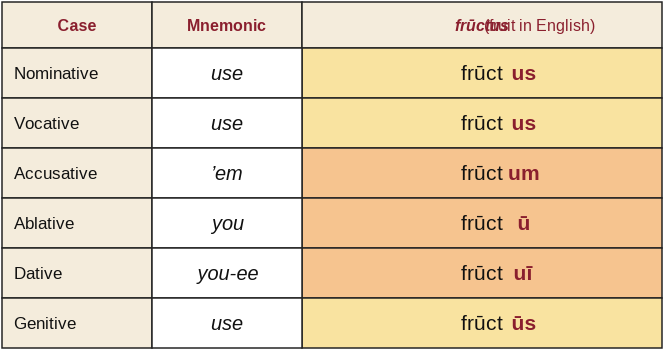
Mnemonic: use, use, 'em, you, you-ee, use. Word: frūctus (fruit in English).
Check your answers:
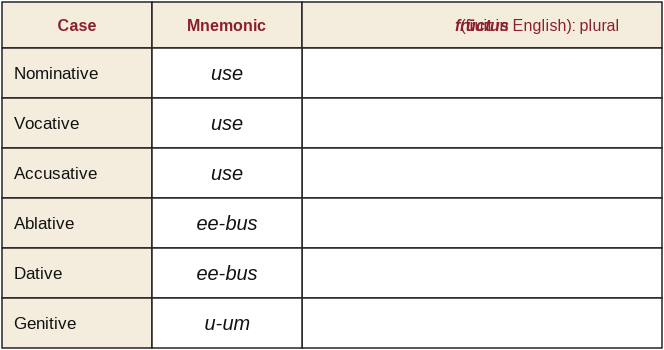
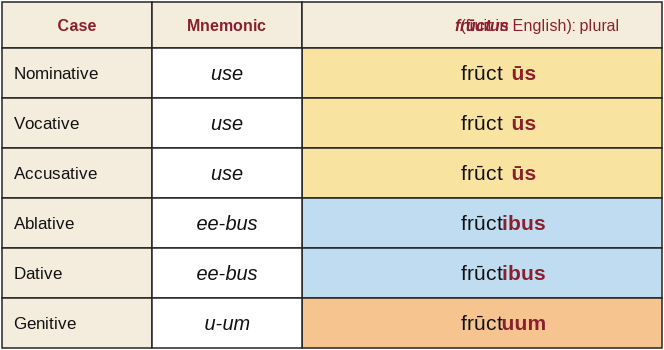
Mnemonic: use, use, use, ee-bus, ee-bus, u-um. Word: frūctus (fruit in English).
Check your answers:
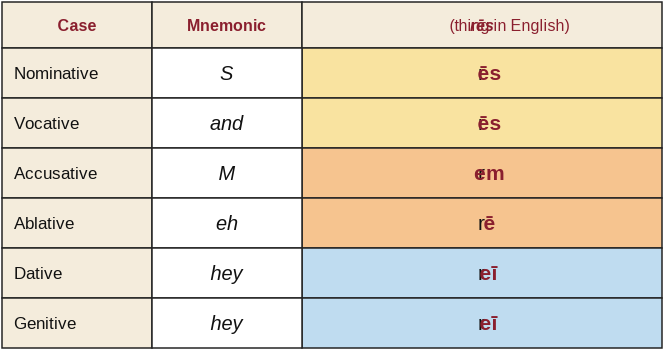
Mnemonic: S, and, M, eh, hey, hey. Word: rēs (thing in English).
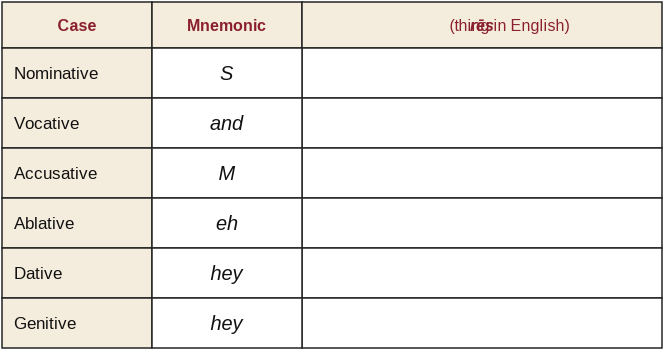
Note: in rēs the e of the dative and genitive is short, reī, because it comes after a consonant. In diēs it comes after a vowel, so it is long, diēī.
Check your answers:
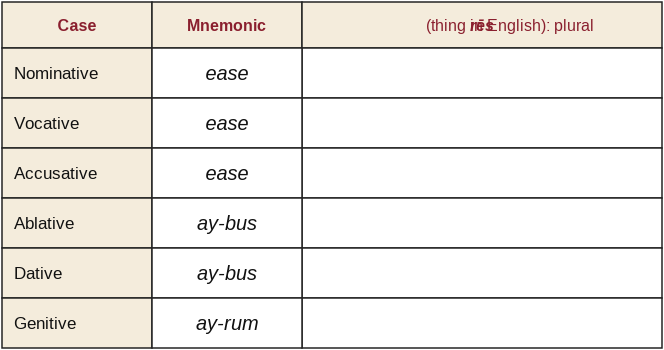
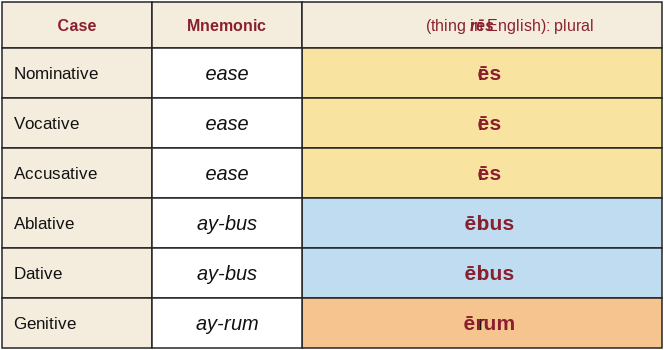
Mnemonic: ease, ease, ease, ay-bus, ay-bus, ay-rum. Word: rēs (thing in English).
Check your answers:

Memorising for Latin — Book One: Nouns · Evan Millner · Published by Abecedaria Press