

Abecedaria Press · Memorising for Latin
Part Twenty-Three
Some verbs have no "I" and no "you". They have only "it": the third person singular, in every square, and the infinitive on the ceiling. They are called impersonal verbs, because no person does them. English has a few of these as well: it is raining, it seems, it matters.
So for an impersonal verb, each square holds only one form, the third person singular, ending in -t. Everything else in the square is empty.
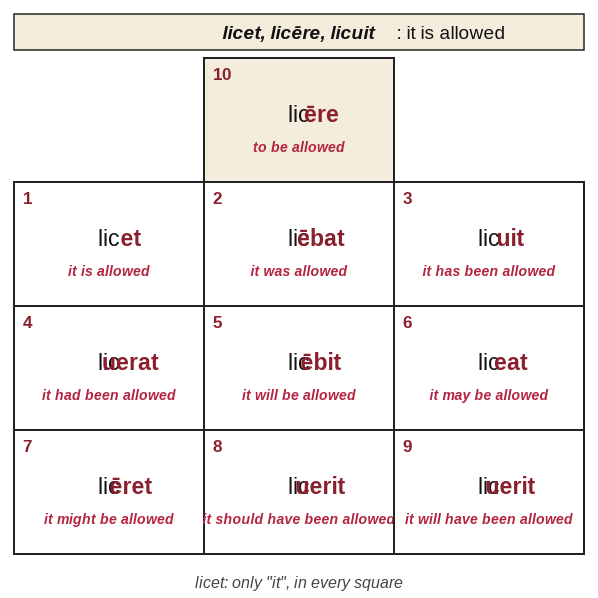
The person who is allowed goes in the dative: mihi licet, it is allowed to me, I may; tibi licet īre, you may go. A medieval proverb puts it neatly: quod licet Iovī, nōn licet bovī, what is allowed to Jupiter is not allowed to an ox.
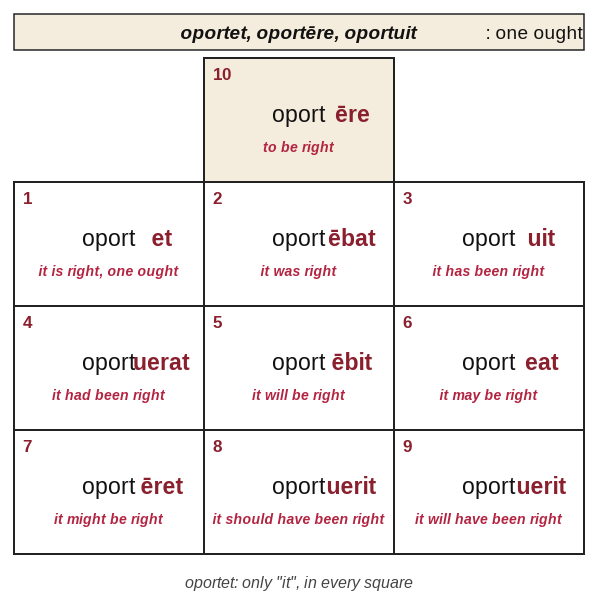
The person who ought goes in the accusative, with an infinitive: mē oportet īre, it is right for me to go, I ought to go. Oportuit, in square 3, often means "one ought to have": hoc facere oportuit, this ought to have been done.
They all go into the squares in the same way, with "it" alone:
English has kept licet in licence and licit, placet in placebo (I shall please), and paenitet in penitent and repent.
Finally, any verb that has no object can be used impersonally in the passive, in the third person singular, to say that something is going on, without saying who is doing it:
The historians use these forms when the action matters more than the people: diū atque ācriter pugnātum est, there was fighting for a long time, and fiercely.

Memorising for Latin — Book Three: Verbs · Evan Millner · Published by Abecedaria Press