

Abecedaria Press · Memorising for Latin
Part Twenty-Two
You have met the deponent verbs on the ceiling of the third wall: hortārī, verērī, loquī, patī, partīrī. They have passive forms everywhere, but an active meaning.
A few verbs are deponent only halfway. They are called semi-deponent (sēmi-, half). In the present squares they have ordinary active forms. In the perfect squares they have passive forms, the participle with sum, but their meaning stays active.
The room shows exactly where the change comes. It happens in squares 3, 4, 8 and 9: the four perfect squares, the same four in which the passive of every verb uses the participle and sum.
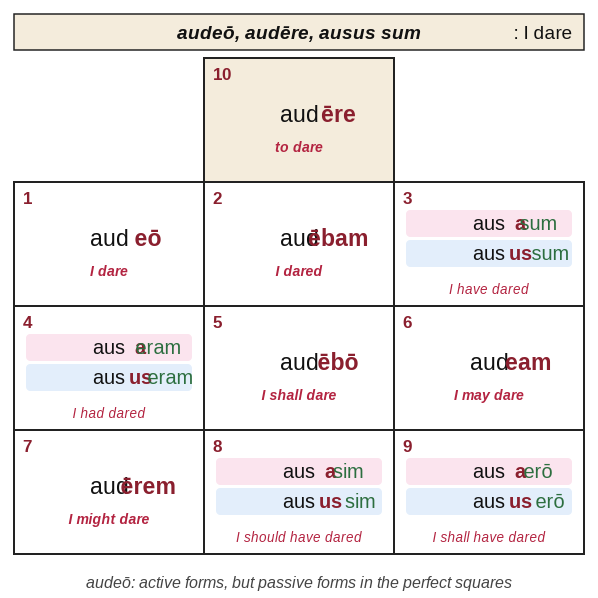
The meaning never changes: ausus sum means "I have dared", not "I have been dared".
There are only a handful of these verbs, and they are worth learning by their dictionary forms, which show you the change at once:
The third dictionary form, with sum, is the sign: a verb whose perfect is a participle with sum, but whose first form ends in -ō and not in -or, is semi-deponent.
English has kept several of them: audacity (from audāx, daring), gaudy and joy (from gaudium), confident and diffident (from fīdō).
You have already met a verb that does the opposite: fīō, among the irregular verbs. It has active forms in the present squares (fīō, fīēbam, fīam) with a passive meaning, "I am made", and passive forms in the perfect squares (factus sum). Between them, audeō and fīō show you that the line between the present squares and the perfect squares runs straight through the room.
Last of all, the impersonal verbs: verbs that have only "it".

Memorising for Latin — Book Three: Verbs · Evan Millner · Published by Abecedaria Press