

Abecedaria Press · Memorising for Latin
Part Twenty-One
When the Romans spoke quickly, they shortened some of the long forms of the perfect. The poets did the same, to fit the verse, and so did the historians. You will meet these shortened forms everywhere, and they can be puzzling at first. But they are all in the perfect squares (3, 4, 8 and 9 on the floor, and squares 1 and 2 on the first wall), and they follow one rule.
In the perfect stem amāv-, the v stands between two vowels. Leave out the v, and the two vowels melt into one long vowel: amā(v)i- becomes amā-, amā(v)e- becomes amā-.
So amāvistī becomes amāstī, and amāverat becomes amārat. Nothing else changes. The square is the same, and the meaning is the same.
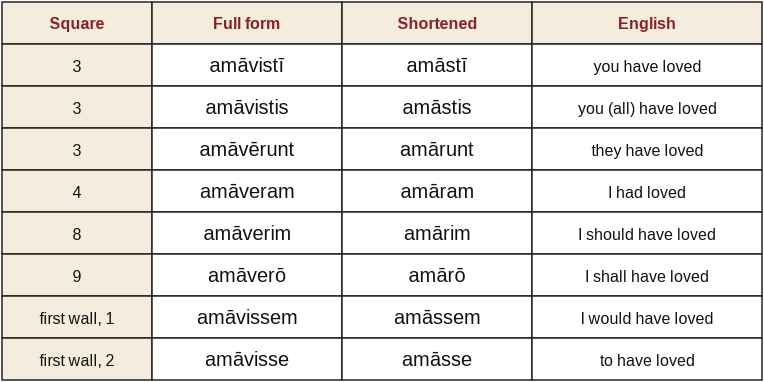
The same happens with -ēv- and -ōv-: dēlēvistī becomes dēlēstī, and nōvistī, you know, becomes nōstī; nōveram becomes nōram; nōvisse becomes nōsse. And in fēcērunt or rēxērunt, where there is no v, nothing is shortened in this way.
In the fourth conjugation, the v simply drops out, and the forms that are left are shortened a little further:
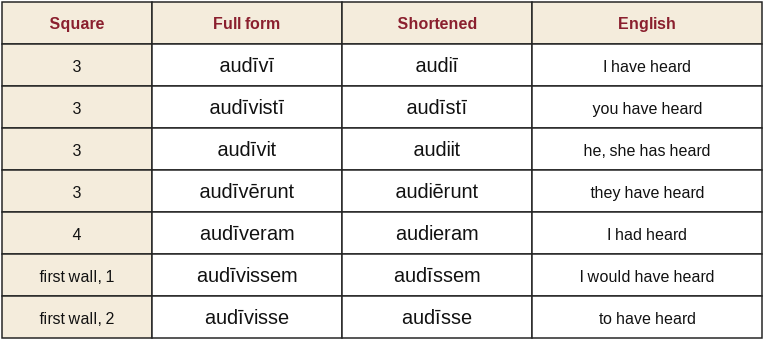
So audiī is the same as audīvī, and audīstī the same as audīvistī. You met this already with eō, whose perfect iī is short for īvī, and īstī for īvistī.
There is one more shortened form, and it is the most important. In square 3, the third person plural, -ērunt, they have, is often written -ēre:
The historians, above all, use this form all the time. It looks like an infinitive, but it is not. The perfect stem tells you where you are: amāv-, monu-, rēx- and fu- belong only in the perfect squares. So amāvēre can only be square 3: they loved.
Next, the semi-deponent verbs: verbs that are active in some squares and passive in form in others.

Memorising for Latin — Book Three: Verbs · Evan Millner · Published by Abecedaria Press