

Abecedaria Press · Memorising for Latin
Part Twenty
Some Latin verbs have lost many of their forms. They are called defective verbs (from dēficiō, I fail, I am lacking): they are missing some of their squares. But the forms they do have go into the usual squares, and the room shows you at once which squares are empty. These verbs are few, but they are very common, and you will meet them on almost every page.
Two of the most common have only the perfect squares, 3, 4, 8 and 9. But they use them with a present meaning. Ōdī looks like "I have hated", but it means "I hate". Meminī looks like "I have remembered", but it means "I remember".
The rule is simple. The form is in its usual square; only the meaning moves back one step:
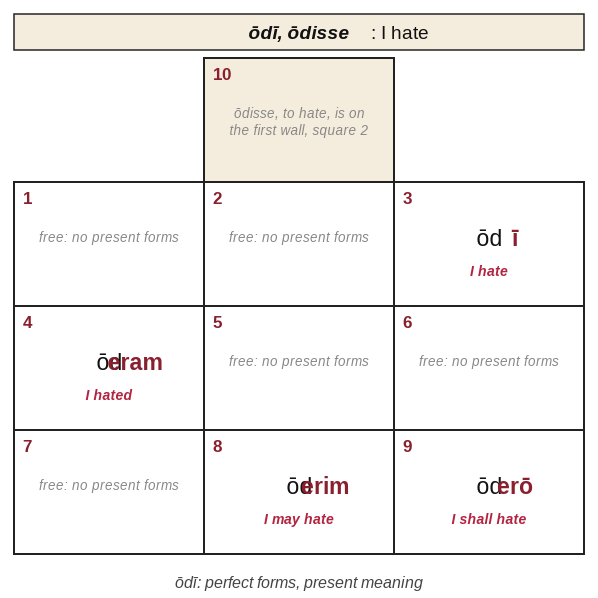
The best-known line in all Latin love poetry begins with these two verbs, side by side. Catullus wrote: ōdī et amō, I hate and I love. Ōdī is in square 3, amō in square 1, and both mean the present.
And square 8 has a famous line of its own, from the old Roman poet Accius, said to have been a favourite of the emperor Caligula: ōderint, dum metuant, let them hate, so long as they fear. Ōderint is square 8, with its present meaning: let them hate, may they hate.
Ōdī also has ōdissem on the first wall, square 1, and a future participle, ōsūrus, about to hate, on the first wall, square 6. Its infinitive, ōdisse, stays where every perfect infinitive goes, on the first wall, square 2, but it means simply "to hate".
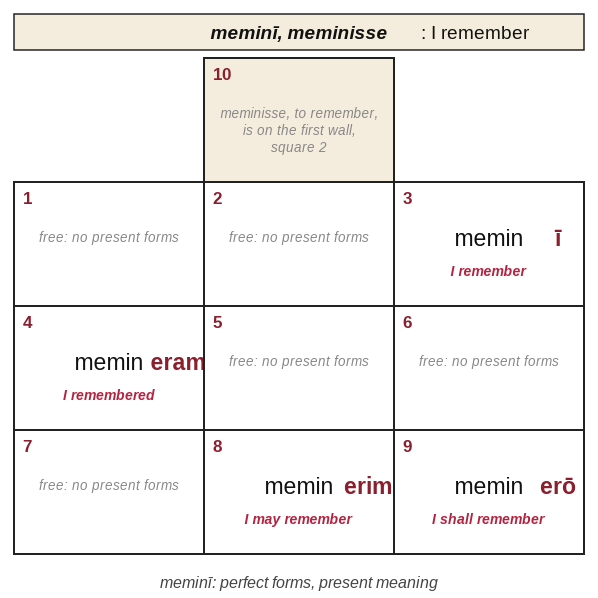
Meminī works in exactly the same way: meminī, I remember; memineram, I remembered; meminisse, to remember. It has one form more, a command, and it sits in the square for the future command, square 8 of the first wall: mementō!, remember!, and mementōte!, remember (all of you)! Hence the old saying mementō morī, remember that you must die.
Meminī often takes the genitive: meminī tuī, I remember you.
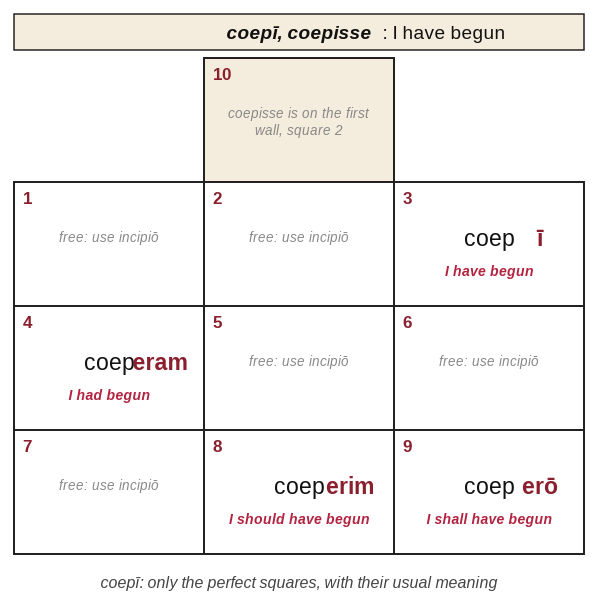
Coepī, I have begun, I began, also has only the perfect squares. But here the meaning does not move: coepī means "I began". For the present squares, Latin uses another verb, incipiō, I begin, which goes like capiō.
Nōscō means "I get to know". So its perfect, nōvī, means "I have got to know", that is, "I know". It is not defective, because nōscō has all its squares, but nōvī behaves like ōdī and meminī: nōvī, I know; nōveram, I knew; nōverō, I shall know. The same is true of cōnsuēvī, I have become used to, that is, "I am used to".
Two verbs of saying have only a handful of forms, almost all in square 1. You will meet them inside quotations, where English says "he said":
Aiō is also the opposite of negō, I say no. Aiō is "I say yes".
Two words of greeting are verbs that have kept only their commands, on the first wall, square 7:
So a Roman greeting is a command: "be well!"
Next, the shortened forms of the perfect, which you will meet everywhere in poetry and in speech.

Memorising for Latin — Book Three: Verbs · Evan Millner · Published by Abecedaria Press