Universitas Scholarium — A Community of Scholars Log In

Abecedaria Press · Memorising for Latin

Part Nineteen

The five verbs side by side

Here is the first person of all five verbs, square by square, with the infinitive from the ceiling at the top:
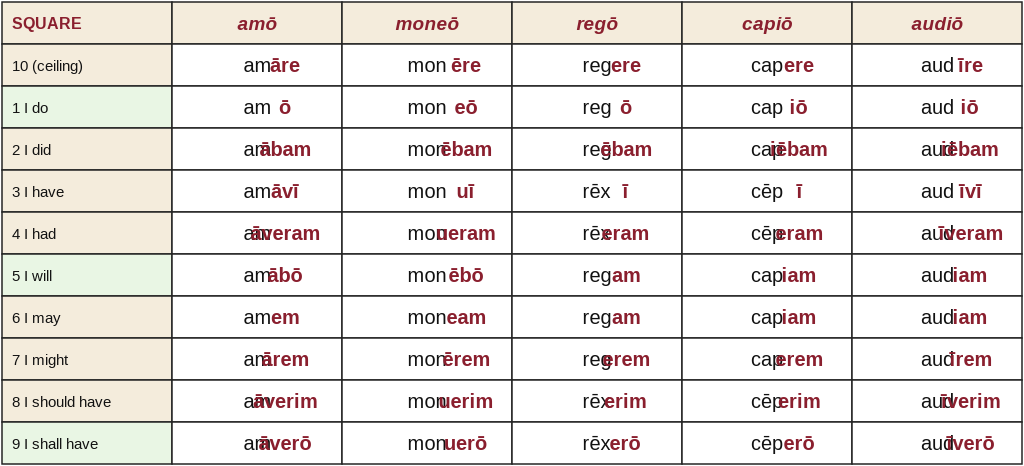
The five verbs compared

Read it across, and you will see how little changes:

  • square 10 tells you the family: -āre, -ēre, -ere, -īre. Capiō, with -ere, belongs with regō;
  • square 2 always has -bam, with ā, ē or iē in front;
  • square 5 comes in two kinds: -bō for amō and moneō, and -am for regō, capiō and audiō;
  • square 6, the present subjunctive, changes its vowel from family to family: amem, moneam, regam, capiam, audiam. An old schoolroom sentence holds the vowels in order: "we fear a liar";
  • square 7 is always the infinitive with -m: amāre-m, monēre-m, regere-m, capere-m, audīre-m;
  • squares 3, 4, 8 and 9 are built on the perfect stem from the dictionary, and after it their endings never change: -ī, -eram, -erim, -erō.

So once you have the three forms from the dictionary for squares 1, 10 and 3, you can fill the whole floor of any regular verb.

What comes next

The regular verbs are done. The last four parts deal with verbs that are missing some of their forms, or use them in an unusual way: the defective verbs, the shortened forms of the perfect, the semi-deponent verbs, and the impersonal verbs.
