

Abecedaria Press · Memorising for Latin
Part Two
A Latin verb has many more forms than a noun. But the forms are not a jumble. Each tense has its own place, and each place holds the same six persons. So we give every tense a square in the memory room, and we learn them one verb at a time. We begin with amō, I love.
We start with the floor. Each square holds one tense, shown here in its first form, I ..., with its English meaning in red. Under each form is an aid to memory: feel free to make up your own.
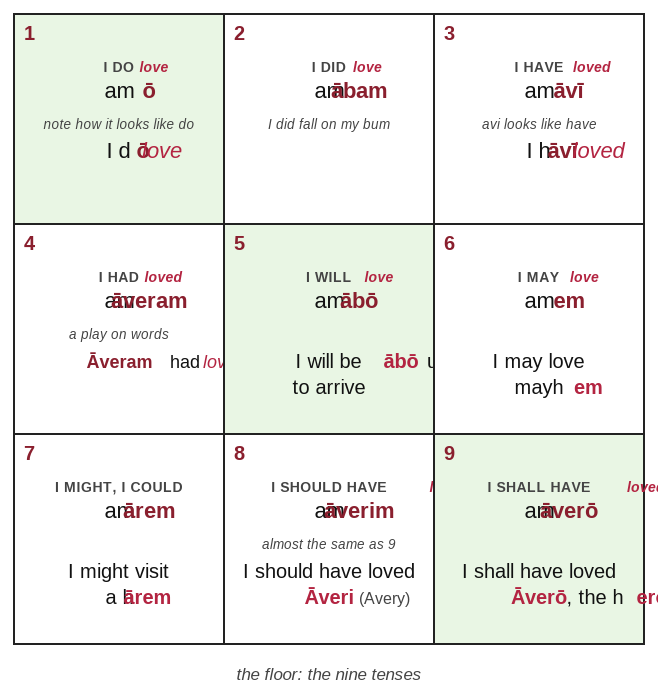
Some things to notice:
First, learn which form is in which square. Sit in your chair and imagine the forms laid out on the floor, each in its square. Make your pictures as clear and as solid as you can, and make up stories for them.
The first step is to recognise the forms quickly when you meet them. The second step is to be able to give them yourself.
Make use of the things in your room that happen to fall in the squares. For example, in my room, the top right-hand corner, square 3, had a table with a top hat on it. So I thought of the line "I have a top hat", and at once I remembered that square 3 holds I have: amāvī.
Each square holds not one form but six: one for each person. And here is the good news: in eight of the nine squares, the six endings are the same.
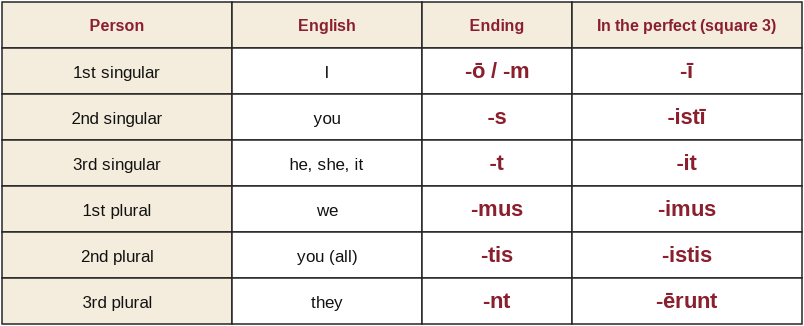
The first person ends in -ō in the green squares (1, 5 and 9), and in -m in the others. Only square 3, the perfect, has endings of its own.
So every form is made of three parts:
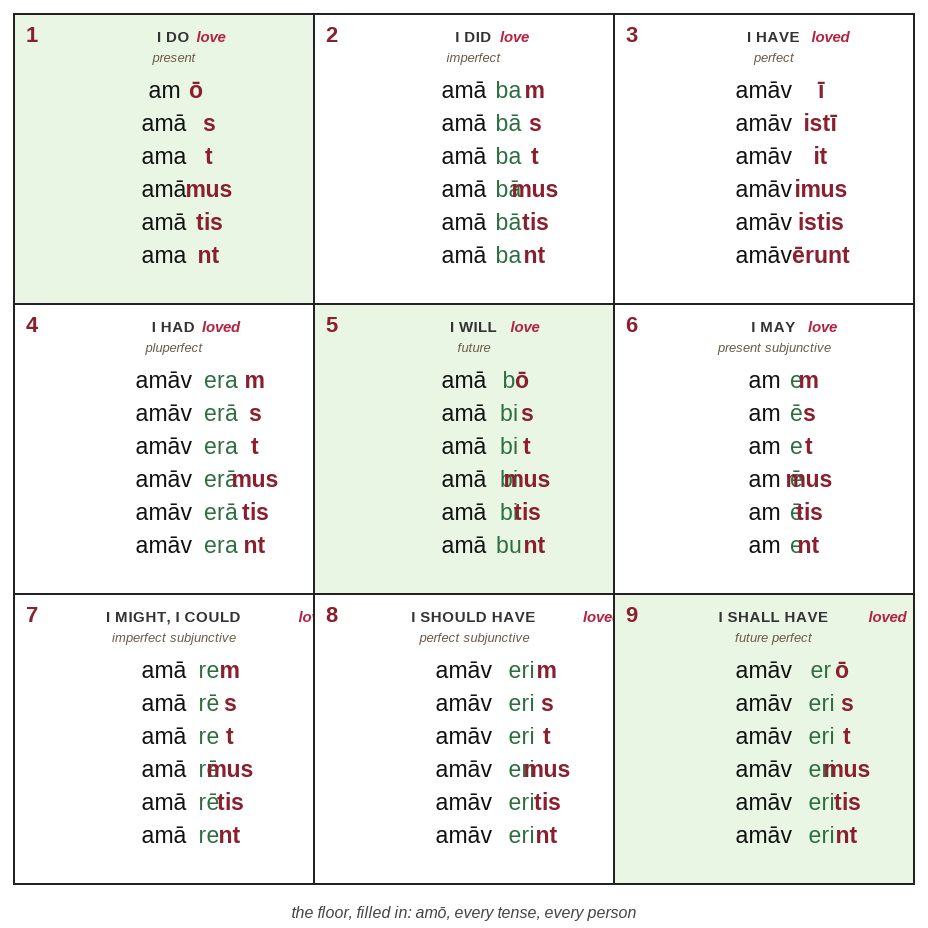
Here is the whole floor, with every form of amō. Look at one square at a time. Say the six forms aloud, from top to bottom, as you said the rhymes of the nouns.
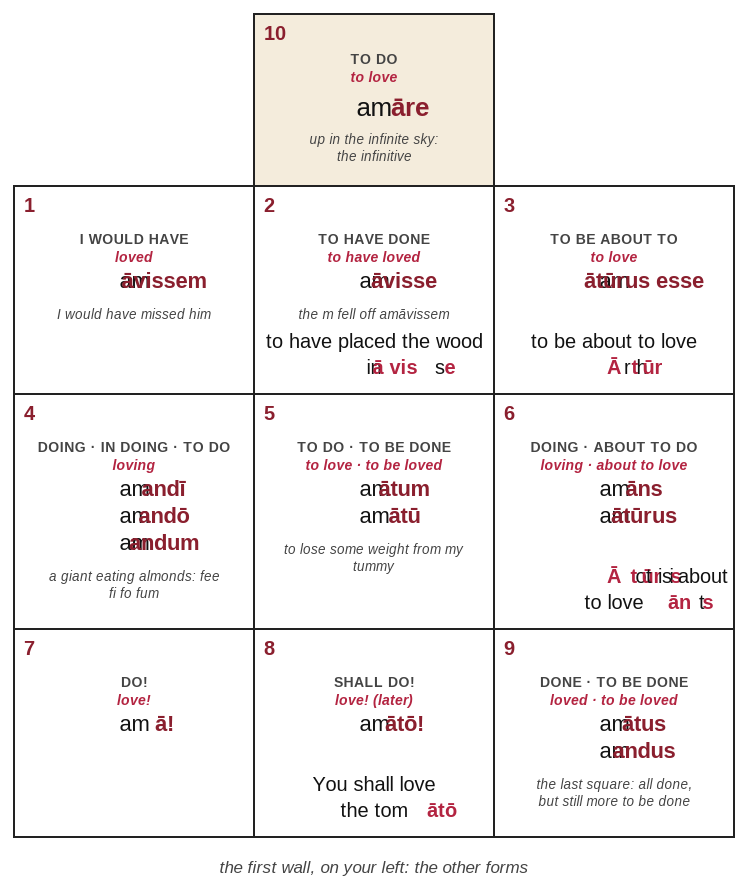
Now we leave the floor, and turn to the wall on our left. Its squares are numbered 1 to 9 again, just like the floor, with 10 on the ceiling above. Here go the other forms of the verb: the pluperfect subjunctive, the infinitives, the gerund, the supine, the participles and the imperatives.
Square 10, on the ceiling above the whole room, holds the infinitive, amāre, to love. It is the key to the verb: its ending tells you the conjugation (amāre, monēre, regere, audīre), just as the genitive told you the declension of a noun. And it is one of the forms the dictionary gives you: amō, amāre, amāvī, amātum. So three of the four are in easy places: amō in square 1, amāre in square 10, amāvī in square 3. Think of it up in the infinite sky: the infinitive.
The infinitive is a verb, but it can also be used as a noun. Amāre means "to love", but it can also simply mean "loving", or "love". Amāre est dulce: to love is sweet, or loving is sweet, or love is sweet.
When it is used in this way, the infinitive is a neuter noun. You can see this in the adjectives that go with it, which are neuter. The poet Horace wrote dulce et decōrum est prō patriā morī: "it is sweet and fitting to die for one's country". Here morī, to die, is the noun, and the adjectives dulce and decōrum are neuter, to agree with it. And the old saying errāre hūmānum est, to err is human, works the same way: errāre is the noun, and hūmānum is neuter.
This is like what we saw in Book Two, where an adjective can work like a noun, and a noun like an adjective. In Latin, the parts of speech are not walled off from each other. The infinitive stands on the ceiling, above the whole room, partly a verb and partly a noun.

Memorising for Latin — Book Three: Verbs · Evan Millner · Published by Abecedaria Press