

Abecedaria Press · Memorising for Latin
Part Three
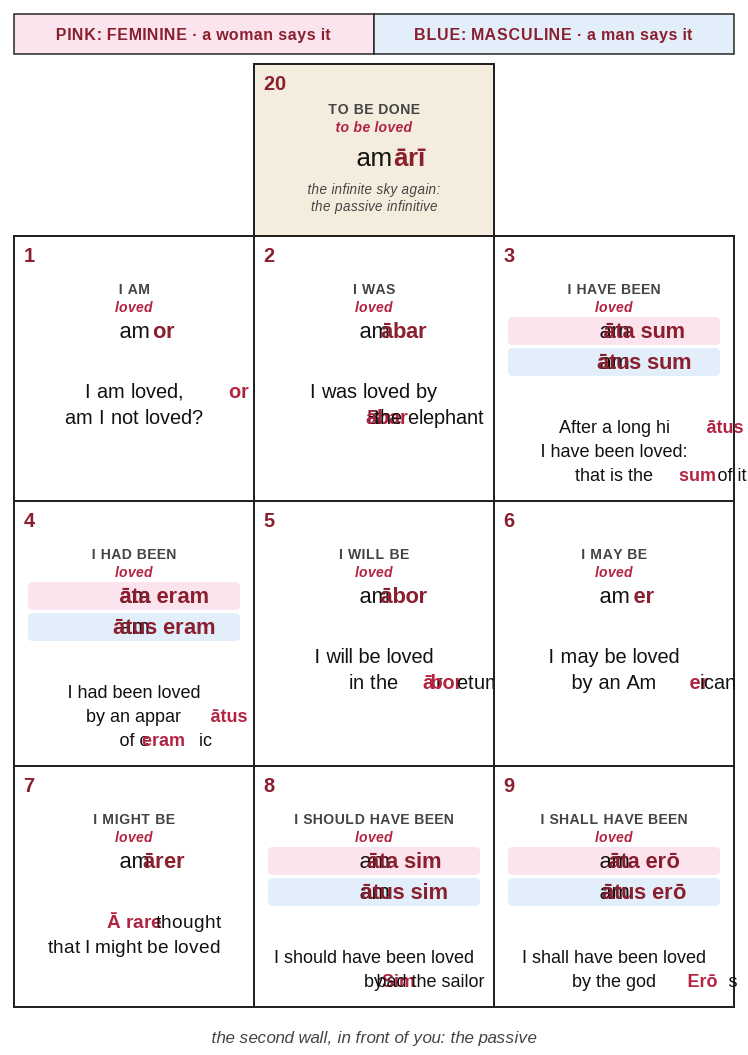
Now turn to the wall in front of you, the second wall, with 20 on the ceiling above it. Here goes the passive: I am loved, I was loved, and so on.
The second wall is arranged exactly like the floor. Each tense of the passive sits in the same square as its active partner: the present in square 1, the imperfect in square 2, the perfect in square 3, and so on to the future perfect in square 9. So if you know the floor, you already know where everything on this wall goes. Always keep each tense in the same place.
And on the ceiling, in square 20, just as amāre sits in square 10, goes the passive infinitive: amārī, to be loved.
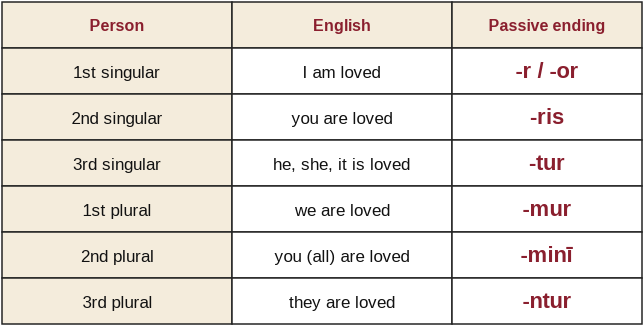
The passive has its own six personal endings, and again they are the same in every square that has them: squares 1, 2, 5, 6 and 7.
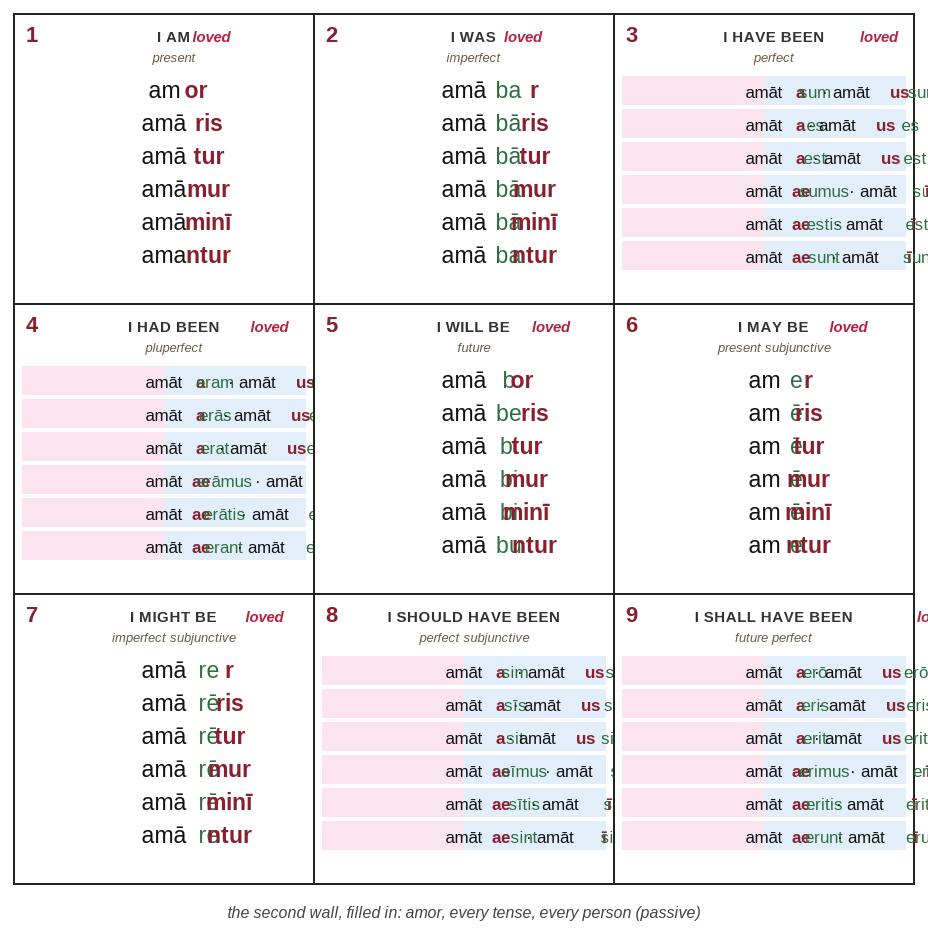
The tense signs (in green) are the same as on the floor: -ba- in square 2, -bi- in square 5, -e- in square 6, -re- in square 7. Only the endings change. In square 5, the second person is amāberis, with e instead of i.
In the four squares of the perfect, the passive is made in a different way: with the participle amātus (loved) and a form of sum, I am. The forms of sum are simple ones: its present, its imperfect, its present subjunctive and its future. The perfect squares of the passive borrow them from the floor of sum:
The participle is an adjective, like bona, bonus, bonum, so it agrees with the person. When the subject is "I", it is the speaker who is a woman or a man: a woman says amāta sum, I have been loved; a man says amātus sum. On the walls below, the woman's form is on pink and comes first, the man's form on blue, the same colours as in Book Two. Grammar books usually give only amātus sum, as if every reader were a man; here both are given. A thing, in the neuter, amātum est, it has been loved. In the plural: amātae sumus, we (women) have been loved; amātī sumus, we (men, or a mixed group) have been loved; amāta sunt, they (things) have been loved.

Memorising for Latin — Book Three: Verbs · Evan Millner · Published by Abecedaria Press