

Abecedaria Press · Memorising for Latin
Part Four
Now turn to the wall on your right, the third wall, with 30 on the ceiling above it. Here goes the rest of the passive.
Just as the second wall mirrors the floor, the third wall mirrors the first wall. Each passive form sits in the same square as its active partner on the first wall:
Squares 4, 5, 6 and 9 stay free. The gerund has no passive, and the supine and the participles are already on the first wall. Free squares are useful: you can keep them for anything you want to add later.
Notice that square 7 holds amāre!, which looks just like the infinitive in square 10. The context tells you which it is.
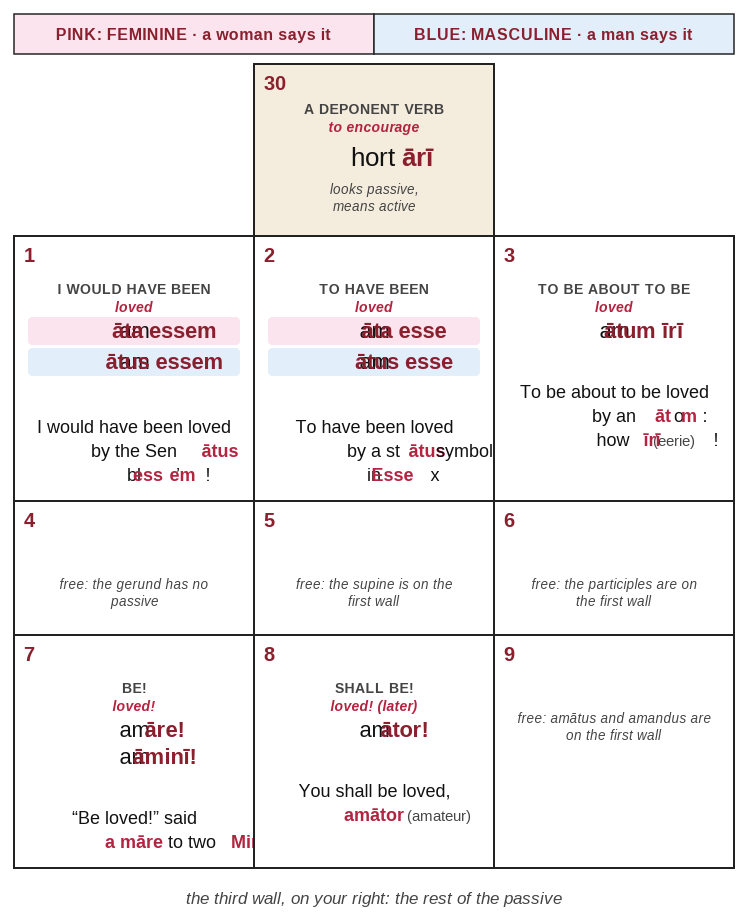
Some Latin verbs have only passive forms, but an active meaning. They are called deponent verbs (from dēpōnō, I lay aside: they have laid aside their active forms). For example, hortor, I encourage; hortārī, to encourage; hortātus sum, I have encouraged.
A deponent verb needs no new squares. Its forms go on the second and third walls, exactly where the passive forms of amō go: hortor in square 1 of the second wall, beside amor; hortātus sum in square 3, beside amātus sum. Only the meaning is different: active, not passive.
So on the ceiling, in square 30, we put hortārī, to encourage: a reminder that a verb can look passive and mean active.
This is only the first verb. Once you know exactly which form of amō is in which square, every other verb goes into the same squares:
They can stand beside amō in the same squares, or in another room laid out exactly like this one. But always keep each tense in the same place, even in a new room.
If you have a reasonably good memory for places, you can learn the floor and the first wall in about an hour. The first attempt will be hard; then it will get easier. Go over it again regularly. Even after one hour, you will find that your reading of Latin improves, because you will recognise the verb forms, and you will know where each one belongs.
Learning the endings for each person, all six in every square, does take longer. But you do not need to have them perfect before you begin to read. Once you have an idea of them, start reading a great deal, especially construed texts, where each Latin word is matched with its English. You will start to see these forms again and again, each one in its place, and you will then find it a lot easier to learn them fully later on.

Memorising for Latin — Book Three: Verbs · Evan Millner · Published by Abecedaria Press