

Abecedaria Press · Memorising for Latin
Part Five
A few very common Latin verbs do not follow the pattern of amō. They are called irregular. But they go into the same squares. Every tense keeps its place: the present in square 1, the imperfect in square 2, and so on, exactly as for amō.
You can imagine each irregular verb standing beside amō in its square. Or, if your room is getting crowded, open a door into a second room, laid out exactly like the first, and put the irregular verbs there. Either way, always keep each tense in the same place.
We begin with the most important verb of all: sum, I am.
You have met sum already, on the second and third walls. The passive of amō borrowed four of its forms: amātus sum, amātus eram, amātus sim, amātus erō, and on the third wall amātus essem. So you already know the first forms of five of its squares.
Here is sum on the floor, with the first form of each tense, just as we first learned amō:
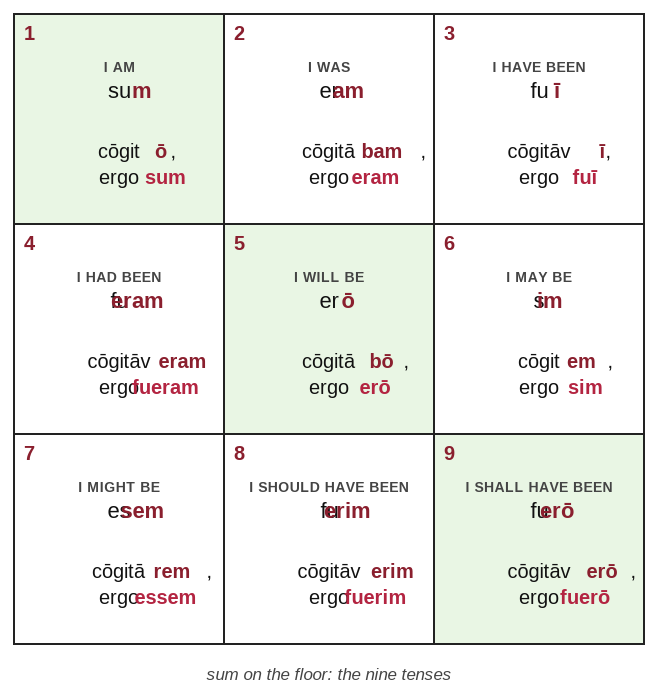
The memory sentence for sum is the most famous Latin sentence in philosophy: cōgitō, ergo sum, I think, therefore I am, from the French philosopher René Descartes. In square 1 it stands as he wrote it. In every other square we put the whole sentence into the tense of that square. It is a bit of a joke, and it is also good practice, because cōgitō goes exactly like amō:
And here is the whole floor, with every person:
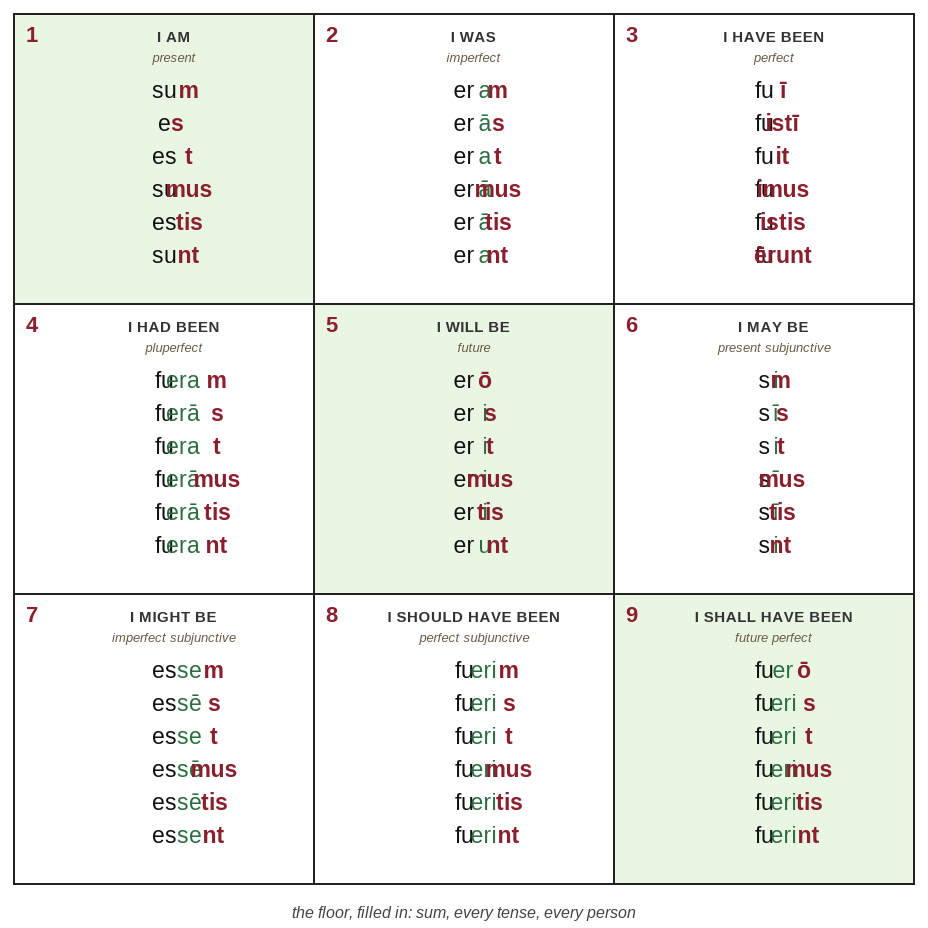
Look at the personal endings in red. They are the same six as for amō: -m (or -ō), -s, -t, -mus, -tis, -nt. Only the beginnings are irregular: su- and es- in square 1, er- in squares 2 and 5, s- in square 6, es- in square 7.
Now look at squares 3, 4, 8 and 9. They are not irregular at all. The perfect stem is fu-, and after that everything is exactly as for amō: fu-ī like amāv-ī, fu-eram like amāv-eram, fu-erim like amāv-erim, fu-erō like amāv-erō. If you know the floor of amō, you know these four squares of sum.
And here is something surprising. Look again at the signs of the perfect squares of amō:
So the perfect squares of every verb are built with the help of sum. Learn sum well, and the right-hand side of the room becomes easy.
Sum has fewer forms on the first wall: it has no gerund and no supine, so those squares stay free. Its infinitive, esse, to be, goes on the ceiling in square 10, just like amāre.
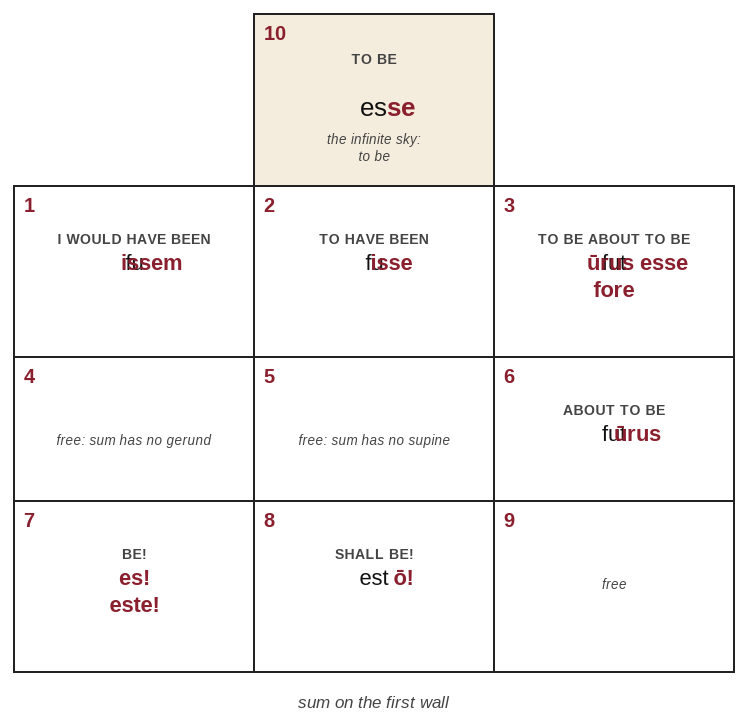
Sum has no present participle in classical Latin, and no passive, so the second and third walls stay empty for sum.

Memorising for Latin — Book Three: Verbs · Evan Millner · Published by Abecedaria Press