

Abecedaria Press · Memorising for Latin
Part Six
Sum does not only mean "I am". It is also the great helper of every other verb. Take a participle from the first wall of amō, put it in front of sum, and you have a new set of forms. There are three of these participles, and you already know them all:
Each of them can go in front of sum in every one of sum's squares. You do not need any new squares for this. You need only the floor of sum, which you have just learned, and three words from the first wall.
These participles are adjectives. They change like bona, bonus, bonum from Book Two, to agree with the person they describe. So the form depends on who is speaking:
In the same way a woman says amātūra sum and amanda sum, and a man says amātūrus sum and amandus sum. In the plural, women say amātae sumus and men say amātī sumus.
When the subject is "I", it is the speaker who is a woman or a man. The ending tells you who is talking:
Grammar books almost never show this. They give only amātus sum, as if every reader were a man. Half the people who have ever spoken Latin were women, so in the squares below both forms are given, in the same colours as in Book Two:
The pink form comes first, as the feminine always does in these books. A woman learning Latin should say amāta sum, amātūra sum and amanda sum from the very beginning.
The neuter, amātum, is not given a wall of its own, because "I" is always a person. It appears only with things, in the third person: dōnum amātum est, the gift has been loved.
You have already met these forms on the second and third walls. Here they are again, standing in sum's own squares, so that you can see where each one comes from. In each square the pink form is what a woman says, the blue form what a man says:
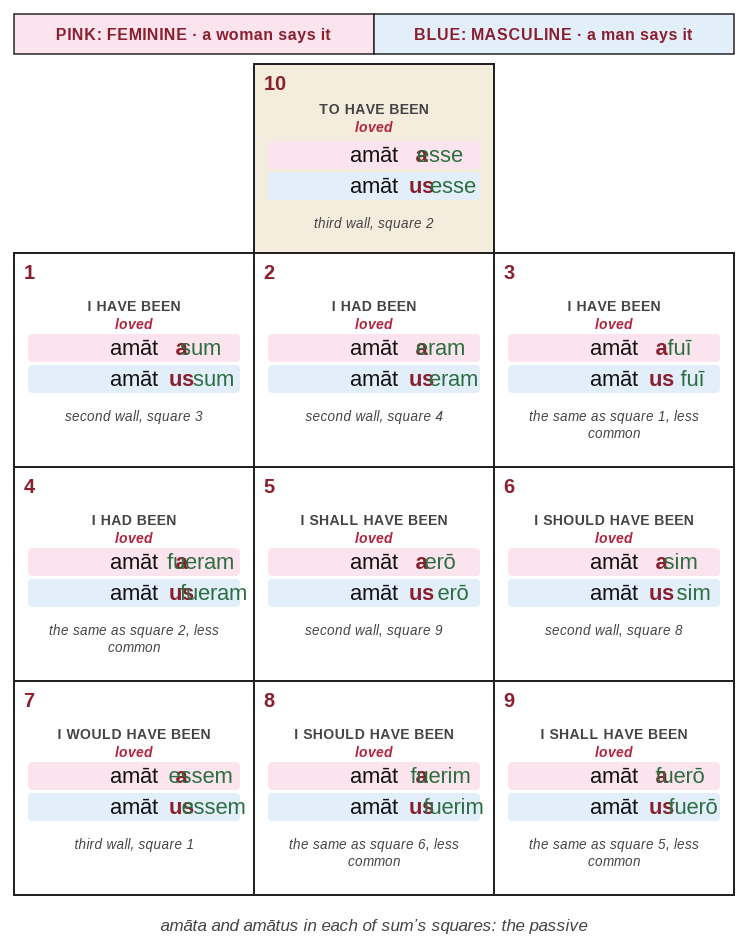
So in square 1, a woman says amāta sum, I have been loved; a man says amātus sum, I have been loved. The English is the same; only the Latin shows who is speaking.
Here are the same squares in full, with every person, singular and plural. In each square the pink column is the feminine and the blue column the masculine. The six lines go in the same order as for amō: I, you, he or she; we, you (all), they. The first three are singular, the last three (after the little gap) plural.
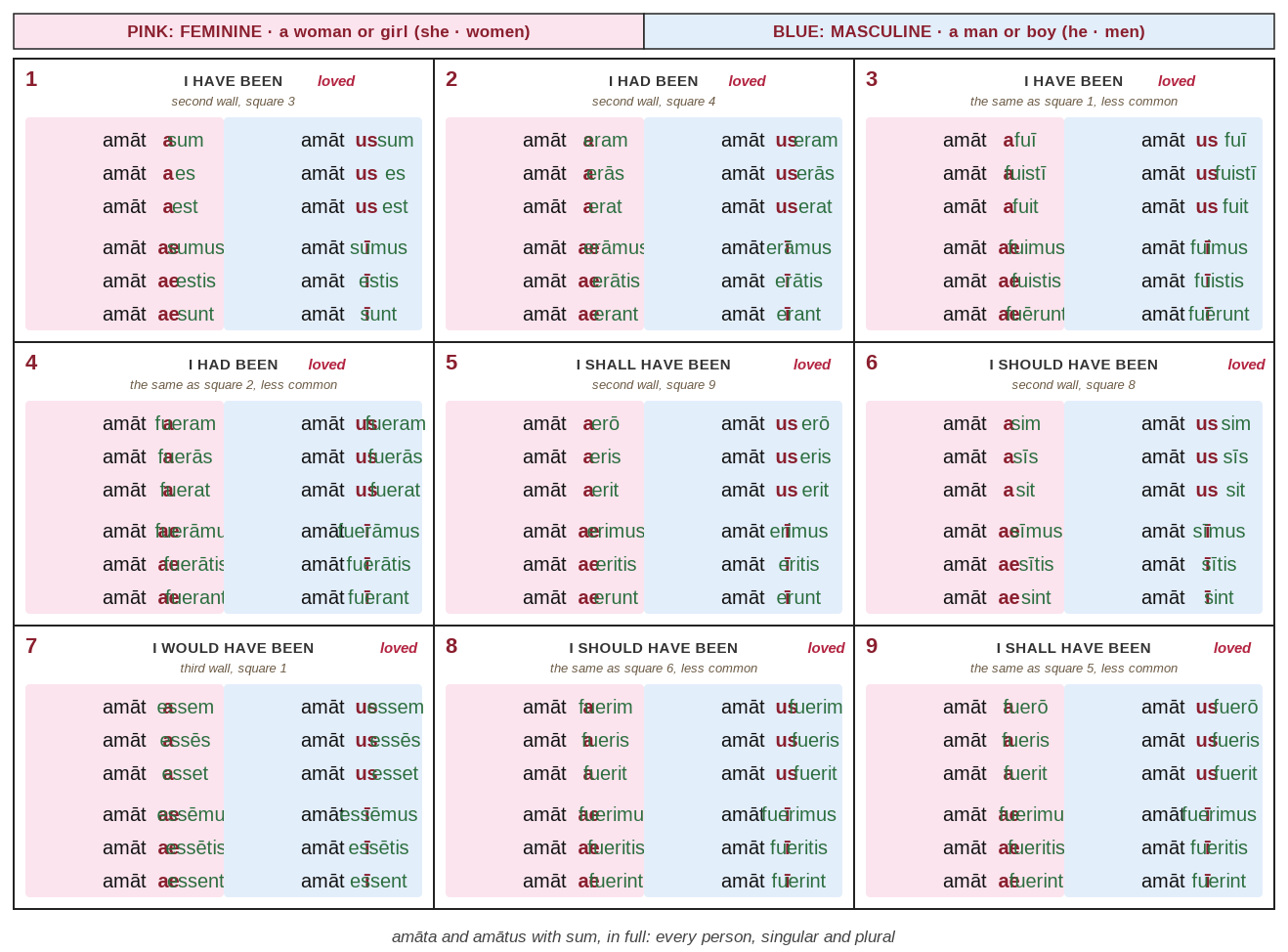
The ending of the participle now tells you about whoever the sentence is about, not only the speaker:
In the plural, -ae is a group of women or girls, and -ī a group of men or boys. For a mixed group, Latin uses the masculine -ī.
Notice that the tense moves. Sum in square 1 means "I am", but amāta sum or amātus sum does not mean "I am loved" (that is amor). It means "I have been loved", and it lives on the second wall, in square 3. Amāta eram or amātus eram, from square 2 of sum, means "I had been loved", and it lives in square 4 of the second wall.
The squares that begin with fu- (3, 4, 8 and 9) give a second way of saying the same thing: amāta fuī means much the same as amāta sum, and amātus fuī the same as amātus sum. The Romans used these less often, but you will meet them in your reading, and now you will recognise them.
A periphrastic form is one made from more than one word. The name is Greek: peri, around, and phrasis, a way of speaking. The Romans "talked around" the verb, using sum to help.
Put amātūra or amātūrus, about to love, in front of sum, and you have the active periphrastic: I am about to love, I am going to love, I intend to love. A woman says amātūra sum; a man says amātūrus sum. This time the tense does not move. Each form stays in sum's own square, with sum's own tense. Pink again for a woman speaking, blue for a man:
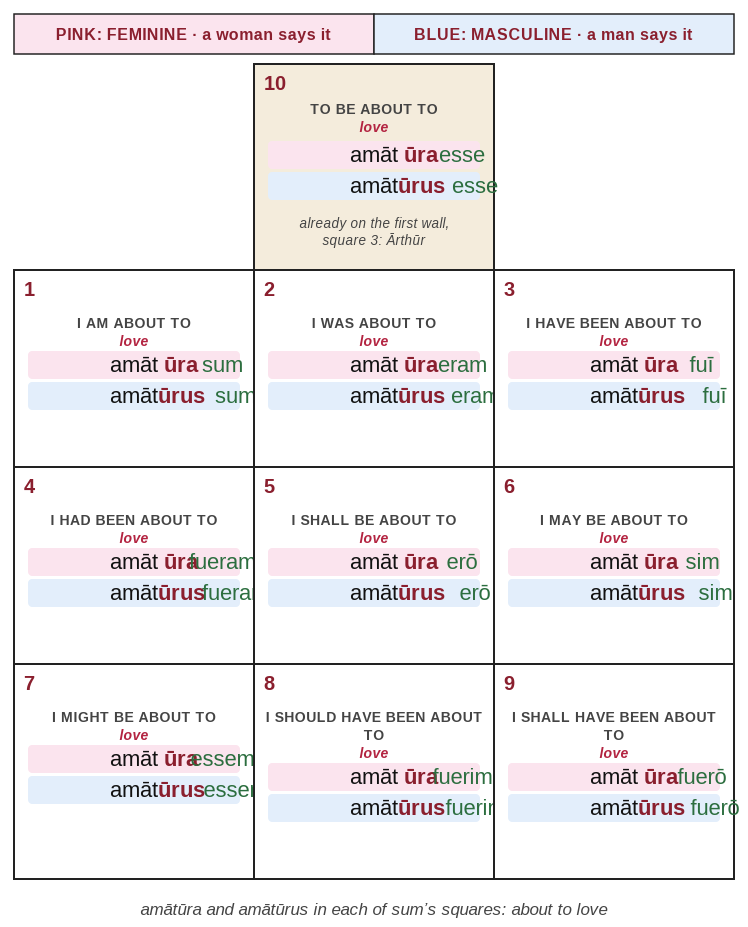
Square 2: a woman says amātūra eram, I was about to love; a man says amātūrus eram, I was about to love.
And in full, every person, singular and plural (pink feminine, blue masculine, in the same order as before):
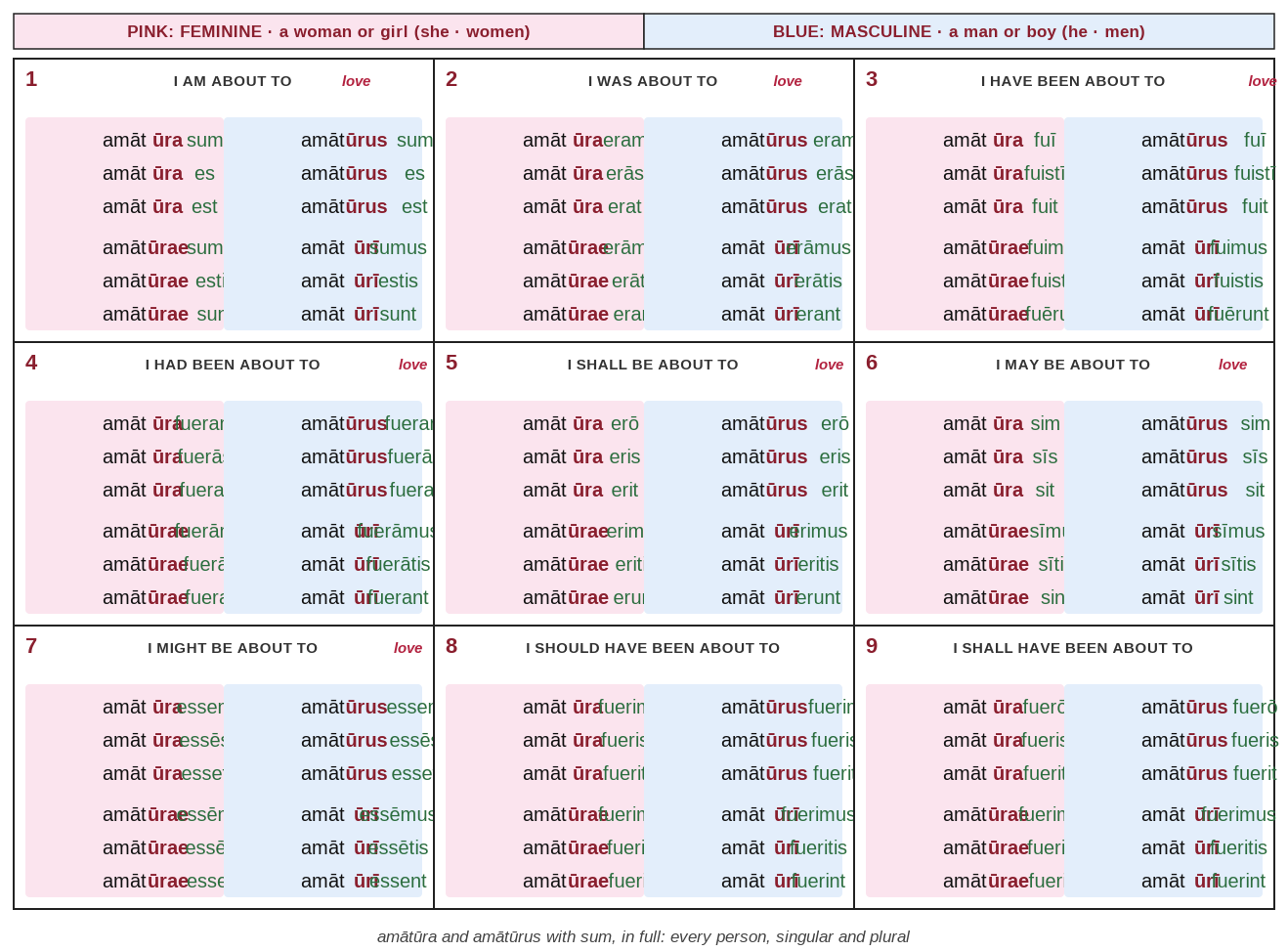
So amātūra est, she is about to love; amātūrus est, he is about to love; amātūrae sumus, we (women) are about to love; amātūrī sumus, we (men, or a mixed group) are about to love.
The most famous future participle in Latin is the greeting of the gladiators to the emperor, as Suetonius tells it: avē, imperātor, moritūrī tē salūtant, hail, emperor, those who are about to die salute you. Moritūrī is the future participle of morior, I die.
English has kept this ending too. Future is futūrus, about to be, from sum itself (first wall, square 6). Adventure is the later Latin adventūra, the things about to arrive. And nature (nātūra) and picture (pictūra, from pingō, I paint) are Latin nouns built in the same way.
Put amanda or amandus, to be loved, in front of sum, and you have the passive periphrastic: I am to be loved, I must be loved, I ought to be loved. A woman says amanda sum; a man says amandus sum. Again the tense does not move: each form stays in sum's own square. Pink for a woman speaking, blue for a man:
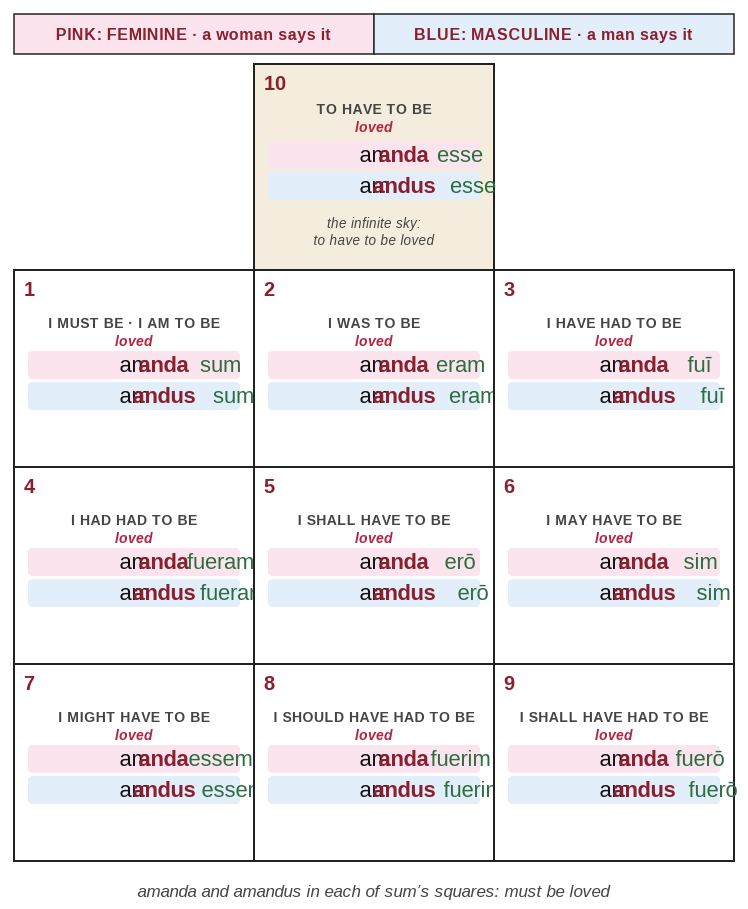
Square 5: a woman says amanda erō, I shall have to be loved; a man says amandus erō, I shall have to be loved.
And in full, every person, singular and plural:
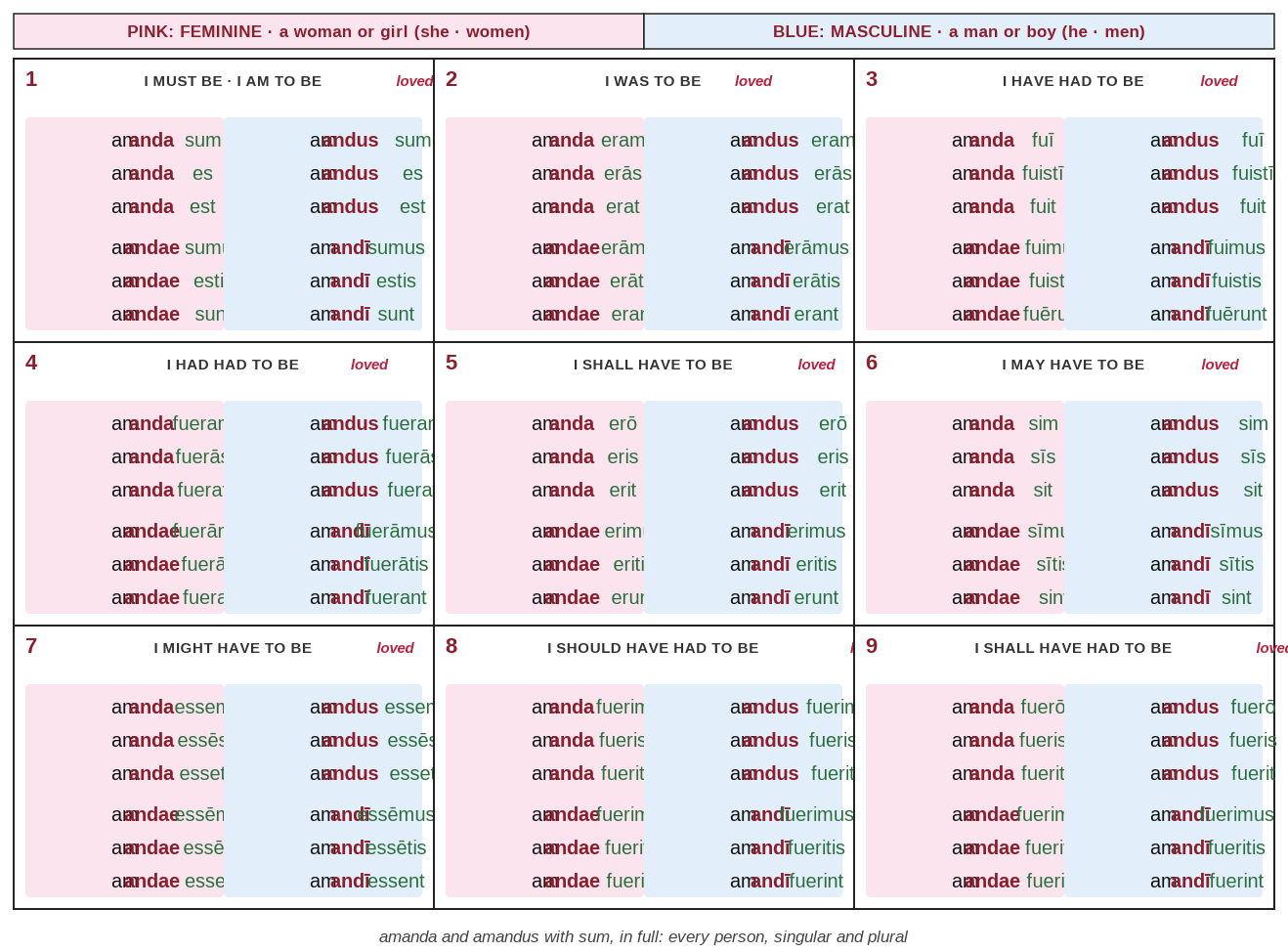
So amanda est, she must be loved; amandus est, he must be loved; amandae sunt, they (women) must be loved; amandī sunt, they (men, or a mixed group) must be loved.
The most famous example is the sentence with which Cato the Elder is said to have ended every speech in the Roman senate, whatever the subject: Carthāgō dēlenda est, Carthage must be destroyed. Dēlenda is feminine because Carthāgō is feminine.
The person who must do the thing goes in the dative: Carthāgō nōbīs dēlenda est, Carthage must be destroyed by us, we must destroy Carthage. And the neuter, amandum est, with nobody as its subject, simply means "one must love", "there must be loving": mihi amandum est, I must love.
English is full of these forms too. An agenda is a list of things to be done (agō, I do). A memorandum is a thing to be remembered, an addendum a thing to be added, a referendum a question to be referred to the people. And the girl's name Amanda is simply amanda: she who must be loved.

Memorising for Latin — Book Three: Verbs · Evan Millner · Published by Abecedaria Press