

Abecedaria Press · Memorising for Latin
Part Seven
Put a little word in front of sum, and you have a new verb. Ab, away, and sum make absum, I am away. Ad, at or near, and sum make adsum, I am here. The Romans made a whole family of verbs like this, and they are all very common.
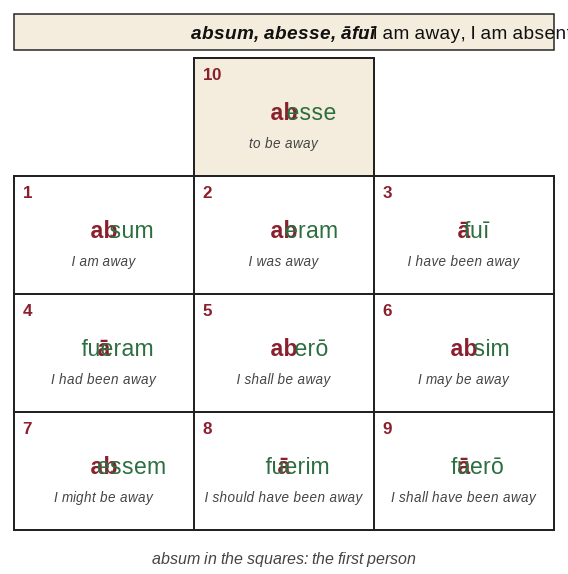
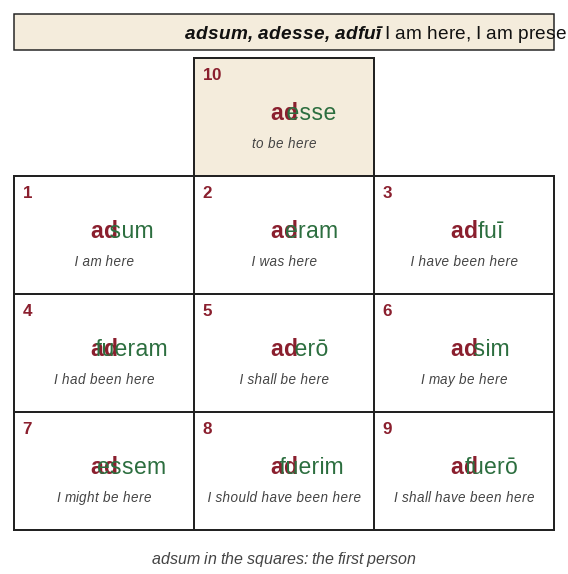
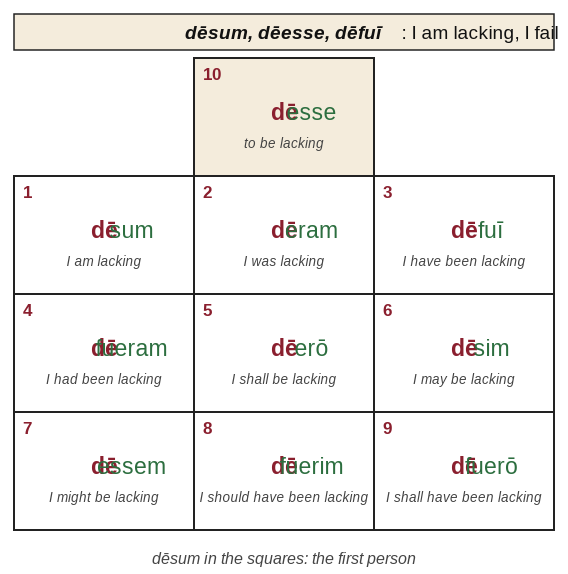
The good news is that you already know them. The little word stays the same, and the rest is simply sum, square for square: absum in square 1, aberam in square 2, āfuī in square 3, and so on. If you know sum, you know them all.
For these verbs we give only the first person, "I", in each square. You do not need more. Every other person follows sum exactly, and you can work it out yourself: if sum, es, est is square 1 of sum, then square 1 of absum is absum, abes, abest, and of adsum, adsum, ades, adest.
If you ever want to see every form written out in full, any Latin grammar book has them, and you can find dozens of old ones free on the internet, on Google Books and elsewhere. They lay out all the paradigms in full. We do not need them here. For memorising, all you need is the first person and its square; the rest follows by itself.
In each square below, the little word in front is in maroon, and the part that is sum is in green. The infinitive goes on the ceiling, in square 10, as before.
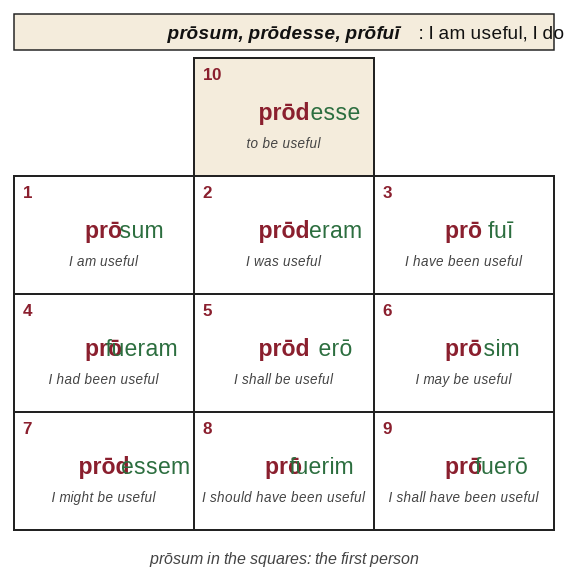
Possum is the most important of them, and the only one with a few surprises. It is pot- (able) and sum: "I am able". Before an s, the t turns into an s: pot-sum becomes pos-sum, pot-sim becomes pos-sim. Before a vowel it stays pot-: pot-eram, pot-erō.
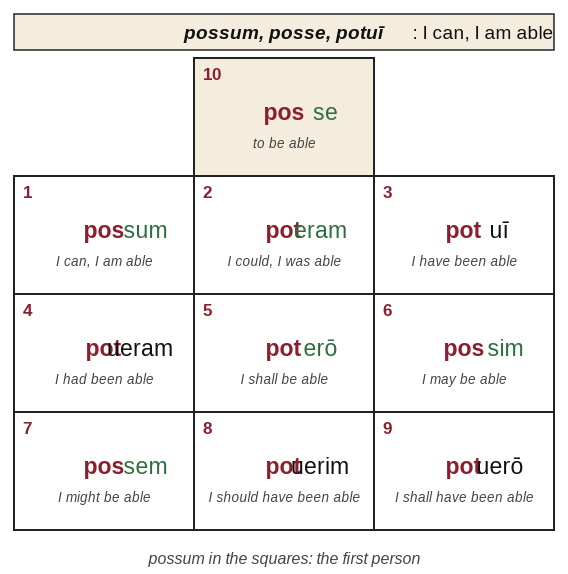
Three things to notice:
English has kept possum in possible and, through potēns, able, in potent and potential.
The rest are regular. Here they are, each with its little word, its meaning, and its squares.
absum, I am away, I am absent. Before f, ab becomes ā: āfuī, not "abfuī".
adsum, I am here, I am present. This is what a Roman pupil answered when the roll was called: adsum, here! The perfect is also spelled affuī.
dēsum, I am lacking, I fail. Note the two e's that meet in dēesse and dēeram.
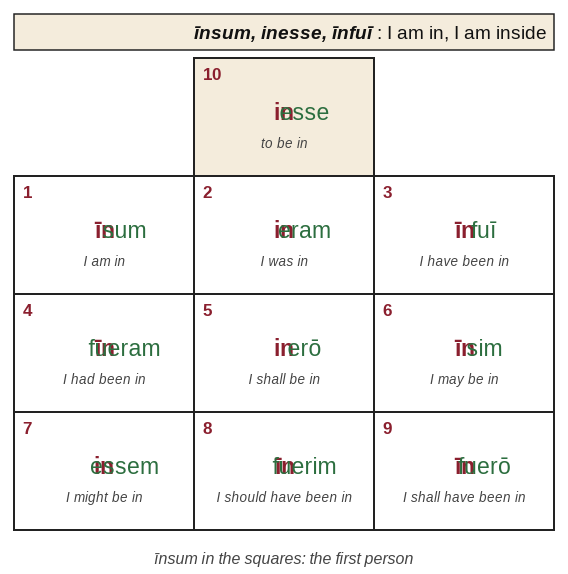
īnsum, I am in, I am inside. The i is long before s and f (īnsum, īnfuī), short before a vowel (inesse, ineram).
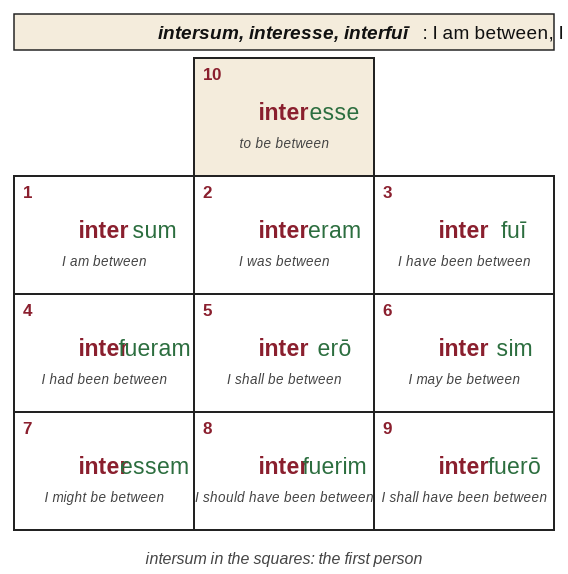
intersum, I am between, I am present at, I take part in. Its third person, interest, means "it matters", "it makes a difference", and gives us the English word interest.
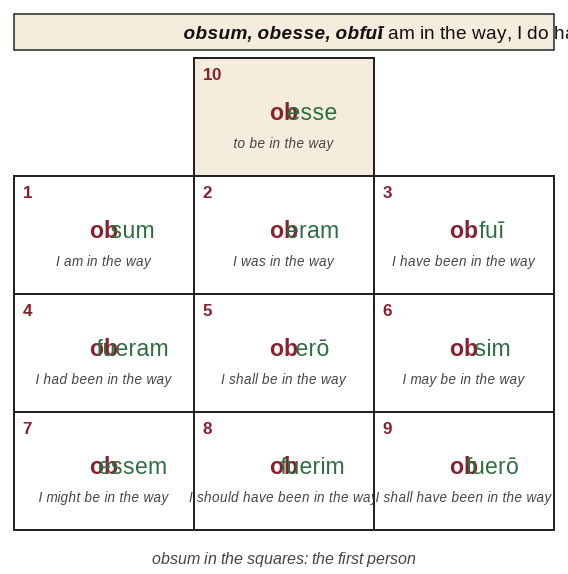
obsum, I am in the way, I do harm.
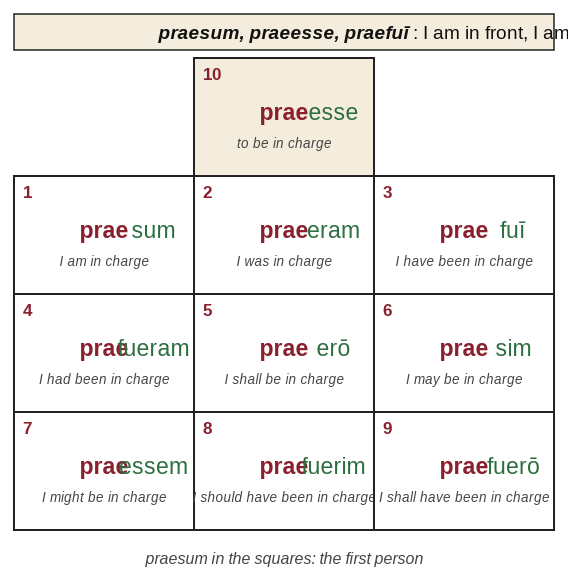
praesum, I am in front, I am in charge of. Note the two vowels in praeesse.
prōsum, I am useful, I do good. Before a vowel, prō becomes prōd-: prōdesse, prōderam, prōderō, prōdessem. Before s and f it stays prō-: prōsum, prōsim, prōfuī.
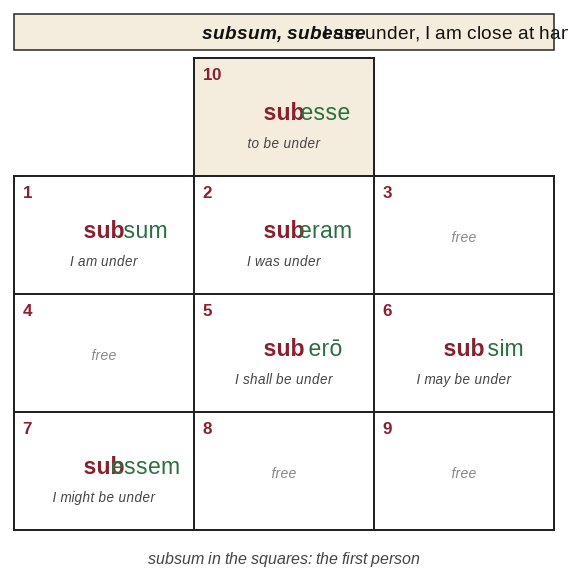
subsum, I am under, I am close at hand. It has no perfect, so its perfect squares are free.
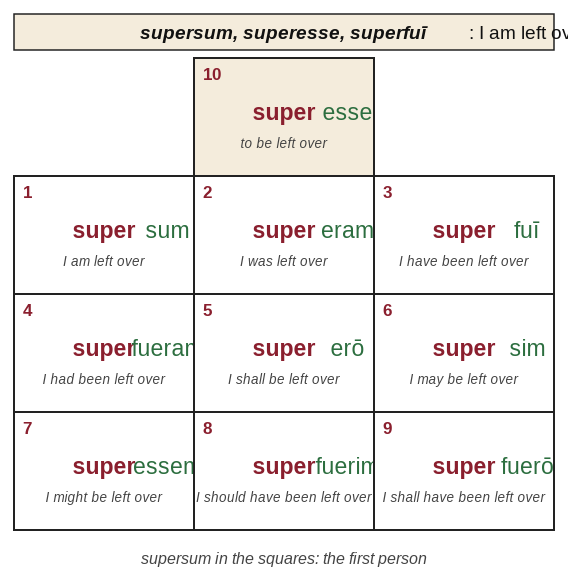
supersum, I am left over, I survive.
Sum itself has no present participle, but two of its compounds do: absēns, being away, and praesēns, being in front, being at hand. They are the English words absent and present. Every time you say a pupil is present or absent, you are speaking the Latin of these squares.
After the family of sum come the other irregular verbs: eō (I go), volō (I want), nōlō (I do not want), mālō (I prefer), ferō (I carry) and fīō (I become). Each goes into the same squares.

Memorising for Latin — Book Three: Verbs · Evan Millner · Published by Abecedaria Press