

Abecedaria Press · Methods to Remember
Part Four
In this part we will use the memory room to learn the elements of the periodic table, in the order of their atomic number.
Each square in the room has a number. So we do not need to remember the number of an element at all. We only need to find a way to put the element into its square. Then, if you want to know which element has atomic number 9, you just go to square 9 in your mind, and look in it. You will see what is there.
To do this well, you need a few skills. We will teach them to you one at a time.
Most names of elements are words that do not have a picture. You cannot see "helium". So the first skill is to turn a word that has no picture into a word that does have a picture.
Sometimes the picture is the thing itself, or something that uses it. Sometimes it is something that only sounds like the word, or reminds you of it.
Take helium. There are two ways we could remember it.
One way: the party balloons at a children's birthday party are often filled with helium. So we put a picture of a helium balloon inside the square. That balloon is helium.
Another way: the word helium begins like the word hell. So we make a picture of the devil. Perhaps the devil is also holding a helium balloon. We put him in the square, and that is how we remember what is in that square.
Here are some things that help:
Some people do not make pictures at all. They simply put the word itself into the square, and see it written there. That works too. Use the way that works best for you.
Here are the first ten elements, in order of their atomic number:
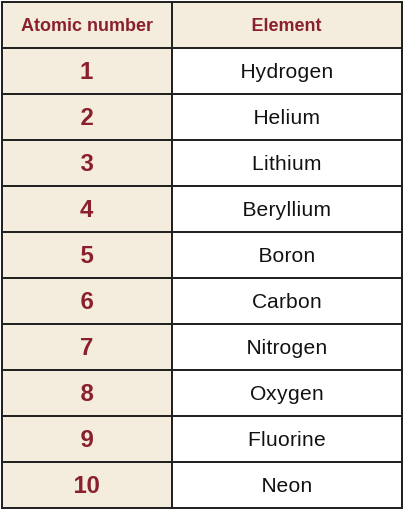
The first nine go on the floor. Number 10 goes in the tens square on the ceiling, above the first wall, on your left.
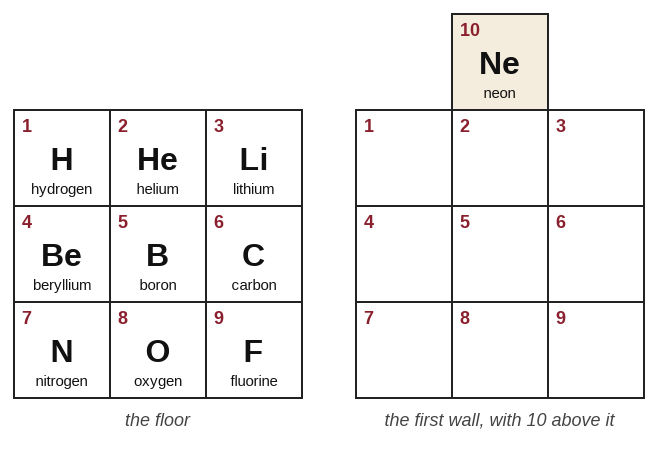
Sit in your room, in your usual place, in square 8. Now we will put each element into its square. For most of them we give you more than one picture. Choose the one you like best, or put two together.
1 — Hydrogen. Square 1 is on the floor, far away from you, on the left. Hydrogen begins like high, so put a ladder in square 1, because a ladder goes up high. Or put a fire hydrant there, the red pipe in the street that firemen use to put out fires. Or put both: a fire hydrant at the top of the ladder.
2 — Helium. Square 2 is in the middle of the far row. Here is the devil, laughing, holding a big helium balloon, the kind of balloon children have at a birthday party. That is helium.
3 — Lithium. Square 3 is far away on the right. Lithium sounds like light, so just imagine an electric light bulb, shining in square 3. Or imagine a battery, a lithium battery, if you know what one looks like.
4 — Beryllium. Square 4 is in the middle row, on the left. Beryllium sounds like berry, so you can put a berry there. Or perhaps you know a lady called Beryl, because Beryl is a lady's name. Imagine her, or any lady called Beryl, and what she looks like. She is eating a berry, and you put her in square 4.
5 — Boron. Square 5 is in the very middle of the floor. Boron sounds like boar, and also like bored. So make a picture of a boar, which is a male pig, sitting there looking very bored. Or just a picture of yourself, looking very bored, in square 5. And you can also bore a hole in something, so another way is to imagine a drill boring a hole in a piece of wood. That is boron.
6 — Carbon. Square 6 is in the middle row, on the right. Carbon is very simple: it sounds like car. Make a nice big car, and make sure it is a black one, because carbon is usually black. A black sports car, a Ferrari for example, comes zooming out of square 6. That is carbon.
7 — Nitrogen. Square 7 is in the row next to you, on your left. Nitrogen sounds like a knight in shining armour, like in the stories of King Arthur. There he is, beside you, clanking about in his noisy armour. Maybe he is sitting on a horse. That is number 7, nitrogen.
8 — Oxygen. Square 8 is where you are sitting. Oxygen begins like ox: a great big ox, with large horns. Maybe the ox is in a hospital, wearing an oxygen mask. But either way, that is your ox, ox for oxygen.
9 — Fluorine. Square 9 is next to you, on your right. That one is easy: fluorine sounds like floor, and there is fluorine in toothpaste. So imagine the floor of square 9 covered in toothpaste, with a tube of toothpaste sitting there too. That is fluorine.
10 — Neon. Square 10 is on the ceiling, above the first wall on your left. Neon is very simple: it sounds like knee. So just imagine a knee up there, and that is neon, number 10. Or, if you like, imagine a neon sign, the kind of bright sign used for advertising. Perhaps it is an advertising sign showing someone's knee. That is neon. ### How this works: a reminder
As you can see, we have done different things here to help us remember these words. Often we thought about what a word sounds like. Neon sounds like knee, so we made a picture of a knee. Helium sounds a little like hell. And lithium looks a little like light, if you look at the way the word is spelled. This is one good way to deal with a word that is strange and unusual.
So sometimes we have to change a word, and twist it a little, to make this work. The pictures are not always direct. We have to use our imagination, and be like poets of pictures. And the stranger the pictures are, the better.
This method was used for many hundreds of years, from the time of the ancient Romans. One reason it is not taught in schools today is a group of people called the Puritans, about four hundred years ago. They were very religious, and they had a great deal to do with the education of children in the English-speaking world. One of them, William Perkins, wrote against the method in England in the 1580s.
The Puritans did not like the idea of making funny pictures, because they did not like things that were funny. And the stranger and more unusual a picture is, the better you will remember it. Nobody can see into the heads of little boys and girls, but you can imagine what kind of pictures they might make in there! The Puritans did not like that at all. They could not see into the children's heads, and they did not want children thinking of strange pictures. And so the method stopped being taught in schools.
But we are teaching it again, because we do not mind if you make funny pictures in your head: strange pictures, weird pictures, unusual pictures. This is good. The stranger and more unusual your pictures are, the easier they will be to remember. And you do not have to tell anybody what they are. They are yours alone.
Now walk through the squares, from 1 to 10. Say the name of each element as you see it: hydrogen, helium, lithium, beryllium, boron, carbon, nitrogen, oxygen, fluorine, neon.
Now go backwards, from 10 to 1. It is just as easy, because you are only walking back through the room.
Now jump about. What is in square 7? What is in square 4? What is in square 10? Go straight to the square, look in it, and you will know.
Which element has atomic number 9? Go to square 9: there is the toothpaste. It is fluorine.
Here are the next nine elements:
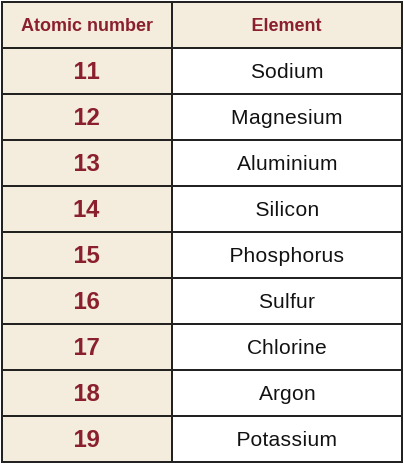
These go on the first wall, the wall on your left, under the 10 square. Remember how the wall works: turn to face it, and its squares are numbered just like the floor, 1 to 9, starting from the top left-hand corner. Because the 10 is above them, the 1 is really 11, the 2 is really 12, and so on up to 19.
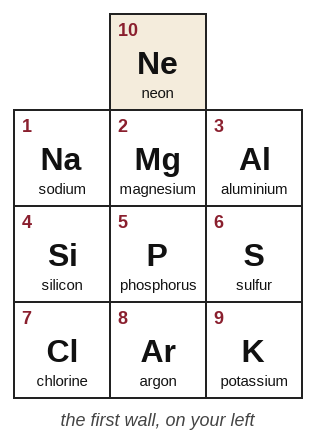
Turn to face the first wall, on your left. Above you, on the ceiling, the neon sign with the knee is still glowing. Now we fill the wall.
11 — Sodium. Top row, on the left. Notice that the symbol for sodium is Na. This is because in Latin this element is called natrium, and so we are going to remember that too. We need to remember that its symbol is not the same as the sound of its English name, sodium. There are historical reasons why these are different. So we picture natrium with a picture of nature: a tree, with little birds in it, and lots of other natural things around it. That reminds us of nature, and so of natrium. And the tree also has some soda bottles hanging from it, which remind us of sodium. Out in nature, there are some soda bottles: natrium, sodium, Na.
12 — Magnesium. Top row, in the middle, just under the neon sign. Magnesium begins like magnet. A huge magnet hangs on the wall, pulling knives and forks towards it. Or, because magnesium burns with a bright white light, imagine fireworks and sparklers.
13 — Aluminium. Top row, on the right. Kitchen foil and drinks cans are made of aluminium. Imagine a drinks can, wrapped in shiny kitchen foil.
14 — Silicon. Middle row, on the left. Silicon begins like silly, and the chips inside computers are made of silicon. So imagine a silly clown, with a computer chip on the end of his nose.
15 — Phosphorus. The very middle of the wall. There is phosphorus on the heads of matches, and phosphorus begins a little like fox. Imagine a fox striking a match.
16 — Sulfur. Middle row, on the right. We know that sulfur smells like rotten eggs, and the word sulfur has the word fur in it. So imagine a furry rotten egg. That would be a very strange thing indeed. Nobody knows what it would look like, but you can imagine it: a rotten egg, covered in fur, and smelling terrible. That is sulfur.
17 — Chlorine. Bottom row, on the left. Swimming pools smell of chlorine, and chlorine begins like claw. Imagine a small swimming pool on the wall, and a big crab's claw coming up out of the water.
18 — Argon. Bottom row, in the middle. Argon sounds like Aragorn, the hero of The Lord of the Rings: Aragorn, son of Arathorn, the wanderer who becomes a king. That is easy to remember. Just make a picture of him in that square. Or, if you do not know the story, imagine a pirate who shouts "Arrr!" and then disappears: he is gone. Arrr, gone: argon.
19 — Potassium. Bottom row, on the right. Here is an example of the kind of picture the Puritans did not like boys to make! Potassium begins with pot. And the bottom that you sit on is also called your ass. So you can imagine a person sitting on a pot, and that is your potassium. An ass is also a donkey, so you can imagine a donkey sitting on a pot instead. That also gives us potassium. And there is a lot of potassium in bananas. You probably did not know that, but now you do. So perhaps the donkey on the pot is eating a banana.
Now look at the symbol for potassium: it is K. Like sodium, potassium has a Latin name, kalium, and the K comes from that. To remember K, we use kale. Kale is a kind of cabbage with dark green leaves, eaten by people who like to keep very, very healthy. Kale for kalium.
The history of the word helps too. Potassium comes from the word potash. In the olden days, people made this chemical by burning leaves in a pot. The ash left over in the pot had potassium in it: pot-ash, potassium. So imagine kale leaves burning in a pot. That reminds you that the symbol K is for kalium, and it connects kalium to potash, and potash to potassium. You can even put the pictures together: the donkey is sitting on a pot in which kale leaves are burning.
Most school chemistry courses ask you to learn the first twenty elements, so we will finish with number 20. It goes in the tens square on the ceiling, above the second wall, the wall in front of you.
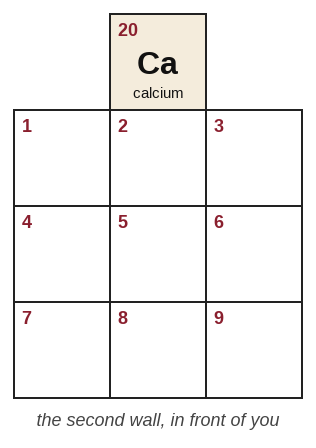
20 — Calcium. Look up, above the wall in front of you. There is calcium in milk, and it makes our bones and teeth strong. And calcium begins like calf, a young cow. So imagine a calf up there on the ceiling, drinking a big bucket of milk. Or imagine a skeleton, with big strong bones, drinking a glass of milk. Here is another way: Superman's real name, from his home planet Krypton, is Kal-El, and Kal sounds like the start of calcium. So imagine Superman flying across the ceiling above the wall in front of you. But instead of kryptonite, he is carrying calcium: a big glass of milk.
Now walk through the whole room so far, from 1 to 20: across the floor, up to the neon sign on the ceiling, along the first wall, and then up to the calf above the wall in front of you. Then go backwards, from 20 to 1. Then jump about: what is in square 15? What is in square 12? Which element has atomic number 17? And which is number 20?
You now know the first twenty elements of the periodic table, in order, and you can find any one of them in a moment. If you want to go on, there is plenty of room: the second wall holds 21 to 29, the third wall 31 to 39, and so on, and the room has fifty squares in all.
When you have learnt the first fifty elements, your room is full. Then open a door in the room, or just walk through the wall, as if by magic, into the next room. The next room holds 51 to 100, numbered in just the same way.
The next room can be any room you like. It could be a room in your house. It could be a classroom in your school. It could be a completely imaginary room that you make up. What matters is that you always go from one room to the next in the same order.
And if you make up lots of rooms, one after another, you can build something called a memory palace: a whole building in your mind, full of rooms, and every room full of things that you have learnt.

Methods to Remember — The Memory Room and the Major System · Evan Millner · Published by Abecedaria Press