

Abecedaria Press · Methods to Remember
Part Five
In the Introduction we said that you can use the memory room to learn a long poem. Now we will do it together.
The method is simple. Each line of the poem goes into one square of the room, in order: the first line in square 1, the second line in square 2, and so on. For each line you make a picture, or you simply put the words of the line in the square. When you want to say the poem, you walk through the squares, one by one, and each square gives you back its line. And because every square has a number, you will also know that line 9 is in square 9, and you can start the poem from any line you like, or even say it backwards.
Here is the poem we will learn. It is a sonnet by William Shakespeare, written more than four hundred years ago. A sonnet is a poem of fourteen lines, so it will fill the floor of your room (squares 1 to 9), the 10 square on the ceiling, and the first four squares of the first wall (11 to 14).
Sonnet 18
Shall I compare thee to a summer's day?
Thou art more lovely and more temperate:
Rough winds do shake the darling buds of May,
And summer's lease hath all too short a date;
Sometime too hot the eye of heaven shines,
And often is his gold complexion dimm'd;
And every fair from fair sometime declines,
By chance or nature's changing course untrimm'd;
But thy eternal summer shall not fade,
Nor lose possession of that fair thou ow'st;
Nor shall Death brag thou wander'st in his shade,
When in eternal lines to time thou grow'st:
So long as men can breathe or eyes can see,
So long lives this, and this gives life to thee.
William Shakespeare
Shakespeare wrote in an older kind of English. Here are the old words in this poem, and what they mean:
When we memorise a poem, we do not have to put the entire poem into the room. What we need is a hook: something that hooks each line of the poem to a square of the memory room. We do not need to make detailed pictures for every single word, because the poem rhymes, and it has its own shape and rhythm. Your mind only needs the hooks to hang the lines of the poem on.
So for each line, find the most important word, or the word that is easiest to picture, and make a picture of that. Then put the picture in the square. Here are our suggestions. They are only suggestions: you can change the pictures and make your own.
Sit in your room, in your usual place, in square 8.
Square 1 — "Shall I compare thee to a summer's day?" The most important thing here is a summer's day. So make a picture of that: a lovely summer's day, with the sun shining and the birds singing. It goes in square 1, on the floor, far away on the left.
Square 2 — "Thou art more lovely and more temperate:" Let us remember the word temperate. It reminds us of temperature, and so of a thermometer. Put a thermometer in square 2, and the thermometer is admiring itself in a mirror: such a lovely thermometer.
Square 3 — "Rough winds do shake the darling buds of May," Put a storm here, with heavy winds blowing. The darling buds, the flowers, are blowing off the trees in the springtime month of May.
Square 4 — "And summer's lease hath all too short a date;" That is simple: put a calendar in square 4.
Square 5 — "Sometime too hot the eye of heaven shines," In this square, put an eye, and it is hot: a burning hot eye, like the eye of the devil.
Square 6 — "And often is his gold complexion dimm'd;" Put some gold here. Perhaps a sleepy gold eye, half closed, its light growing dim.
Square 7 — "And every fair from fair sometime declines," Fair sounds like a fair, a fun fair. So put a Ferris wheel and some fair rides here. And the ride is going down, because it is declining.
Square 8 — "By chance or nature's changing course untrimm'd;" This is the square you sit in. Imagine a river changing its course: a winding stream, running round you.
Square 9 — "But thy eternal summer shall not fade," Here we can use the picture we had for summer before, in square 1. But this time it is fading out slowly, as at the end of a film. Perhaps put an hourglass there too, the glass with sand running through it, which is a sign of time running out.
Square 10 — "Nor lose possession of that fair thou ow'st;" This square is on the ceiling, above the first wall. A possession is something that you own, so imagine something of yours up there, such as your wallet or your bank card. And we have the fair again, so put the fun fair there too, with its Ferris wheel and rides.
Square 11 — "Nor shall Death brag thou wander'st in his shade," Now turn to the first wall, on your left: top row, on the left. Here we put a symbol of death: a skeleton, holding an umbrella to make some shade.
Square 12 — "When in eternal lines to time thou grow'st:" Top row, in the middle. Put railway tracks here: eternal lines, going on into the distance.
Square 13 — "So long as men can breathe or eyes can see," Top row, on the right. In this square, put some men, breathing deeply, and their eyes are blinking.
Square 14 — "So long lives this, and this gives life to thee." Middle row, on the left. Here, someone is giving something to someone else. They are giving life. How do you picture that? It is up to you, but they are giving it.
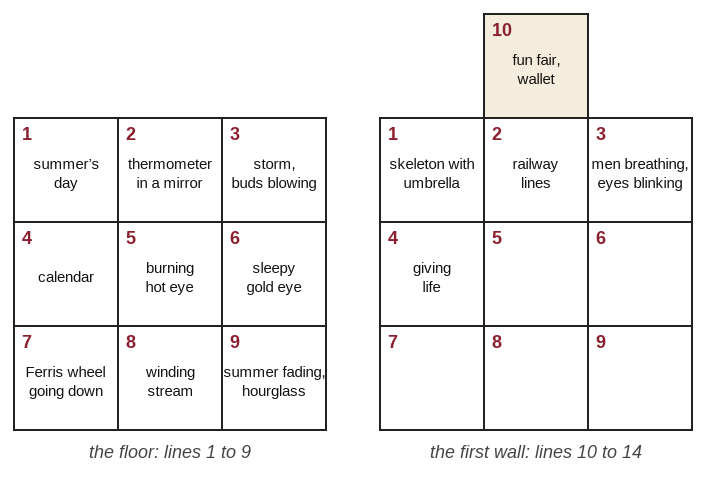
And that is it. You have made a picture for each line. Now walk through the squares, one by one. Look at the picture in each square, and say its line. That is how you remember the poem.
And now you can say the poem backwards, too. Once the pictures are in their squares, you can go to any square, look at its picture, and say the line that belongs to it. Start at square 14 and walk back to square 1. Or jump about: what is line 7? Go to square 7: there is the Ferris wheel going down, "And every fair from fair sometime declines." Once every picture is in its square, you can say any line of the poem, in any order.
The same method works for a speech. In the old days, people took pride in being able to give a long speech from memory. The Roman orator Cicero, and many other famous Romans, would speak for hours, and they used this system, or one very like it, to remember the main points of their speeches. The Greeks called each of these places a topos, which is where our word topic comes from. In Latin a place is a locus, and so in scientific books this way of remembering is called the method of loci, the method of places.
Here is a speech for you to try by yourself. It is the last paragraph of the Gettysburg Address, which Abraham Lincoln, the President of the United States, gave on 19 November 1863, during the American Civil War, at the opening of a cemetery for the soldiers who died in the battle of Gettysburg.
But, in a larger sense, we can not dedicate—we can not consecrate—we can not hallow—this ground. The brave men, living and dead, who struggled here, have consecrated it, far above our poor power to add or detract. The world will little note, nor long remember what we say here, but it can never forget what they did here. It is for us the living, rather, to be dedicated here to the unfinished work which they who fought here have thus far so nobly advanced. It is rather for us to be here dedicated to the great task remaining before us— that from these honored dead we take increased devotion to that cause for which they gave the last full measure of devotion— that we here highly resolve that these dead shall not have died in vain— that this nation, under God, shall have a new birth of freedom— and that government of the people, by the people, for the people, shall not perish from the earth.
Abraham Lincoln
This speech is quite difficult, because its ideas are abstract: they are not easy to turn into pictures. So you will need more squares than you might think. Break each sentence into two or three parts, and give each part its own square. Here is one way to divide it, into twenty parts. The first part has a picture to start you off. The rest is work for you to do yourself: find a hook for each part, and put it in its square. You can also divide the speech in your own way: sometimes a whole sentence in one square, sometimes a smaller part.
Twenty parts fill the floor (1 to 9), the 10 square on the ceiling, the first wall (11 to 19), and the 20 square on the ceiling above the wall in front of you.

Methods to Remember — The Memory Room and the Major System · Evan Millner · Published by Abecedaria Press