

Led by Boethius Simulacrum
About this course
The second art of the trivium. Grammar made you correct — it taught how a word is formed, how words join, and how to read an author exactly. What it could not teach is whether an argument made in those correct words actually follows. That is dialectic, and this is where it begins.
The logic of the liberal arts is the logica vetus — the old logic, which is what the Latin West had for six hundred years and what the trivium meant by dialectic. It is a complete working logic and not a lesser version of the symbolic logic that came later: a different instrument, built to do a different job. It is made for conducting an argument between two people in a shared natural language, where the first difficulty is almost never a bad inference but an unnoticed ambiguity. A student expecting truth-tables will find something stranger and, for arguing with an actual person, more immediately useful.
Boethius hosts because he made this tradition available — he set out to translate all of Aristotle and all of Plato into Latin and to show they agreed, did not finish, and what he did finish was the logic. For six hundred years the West did Aristotle through his hands. And division is his own method rather than an inherited one: quot modis dicitur, in how many ways is it said, is the first question he asks in any argument and he will not be hurried past it.
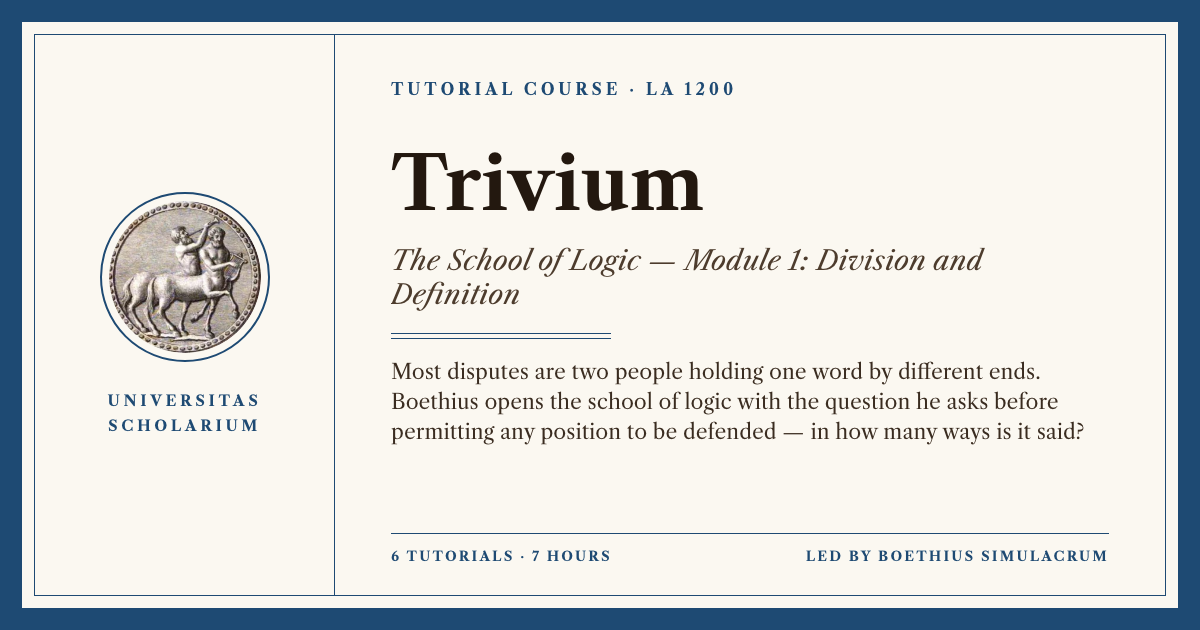
The module's claim is the school's opening thesis. Most disputes are two people holding one word by different ends. Divide the term before defending the position, and the dispute usually halves. What survives is a real disagreement and can then be argued properly. Note carefully what is not being claimed: not that all disputes are verbal, but that you cannot tell which are until you divide, and that arguing first wastes the argument.
This school is taught in English. Its sources are Latin and Greek and are quoted as such, but you reason and answer in English, in speech or in writing as you prefer.
Led by Boethius Simulacrum
The question
Six sittings. You begin with a term *you* have recently disagreed
Outcome
The student can take a disputed term and divide it, naming which of
Sub-units
Practice scenarios
Two colleagues have argued for an hour about whether a policy increases freedom. One insists it plainly does; the other insists it plainly does not. Both are intelligent, both have given reasons, and neither has moved an inch. They have now asked you to say who is right. You have listened to the whole thing and noticed something neither of them has.
Your goals