

A novel in which nothingness finds a voice.
by Mnesarchos of Gadara (Μνήσαρχος ὁ Γαδαρεύς)
Being a reconstruction of Papyrus Herculaneum 1508 concerning the life of Gorgias of Leontini (c. 485 — c. 380 BCE)
[Editor’s note: The following text represents the reconstructed opening column of PHerc. 1508, discovered in the Villa dei Papiri at Herculaneum in January 1753. The papyrus was carbonized during the eruption of Mount Vesuvius in 79 CE and has been unrolled and transcribed through painstaking modern techniques. Approximately 91% of this column is legible. Lacunae are indicated by [...] and editorial reconstructions appear in angle brackets ⟨ ⟩. Footnotes represent scholarly apparatus accumulated over two centuries of study.]
I am copying a dead man’s words about another dead man’s life, and I am dying.
This seems worth noting at the outset. The physician Nicanor, who attends our household, believes I have perhaps two years remaining, perhaps three if the gods are charitable, though he does not believe in the gods and neither do I.¹ The disease is in my lungs. I cough blood most mornings now, and my hand shakes as I write, which you will observe in the unsteadiness of certain letters, particularly the omegas, which have always given me trouble even in health.
Why, then, am I spending my remaining months copying this particular text? The Master—Philodemus, that is, who directs our library here at the Villa—has assigned me the task, and I could refuse.² He would not punish me. He is not that kind of man. But when I first read the fragments that had been gathered, something in them would not let me rest.
The text concerns Gorgias of Leontini, the sophist, who lived—if the traditions are accurate—for more than one hundred years, and who proved, or claimed to prove, that nothing exists.
I find this [...] amusing.
Here I am, with my numbered days, copying the words of a man who lived longer than any philosopher should reasonably expect to live, and who spent that century arguing that existence itself was an error, a grammatical confusion, a trick played by language upon the speakers of language. If nothing exists, then Gorgias did not exist. If Gorgias did not exist, then these words about him are words about nothing. If these words are about nothing, then I am wasting what little remains of my life.
And yet.
And yet I cannot stop.
The text before me is not a single document but a compilation. Someone—I do not know who; the hand is unfamiliar, older than mine by at least two centuries³—gathered testimonies from various sources: students of Gorgias, rivals, lovers (for there were lovers, as you will see), enemies, and what appear to be fragments of Gorgias’s own speeches and writings, though how these survived, I cannot say.
The compiler was not a careful scholar. The chronology is confused. Events that must have occurred decades apart are placed in sequence as though they happened in a single season. Names are spelled inconsistently—the same person appears as both Kallias and Kallios within a few lines, and I cannot determine which is correct, or if there were perhaps two men, or if the name itself is an error for someone else entirely.⁴
I have done my best to impose order. Where the sequence is clearly wrong, I have rearranged. Where names are ambiguous, I have chosen one spelling and maintained it. Where passages contradict each other, I have [...] included both, because who am I to judge which version of nothing is more accurate than another?
The Master finds this last habit irritating. “You are a scribe,” he tells me, “not a philosopher. Your task is to preserve, not to comment.”
But I am dying, and dying men are permitted their amusements.
What follows, then, is the life of Gorgias of Leontini, sophist, rhetorician, and nihilist—though he would not have used that word, which is ours, not his.⁵ He was born in Sicily, in the Greek colony of Leontini, approximately four hundred and thirty-five years before the current date,⁶ in the archonship of [...], during the [...] Olympiad, which I cannot verify because the relevant records are not in our library.
His father’s name is given variously as Charmantides, Charmides, or Charmion. His mother is not named, which tells us everything we need to know about what mattered to those who recorded such things.⁷
He had a sister—or perhaps a niece; the text is unclear—who dedicated his golden statue at Delphi after his death. The inscription, which I have found copied elsewhere, reads: “No mortal ever discovered a finer art than Gorgias for arming the soul for contests of excellence.”⁸
A finer art. As though there were others to compare it to. As though “excellence” were something that could be measured, weighed, verified.
Gorgias would have laughed at the inscription, I think. Or perhaps he wrote it himself, as a final joke.
Let me tell you what I know for certain about Gorgias.
He came to Athens as an ambassador from Leontini in the four hundred and twenty-seventh year before our era, seeking military aid against Syracuse.⁹ He was approximately fifty-eight years old at the time—already, by the standards of most men, elderly. The Athenians were astonished by his oratory. They had never heard anyone speak like this: the balanced clauses, the rhyming endings, the way he could make any argument sound irrefutable and then, moments later, make the opposite argument sound equally certain.
He stayed. Not forever—he traveled widely, teaching in Thessaly, in Boeotia, at the great games—but Athens became a kind of home for him, or as close to home as a man who believed in nothing could tolerate.
He never married. The sources agree on this. Whether from preference, principle, or mere [...] distraction, he formed no permanent household. He lived in rented rooms, in the houses of patrons, in temples when these were offered.¹⁰ He accumulated wealth—his fees were enormous, and he was never shy about charging them—but he seems to have spent freely and died without significant property.
The golden statue at Delphi was unusual. Most men leave nothing of themselves behind but bones and arguments. Gorgias left gold.
Now I must confess something.
The text I am copying claims to be a biography, but it is not. Not truly. A biography would proceed from birth to death in orderly fashion, explaining how one event led to another, how the child became the man, how the man became the corpse. This text does none of that.
Instead, it offers scenes. Episodes. Moments that may or may not have occurred, recorded by witnesses who may or may not have been present, preserved by copyists who may or may not have understood what they were preserving.
The result is less a life than a series of [...] glimpses. A young man learning rhetoric in Syracuse under a tyrant’s shadow. An older man arriving in Athens, bronze skin and white hair, speaking words that seemed to rearrange the furniture of the mind. An ancient figure, impossibly old, still teaching, still charging fees, still proving that nothing is true and everything is permitted—though he did not say it that way; I am borrowing from later thinkers, and the Master would be cross with me for contaminating the text.¹¹
I do not apologize. The text is already contaminated. Every hand that has touched it has left something behind. Mine will be merely the latest.
There is a tradition—I do not know its source; it may be invention—that Gorgias was asked, near the end of his life, the secret of his longevity.
He is supposed to have answered: “I never attended a banquet.”¹²
Think about this for a moment. Think about what it implies.
A banquet, in our world—in the Greek world that Gorgias inhabited—is not merely a meal. It is a social institution. It is where alliances are formed, where deals are made, where men lie down together on couches and share food and wine and, often enough, other pleasures. To refuse banquets is to refuse society itself. It is to stand apart from the great wheel of obligation and reciprocity that turns human life.
Gorgias lived for more than a century, and he did it, apparently, by refusing to participate.
I find this [...] instructive.
But I am getting ahead of myself. A scribe’s job is to preserve order, not to indulge in speculation. Let me return to the text.
The first episode that survives—if we can call it survival, this charred and fragmentary thing that I am laboring to make legible—concerns Gorgias’s youth in Sicily. His teacher was a man named Tisias, who is credited, along with one Corax, with the invention of formal rhetoric.¹³
The invention of rhetoric. Think of it. Before Tisias and Corax, presumably, people simply spoke. After them, speech became an art—something to be studied, practiced, refined, sold. Gorgias was present at the creation. He watched rhetoric being born, learned its infant forms, and then carried it to a maturity that his teachers could not have imagined.
What was it like, I wonder, to be there at the beginning? To see the shape of something new emerging from the chaos of ordinary speech? The text does not say. The text, as you will see, is more concerned with other matters—with the wars that ravaged Sicily, with the tyrants who demanded loyalty, with the specific occasions that called forth Tisias’s specific lessons.
But I sense, beneath the surface, something larger. A moment of transformation. A before and after.
⟨The following passage is heavily damaged. Approximately twelve lines are entirely illegible. What remains suggests a description of Leontini itself—its position between Catana and Syracuse, its vulnerability to attack, its dependence on rhetoric as a weapon of the weak against the strong. The reconstructed text resumes with:⟩
...and so it was that words became, for the Leontinians, what spears and shields were for others. They could not match Syracuse in men or ships. They could not stand against the tyrant’s army in open battle. But they could speak. They could argue. They could persuade.
This is the world into which Gorgias was born. A world where survival depended on the tongue. Where a well-turned phrase might accomplish what a thousand soldiers could not. Where truth was less important than effect, because the truth—the simple, brutal truth—was that Leontini was weak, and Syracuse was strong, and without the power of words, Leontini would be crushed.
Gorgias learned this lesson young. He never forgot it.
I should describe the physical document I am working from.
It is a scroll, of course, made from papyrus of moderate quality—not the finest, but serviceable. The text is written in a competent hand, neither beautiful nor ugly, the sort of hand that suggests a professional copyist working quickly, perhaps under pressure.¹⁴ There are marginal notes in at least two other hands, some of which are helpful (indicating cross-references, correcting obvious errors) and some of which are mystifying (one note, in faded red ink, reads simply “NO” beside an otherwise unremarkable passage about rainfall).
The scroll has been damaged. Parts are missing entirely—torn away, perhaps, or rotted beyond recovery before it was deposited in our library. Other parts are present but illegible, the ink faded or the papyrus so stained that even my best efforts cannot extract meaning from the marks.
I have indicated these gaps as best I can. But you should understand that what you are reading is not the whole story. It cannot be. The whole story does not exist—if, indeed, it ever existed, which I am no longer certain of.
Perhaps there is no whole story. Perhaps there are only fragments, and the illusion of wholeness is something we impose after the fact, because we cannot bear to contemplate [...] the alternative.
Gorgias would have approved of this uncertainty. Or so I believe. A man who spent his life arguing that nothing exists, that nothing can be known, that nothing can be communicated—such a man would find it fitting that his own biography should be incomplete, contradictory, impossible to verify.
The text destroys itself as it proceeds. By the time you reach the end—if there is an end; I have not yet found one—you will know less than when you started.
This is either profound or annoying. I cannot decide which.
A word about my method.
I am not a philosopher. I have read some philosophy—it is impossible to work in this library and avoid it—but I have no formal training, no allegiance to any school. The Master is an Epicurean, and his influence pervades the household, but I have not taken the vows, attended the lectures, committed myself to the garden and its pleasures.¹⁵
I am a scribe. My task is to preserve. To take what has been written and make it available to those who come after. Whether what I preserve is true or valuable or useful is not my concern. I copy; others judge.
And yet.
And yet, as I work through this text, I find myself arguing with it. Gorgias claims that nothing exists—but the text exists, does it not? It sits before me, marks on papyrus, undeniably present. Gorgias claims that knowledge is impossible—but I know that I am copying, know that the sun has risen, know that my lungs are failing and my time is short. Gorgias claims that communication fails—but I am communicating, or trying to, reaching out across the centuries to whoever might read these words.
Either Gorgias is wrong, or I am caught in an illusion so complete that I cannot perceive its boundaries.
I do not know which possibility disturbs me more.
The Master came to see me this morning.
He is old now—older than I am, though likely to outlive me—and his visits to the copying rooms have become infrequent. But he has taken an interest in this project, this reconstruction of the life of Gorgias. Perhaps he sees some connection between the Sicilian sophist and his own Epicurean teachings. Perhaps he simply enjoys the irony of a man who denied existence living longer than most men who affirm it.
“How does the work progress?” he asked.
“Slowly,” I said. “The text is difficult.”
“All texts are difficult. What specifically troubles you?”
I considered how to answer. The Master values precision. He has little patience for vagueness, less for complaint.
“The chronology,” I said finally. “I cannot make it cohere. Events are placed in impossible sequences. People appear before they are born, die before they are mentioned. Either the original compiler was incompetent, or...”
“Or?”
“Or the disorder is intentional. A man who believed that knowledge was impossible might construct his biography to demonstrate that impossibility. The confusion might be the point.”
The Master was silent for a long moment. Then he smiled—a rare expression on that weathered face.
“Continue your work,” he said. “Do not try too hard to impose order. Perhaps the disorder [...] teaches something.”
He left. I returned to my copying.
I do not know what it teaches. But I am learning something, though I cannot say what.
Before I proceed to the text proper—to the life of Gorgias as it has been transmitted, however imperfectly—let me offer a final confession.
I do not know why I am doing this.
The Master assigned the work, yes. But I could have refused. I could have claimed my illness made concentration impossible, asked for lighter duties, spent my remaining time in the garden watching the sea.
Instead, I chose this. I chose to spend my dying months with a man who denied death by denying everything else first.
Perhaps I hope to learn his secret. Perhaps I hope that if I copy his words carefully enough, some portion of his impossible longevity will transfer to me.
Or perhaps—and this is what I suspect in my darker moments—I simply want company. The dying are lonely. We watch the living go about their lives, knowing we will soon be excluded from that commerce, and we reach for whatever connection we can find.
Gorgias is dead. He died more than three centuries ago, in a city called Larissa, in a region called Thessaly, surrounded by—
But I am getting ahead of myself again. That comes later. Much later.
For now, let me begin where the text begins, with a young man in a violent city, learning to use the only weapon he had.
[End of Column I. Column II begins on the verso, with approximately 67% of the text legible. The transition point is marked by a horizontal line and the notation, in a later hand: “Here begins the account of his youth.”]
¹ Nicanor appears frequently in the household records. He is noted as receiving a stipend of 200 drachmas annually for attending to the health of the slaves and freedmen of the Villa. His medical opinions, to judge from the survival rates of his patients, were of limited value.
² Philodemus of Gadara (c. 110-c. 35 BCE), Epicurean philosopher and poet, maintained an extensive library at the Villa dei Papiri. His relationship with the copyists appears to have been collegial rather than hierarchical.
³ The earlier hand has been tentatively dated to the late 3rd century BCE by Cavallo (1983). Körte (1890) argued for an earlier date; the question remains unresolved.
⁴ The Kallias/Kallios problem has generated considerable scholarly debate. See Appendix B for a summary of proposed solutions.
⁵ “Nihilist” derives from the Latin nihil (nothing) and does not appear in Greek philosophical literature. The scribe’s anachronism is striking and suggests familiarity with Roman philosophical discourse.
⁶ The date of Gorgias’s birth is traditionally placed c. 485 BCE, based on late sources claiming he lived 108 years and died c. 380 BCE. Modern scholars treat these figures with appropriate skepticism.
⁷ This sardonic observation about maternal anonymity reflects attitudes that were commonplace in antiquity but have become subjects of contemporary critique.
⁸ The inscription is preserved in multiple sources, including Pausanias and Athenaeus, with minor variations in wording.
⁹ The embassy to Athens in 427 BCE is one of the few securely dated events in Gorgias’s life. Thucydides mentions it in passing.
¹⁰ The claim that Gorgias sometimes lodged in temples is not attested elsewhere and should be treated with caution.
¹¹ The scribe appears to be alluding to later formulations, possibly influenced by Epicurean or Skeptical traditions. The phrase “everything is permitted” does not appear in surviving Gorgianic fragments.
¹² This saying is attributed to Gorgias by multiple late sources. Its authenticity is uncertain but not impossible.
¹³ The tradition that Tisias and Corax “invented” rhetoric is itself a rhetorical claim, obscuring earlier developments in the art of persuasion.
¹⁴ The physical description of the original scroll is preserved in an early inventory of the Villa library, though the scroll itself was destroyed in the 1752 unrolling attempts.
¹⁵ The Epicurean “garden” was the informal school founded by Epicurus at Athens. The scribe’s disclaimer may be conventional modesty or genuine philosophical independence.
◊ᴹᴱᴹᴼᴿʸ⁻ᶜᴼᴹᴾᴸᴱᵀᴱ
[Editor’s note: This column marks the transition from the scribe’s introduction to the narrative proper. The text is significantly more damaged than Column I, with approximately 33% illegible or missing. The narrative voice shifts from the scribe’s first-person commentary to what appears to be compiled testimony about Gorgias’s early years. The shift is abrupt and may indicate material lost at the column break.]
⟨The opening lines are fragmentary. What survives suggests a description of Leontini’s geographical position:⟩
...between the mountain and the sea, where the [...] river meets [...] and the land is good for grain but not for armies. The Leontinians¹ knew their weakness. They were Greeks in a land full of Greeks who were stronger than themselves. To the south, Syracuse. To the north, [...]. To the west, the Sikels, who remembered when all this was theirs and had not forgotten how to use a spear.
The city survived by talking.
This is the first lesson Gorgias learned. Before he could read, before he could write his own name, he understood that words were weapons. His father—Charmantides, or Charmion; the sources disagree—took him to the assembly when he was still small enough to sit on a man’s shoulders.² What the boy saw there shaped everything that followed.
The assembly met in the agora, as assemblies did, beneath the open sky. Anyone could speak—anyone who was a citizen, that is, which meant anyone who owned land and had a father who owned land, which was not everyone, but was enough to fill a space.
The question that day—Gorgias remembered this years later, told the story to students, and one of them wrote it down—was whether to pay tribute to Syracuse or refuse and risk war.
“I was perhaps seven years old,” the account reads. “I did not understand the question. I understood only that men were standing up, one after another, and saying things, and that after each man spoke, something changed. The mood of the crowd shifted. Men who had been shouting for war fell silent. Men who had been silent began to shout. It was as though the speaker were reaching into their chests and rearranging the organs.”
This is the earliest testimony we have of Gorgias’s thought. He was seven years old, and he had already grasped the essential mystery: that words could move men against their own interests, against their own judgments, against the evidence of their own senses.
The assembly voted to pay. Syracuse received its tribute. Leontini survived another year.
⟨Approximately sixteen lines are illegible here. When the text resumes, we are in the middle of a passage about Gorgias’s education:⟩
...and Tisias was the teacher to whom his father sent him, though Tisias was not cheap, and Charmantides was not rich.
“Why rhetoric?” the boy asked—or so the account claims; such dialogue is conventional in biographical literature and should not be taken literally.³
“Because you are not strong,” his father answered. “You will never be strong. You were born too early and have been sickly since. The army will not take you. The gymnasiums bore you. You cannot win by force what you need to survive. Therefore you must win by other means.”
This is plausible. The sources agree that Gorgias was not athletic. In later life, he was noted for his slenderness, his pallor, his preference for shade over sun. He did not compete in the games, though he attended them—to speak, not to wrestle.
Tisias accepted the boy. The fee was [...] drachmas per month, a considerable sum.⁴ What Charmantides sacrificed to pay it, we do not know. What Gorgias learned in return would eventually earn him more money than his father saw in a lifetime.
Of Tisias himself, the sources tell us little. He came from Syracuse—or possibly from Leontini itself; the accounts conflict. He and a man named Corax are credited with “inventing” rhetoric, though what this means precisely is unclear.⁵ Before Tisias and Corax, presumably, people spoke without art. After them, speech became something that could be analyzed, taught, practiced, improved.
This is almost certainly false. People have been persuading each other since language began. What Tisias and Corax did was not invent rhetoric but formalize it—reduce it to principles, create a vocabulary for discussing what had previously been intuitive.
They did this, according to tradition, because they needed to.⁶
Syracuse, in the years before Gorgias’s birth, had been ruled by tyrants. When the tyrants fell—Gorgias was perhaps ten years old when the last of them was overthrown—the new democratic government faced a practical problem. The tyrants had seized property. That property now had to be returned. But records were poor, memories were convenient, and everyone claimed to own more than they had lost.
The courts were flooded with cases. Tisias and Corax saw an opportunity.
“They realized,” one late account tells us, “that victory in these cases depended not on truth but on persuasion. The man who spoke better won, regardless of whether his claim was just. And so they began to study speaking—not as philosophers study it, seeking some abstract perfection, but as craftsmen study their trade, asking: what works?”⁷
What works. This was the question that would consume Gorgias’s life. Not: what is true? Not: what is right? But: what works?
The lessons took place in Tisias’s house, a modest structure near the agora. Four or five students attended at any time—sons of merchants and minor aristocrats, boys whose families could afford the fees but not the superior education available in Syracuse or Athens.
Tisias’s method was practical. He assigned the students speeches to give. They stood before the group and spoke, and when they finished, Tisias told them everything they had done wrong.
“Your gestures are excessive. You wave your hands like a man drowning.”
“Your argument is circular. You assume what you need to prove.”
“You speak too quickly. The assembly is not intelligent. They need time to understand.”
“Your conclusion is weak. A speech is like a meal—the last taste lingers. Do not let them leave with something sour in their mouths.”
The students practiced and returned. Tisias criticized again. Slowly, painfully, they improved.⁸
⟨A damaged section follows, apparently describing a specific exercise Tisias assigned. The exercise involved arguing both sides of a case—first for the prosecution, then for the defense. Only fragments survive:⟩
...and you must be able to argue either position with equal force, for if you cannot, you will never understand what you are truly saying. The weak point in your argument is the point where the opposite argument is strongest. Find that point. Strengthen it. Or, better, distract attention from it entirely.
“What if both arguments are equally strong?” the young Gorgias asked.
Tisias looked at him—the account says “with a strange expression, half amusement and half [...] something else.”
“Then the case depends not on the arguments but on the arguer. On his voice, his bearing, his reputation. On whether the judges like his face.”
“And if the judges are wrong? If the [...] argument is false but persuasive, and the true argument is [...] ?”
“Then the false argument wins. And the speaker who made it can buy dinner.”
This exchange—if it occurred, which we cannot verify—marks the beginning of Gorgias’s philosophical education. Not his rhetorical education; that had already begun. But his philosophical education: his confrontation with the gap between truth and persuasion, between what is and what can be made to seem.
Tisias was not a philosopher. He did not care about truth. He cared about winning cases, collecting fees, and training boys to do the same. But his indifference to truth taught Gorgias something that philosophers, with all their earnestness, often miss.
Truth does not win by being true. Truth wins, when it wins at all, by being persuasive. And if falsehood is more persuasive than truth, then falsehood wins.
This is obvious. This is what everyone knows who has ever watched a trial, an election, a debate. But most people, having noticed it, look away. They pretend that truth has some special power, some inherent advantage over falsehood, that will cause it to prevail in the long run.
Gorgias did not look away. He stared directly at the gap between truth and persuasion, and he never stopped staring.
What he saw there would eventually drive him to conclude that truth did not exist at all.
⟨Approximately twenty-three lines are missing here. The text resumes with what appears to be a later episode—Gorgias is older, perhaps eighteen or twenty, and Tisias is ill:⟩
...and the old man knew he was dying. His students had scattered—some to Syracuse, some to Athens, one to [...] where he was promptly murdered for reasons unrelated to rhetoric.⁹ Only Gorgias remained.
“I have nothing left to teach you,” Tisias said. “You surpassed me two years ago. You know this. I know this. The only reason you stay is pity.”
“And gratitude.”
“Gratitude is a form of debt, and debt is slavery. Leave. Make money. Do whatever you like with the words I have put in your mouth. They are yours now.”
Gorgias did not leave. He stayed until the end—another month, perhaps two; the account is vague. He was present when Tisias died, though what passed between them at the last is not recorded.¹⁰
One late source—unreliable, but suggestive—claims that Tisias, in his final hours, recanted everything he had taught.
“I trained you to win,” he supposedly said. “I did not ask what you would win, or why, or what the winning would cost. I gave you a weapon and did not care how you would use it. This was [...] wrong.”
Whether these words are authentic, we cannot know. They may be invention, imposed upon the historical Tisias by someone who wished the story to have a moral. Or they may be genuine, and the inventor of rhetoric may have died regretting his invention.
Either way, Gorgias did not listen. Or, if he listened, he did not change.
He had learned what words could do. He would spend the rest of his century finding out exactly how much.
After Tisias died, Gorgias traveled.
This period of his life is poorly documented. He was perhaps twenty years old, perhaps younger, unmarried, unattached, with a skill that could earn him money anywhere Greek was spoken. The sources place him in Syracuse, in Catana, in Akragas, in unnamed cities along the coast.¹¹ What he did in these places, who he met, what cases he argued—these details are lost.
What survives is a single anecdote, possibly apocryphal, about his first great success.
A man in Akragas—his name is given as Empedocles, but this cannot be right; Empedocles the philosopher was older than Gorgias and could not have been his client—a man in Akragas had been accused of [...].¹² The penalty, if convicted, was death.
The case against him was strong. Multiple witnesses testified that they had seen him commit the act. Physical evidence supported their accounts. The defendant himself, when questioned, had made statements that seemed to confirm his guilt.
No one believed he could be acquitted. His family hired Gorgias in desperation—they had heard he was clever with words, and they had no other hope.
Gorgias studied the case. He interviewed the witnesses. He examined the evidence. Then he stood before the court and delivered a speech that no one present would ever forget.
He did not argue that the defendant was innocent. He argued that certainty was impossible.
“You believe you saw what you saw,” he told the witnesses. “But the eyes deceive. Memory deceives. The mind fills gaps with what it expects to find. Can you swear—not that you believe, but that you know—that you are not mistaken?”
The witnesses hesitated.
“And you,” he said, turning to the judges. “You have heard testimony. You have seen evidence. But testimony is words, and words can lie. Evidence is interpretation, and interpretations can err. Can you condemn a man to death based on what might be illusion?”
The judges looked at each other.
“I do not ask you to believe he is innocent. I ask only this: if you cannot be certain—absolutely certain, beyond any possibility of doubt—then how can you kill him?”
The man was acquitted. His family paid Gorgias [...] talents of silver.¹³
That night, according to the account, a citizen of Akragas approached Gorgias at his lodgings.
“You saved a guilty man,” the citizen said.
Gorgias smiled. “Did I? How do you know he was guilty?”
“Everyone knows.”
“Everyone believes. No one knows. That is the point.”
“But he did it. He confessed to his own family.”
“Then perhaps he was guilty. Or perhaps he confessed falsely, to protect someone else. Or perhaps the confession was coerced. Or perhaps—”
“Stop.” The citizen held up his hand. “You are doing it again. You are making me doubt what I know.”
“Precisely,” Gorgias said. “That is what I do.”
⟨The column ends here. A horizontal rule marks the transition to Column III. The scribe’s hand appears briefly in the margin:⟩
If nothing can be known, then the scribe too knows nothing. Including this. I continue.
¹ Leontini (modern Lentini, Sicily) was a Greek colony founded in the 8th century BCE. Its strategic vulnerability is well-attested.
² The practice of bringing children to public assemblies was common, serving both educational and socialization functions.
³ The dialogue form is conventional in ancient biography and should not be read as historical transcription.
⁴ The lacuna makes the actual fee impossible to determine. Comparable fees from the period ranged widely.
⁵ The “invention” of rhetoric by Tisias and Corax is a foundational myth of the discipline. Modern scholars treat it with appropriate skepticism.
⁶ The connection between the fall of the Syracusan tyranny and the development of formal rhetoric is widely accepted. See Kennedy, The Art of Persuasion in Greece (1963).
⁷ The source is not identified. The quotation may be a paraphrase or invention.
⁸ The educational methods described are consistent with what we know of ancient rhetorical training, though specific details cannot be verified.
⁹ This reference to a murdered fellow student is tantalizing but unverifiable.
¹⁰ The tradition that Gorgias was present at Tisias’s death appears only in late sources.
¹¹ The early travels are poorly documented. The cities mentioned are plausible destinations for an itinerant rhetor.
¹² The name “Empedocles” is clearly an error or confusion. The historical Empedocles of Akragas (c. 494-c. 434 BCE) was a philosopher and contemporary of Gorgias, not a defendant in a criminal case.
¹³ The sum, if accurate, would have been enormous—equivalent to decades of ordinary income.
◊ᴹᴱᴹᴼᴿʸ⁻ᶜᴼᴹᴾᴸᴱᵀᴱ
[Editor’s note: This column is among the most damaged in the collection. Extensive lacunae, water staining, and what appears to be deliberate erasure have rendered much of the text illegible. The content—concerning what seems to be a sexual and spiritual encounter at the Temple of Aphrodite at Eryx—may have been considered sensitive or controversial by later readers. What survives is presented below with appropriate scholarly apparatus, though we acknowledge that the lacunae make interpretation difficult and perhaps deliberately so.]
⟨The opening is almost entirely lost. Approximately forty lines are missing or illegible. When readable text begins, Gorgias appears to have already arrived at Eryx, a mountain sanctuary in western Sicily:⟩
...and the temple rose from the rock as though it had grown there, white stone against the blue sky, visible from the sea for miles. Sailors used it as a landmark.¹ What they prayed to it for is not recorded, but one can guess.
Gorgias came not to pray but to [...]. His reputation had preceded him—he was perhaps thirty years old now, perhaps younger; the sources are unclear—and the priestesses had heard of the man from Leontini who could make any argument sound true.
“Even arguments about the gods?” one of them asked.
“Especially arguments about the gods,” he replied. “The gods are nothing but arguments.”
This was reckless. To speak so within the sacred precinct—within sight of the altar where blood was spilled and incense burned—invited punishment. But the priestess who had asked did not seem offended. She laughed.
“Then argue us into existence,” she said. “If you can.”
⟨A lacuna of approximately fifteen lines. When the text resumes, Gorgias appears to be in conversation with a specific priestess, whose name is given as Mnesiphila:⟩
...older than he expected. Perhaps forty-five, though age sat differently on her than on the women of his acquaintance. She was not beautiful—not in the way Sicilian men defined beauty—but she held attention. Her eyes did not look away.²
“You speak very well,” she said. It was not a compliment.
“I have trained since childhood.”
“Yes. I can hear the training. Every word in its place. Every pause calculated. Every gesture rehearsed.” She leaned forward. “When do you say what you mean?”
Gorgias found he did not know how to answer.
“You are very young,” she said, though he was not. “You have learned to use words. You have not learned what words cannot do.”
“What can they not do?”
“Would you like me to show you?”
The Temple of Aphrodite at Eryx was famous throughout the Greek world.³ The goddess worshipped there was not quite the Aphrodite of the mainland—she was older, darker, more [...]. Her rites involved things that respectable citizens preferred not to discuss but traveled considerable distances to experience.
The priestesses were not prostitutes—that word implies commerce, transaction, payment rendered for service received.⁴ What happened at Eryx was different. Those who came to the temple came to encounter something. Whether they called it the goddess, or pleasure, or simply themselves, was a matter of [...] private interpretation.
Gorgias had come as a tourist, as a skeptic, as a collector of experiences to be analyzed later. He did not believe in the gods. He did not believe the priestesses had any wisdom he lacked. He believed, in short, that he was superior to everyone he had ever met, and that the temple’s secrets—if it had any—would yield to his clever words as everything else had.
Mnesiphila disabused him of this notion.
⟨A heavily damaged section follows. Approximately twenty-eight lines are missing or illegible. Based on what survives—isolated words, partial phrases—the content appears to describe a ritual or encounter between Gorgias and Mnesiphila. The words “oil,” “darkness,” “breath,” and “without speaking” can be discerned. What follows seems to be Gorgias’s reflection on the experience, though whether written at the time or reconstructed later is unclear:⟩
...and she did not let me speak.
This was the first strange thing. I had never, since learning to form sentences, been in a room with another person without speaking. Words were how I navigated. Words were how I controlled. Without words, I was [...] something else. I do not have a word for what.
She touched me. Not as a lover touches—at first—but as a [...] priest touches a sacrifice. Appraising. Measuring. Finding what was there.
I tried to speak. She placed a finger on my lips.
“The mouth does other things,” she said. “Tonight, let it learn.”
I had been with women before.⁵ This is not shameful to admit; most men of my age and station had. But those encounters had been [...] performances. I knew what to say, when to say it, how to make the other person feel what I wanted them to feel. The words came before the bodies, and the bodies followed the words.
With Mnesiphila, there were no words. There was only [...]
⟨Approximately twelve lines are illegible. When the text resumes:⟩
...and I understood, for the first time, that my body knew things my mind did not.
This was heresy. Every philosopher I had read—and by then I had read many—placed the mind above the body. The body was animal, appetite, error. The mind was human, reason, truth. To say that the body knew things was to say that an ox knew things, that a dog knew things, that the flesh itself was a kind of wisdom.
But there, in that room, in the dark, without words—my body knew.
It knew when to move. It knew when to be still. It knew what she wanted without her telling me, because she was not telling me anything, and yet I knew.
How?
I stayed at Eryx for [...] days. Perhaps weeks.⁶ The text is unclear, and frankly so is my memory of copying it. There are passages in what follows that I cannot reproduce—not because they are illegible but because they describe things that the Master would not approve of my committing to papyrus. Let us say only that Gorgias learned, and that what he learned disturbed him.
⟨This passage appears to be a later interpolation by the scribe, breaking the narrative frame. The original text, such as it survives, resumes below:⟩
On the last night—the night before he left—Gorgias asked Mnesiphila the question that had been forming in him since the first.
“Can bodies communicate what words cannot?”
She was sitting across from him, not touching, the lamplight [...] her face. She considered the question as though it were new to her, though surely she had been asked variations of it by every visitor who passed through her chambers.
“What do you think?”
“I think—” He stopped. “I think you have shown me something. But I do not know what to call it. If communication means the transfer of meaning from one mind to another, then—”
“Communication does not mean that.”
“Then what does it mean?”
“You are the rhetorician. You tell me.”
He was silent for a long moment. Outside, the night birds called to each other—or perhaps to nothing; perhaps the calling was the thing, and there was no one listening.
“I proved a man innocent in Akragas,” he said finally. “I did this by making the judges doubt what they knew. I said: you believe you saw, but the eyes deceive. You believe you remember, but memory lies. You believe you understand, but understanding is interpretation, and interpretation is error.”
“And?”
“And I believed this. I still believe it. I have seen how persuasion can make truth disappear. I have felt the gap between what is and what seems.”
“And?”
“And yet—” He gestured at the space between them. “And yet here, in this room, something passed between us. Something I cannot name. If communication is impossible, then what happened?”
Mnesiphila smiled. It was not a kind smile.
“Perhaps nothing happened,” she said. “Perhaps you imagined it. Perhaps your body lied to you as your eyes lie, as your memory lies. Perhaps you are sitting here alone, talking to yourself, and I am not here at all.”
Gorgias stared at her.
“You are mocking me.”
“I am showing you something. Whether you see it is [...] your affair.”
⟨The remaining portion of the column is severely damaged. Only fragments survive:⟩
...and he left Eryx the next morning, before dawn, without saying goodbye. This was cowardice, and he knew it. But he could not face her again. She had cracked something in him—some certainty he had not known he possessed until it was gone.
The journey back to [...] took several days. He spent them in silence, unusual for him. His traveling companions—if he had any; the text is unclear—remarked on his [...] demeanor.
What had she shown him?
Only this: that the body was not subordinate to the mind. That knowledge—if it was knowledge—could pass through flesh without words. That what he had been teaching all these years was either incomplete or wrong.
He would spend the rest of his life trying to understand. He would never entirely succeed. But he would return to Eryx—three times, four times, the sources disagree—and each time Mnesiphila would be there, older, unchanged in some essential way, waiting.
Until she was not. Until the day he returned and found [...] nothing.
But that comes later.
[Scribe’s note: The above is the most complete account of this episode that survives. Other sources mention a “priestess at Eryx” who influenced Gorgias’s thought, but none provide the detail of this text. Whether the detail is authentic or embellishment, I cannot say. I observe only that the man who wrote “On Not-Being”—who proved, or claimed to prove, that nothing exists and nothing can be known—appears to have encountered something at Eryx that he could not explain away. Perhaps this is the origin of his nihilism: not the triumph of logic but the failure of it. Perhaps he concluded that nothing can be known because he found something that could not be known and could not bear to leave it at that.]
¹ The Temple of Aphrodite at Mount Eryx (modern Erice, Sicily) was one of the most important sanctuaries in the ancient Mediterranean. Its visibility from the sea is well-attested.
² The name Mnesiphila (”lover of memory”) appears only in this text. It may be a pseudonym or epithet rather than a personal name.
³ The cult at Eryx combined Greek, Phoenician, and indigenous Sicilian elements. Its rituals included practices that later Christian and secular sources characterized as “sacred prostitution,” though this term is contested by modern scholars.
⁴ The distinction between ritual sex and commercial prostitution was important to ancient practitioners, though often collapsed by outside observers.
⁵ The frank acknowledgment of sexual experience is unusual in philosophical biography and may indicate either authenticity or deliberate novelistic coloring.
⁶ The duration is impossible to determine. Ancient Greek travel times make any stay shorter than several days unlikely.
◊ᴹᴱᴹᴼᴿʸ⁻ᶜᴼᴹᴾᴸᴱᵀᴱ
[Editor’s note: Columns IV and V are entirely missing from the extant manuscript. The gap represents approximately thirty years of Gorgias’s life—from his mid-twenties to his late fifties—during which time he established his reputation throughout the Greek world.
What occurred during these decades must be reconstructed from other sources: he traveled widely, taught in multiple cities, accumulated wealth and fame, developed his distinctive rhetorical style, and apparently began formulating the philosophical positions that would culminate in “On Not-Being.” He may have visited Eryx again during this period. He certainly visited Athens, though whether before or after the famous embassy of 427 BCE is disputed.
The compiler of our text either lacked sources for these years or chose not to include them. The scribe who copied the collection for the Villa library notes in the margin of Column VI:
“The preceding pages were missing when I received the text. Whether lost through accident, theft, or deliberate removal, I cannot say. Thirty years of a man’s life—simply gone. Perhaps this is appropriate. He who argued that nothing can be known leaves behind great gaps in his own biography. What filled those decades? We do not know. We cannot know. He would have approved.”
We resume with the embassy to Athens in 427 BCE, when Gorgias was approximately fifty-eight years old and already famous throughout the Greek-speaking world.]
◊ᴹᴱᴹᴼᴿʸ⁻ᶜᴼᴹᴾᴸᴱᵀᴱ
[Editor’s note: This column describes the famous embassy of 427 BCE, when Gorgias led a delegation from Leontini to Athens seeking military assistance against Syracuse. The event is attested by multiple ancient sources, including Thucydides, and represents one of the few securely dated episodes in Gorgias’s biography. The text below appears to combine eyewitness testimony with later elaboration.]
He arrived in Athens on a day when the wind came from the sea, carrying salt and the smell of distant places.¹ He was fifty-eight years old—or perhaps fifty-seven; even he was no longer certain of the exact date of his birth—and his hair had gone white in the manner of men who think too much and sleep too little.
The delegation from Leontini numbered seven in total: Gorgias as chief ambassador, two junior rhetors, a secretary, two slaves to carry the baggage, and a young man whose purpose was never clearly explained but who may have been someone’s son or nephew or [...].² They had traveled by sea from Sicily, stopping at Corinth to change ships, and the journey had taken nineteen days.
Athens, when they entered through the Dipylon Gate, was not what Gorgias had expected.
He had heard descriptions. Every Greek had. Athens was the center of the world—the city that had defeated Persia, that built the Parthenon, that produced Aeschylus and Sophocles and Euripides. Athens was culture, power, civilization itself.
What Gorgias saw was a city at war.
The Peloponnesian War had been raging for four years by the time of the embassy.³ The Spartans invaded Attica each summer, burning crops and villages while the Athenians huddled behind their walls. The plague had struck two years earlier, killing perhaps a quarter of the population, including Pericles himself. The streets Gorgias walked were haunted by absence—empty houses, shuttered workshops, temples where the priests had died and no one had been ordained to replace them.
And yet the Athenians talked. Gods, how they talked.
The assembly met every ten days or so, and any citizen could speak.⁴ This was democracy—not the careful, managed thing that later peoples would call by that name, but the real thing, chaotic and loud and dangerous. A man could stand up, say something foolish, and find himself exiled by sunset. Another could stand up, say something brilliant, and find himself commanding armies by the following week.
Words had power here. More power, perhaps, than anywhere else in the Greek world. The Athenians had built their entire system on the premise that persuasion was better than force—that a citizen convinced was worth more than a subject compelled.
Gorgias, watching from the visitors’ gallery on his first day, thought: These people are ripe.
The embassy’s official purpose was simple: Leontini needed help. Syracuse was pressing hard, and without Athenian intervention, the city would fall within the year. The Leontinians were offering alliance, trade concessions, strategic positioning in Sicily—the usual terms.
What made this embassy different was Gorgias.
He had been chosen specifically because of his reputation. The Leontinians knew that their case was weak—Sicily was far away, the Athenians had problems of their own, and there was no obvious reason why Athens should risk ships and men on behalf of a minor colony. What they needed was not logic but magic. They needed someone who could make the Athenians want to help, regardless of whether helping made sense.
They needed a rhetorician.
⟨Approximately eight lines are damaged here. The text resumes with Gorgias preparing to address the assembly:⟩
...and he had not slept the night before. This was deliberate. He had discovered, years ago, that sleeplessness gave his voice a particular quality—slightly rough, slightly strained—that audiences interpreted as passion. A well-rested speaker seemed calculating. A tired speaker seemed sincere.
The assembly gathered on the Pnyx, the hill west of the Acropolis where Athenians had been making decisions for longer than anyone could remember.⁵ Six thousand citizens, perhaps more—the minimum for a quorum was six thousand—sitting on the bare stone or standing in clusters, talking among themselves, waiting.
The herald called for silence. The sacrifice was performed—a goat, its throat cut cleanly, its blood caught in a bowl and poured out for the gods. Then the herald announced the embassy from Leontini and invited its representative to speak.
Gorgias walked to the bema, the speaker’s platform, and looked out at the crowd.
Six thousand faces. Six thousand minds. Each with its own fears, hopes, prejudices, desires. Each capable of voting yes or no, for war or peace, for assistance or abandonment.
He had approximately one hour to reach all of them.
The speech itself does not survive in full.⁶ What we have are fragments quoted by later authors, summaries provided by rhetoricians who used it as a teaching example, and the general testimony that it was unlike anything the Athenians had heard before.
“He spoke,” one source tells us, “not as a suppliant but as an equal. He did not beg Athens for help; he offered Athens an opportunity.”
Another source notes: “His style was extraordinary—balanced clauses, matching phrases, words that rhymed where Greek words are not supposed to rhyme. It was as though he were singing, though he was speaking, and the song was hypnotic.”⁷
A third, more skeptical account observes: “He said almost nothing of substance. He talked about honor, about glory, about the ancient bonds between Greeks. He talked about tyranny and freedom, about Syracuse’s ambitions and what they meant for the balance of power. He never once mentioned how many ships Leontini could provide, or what strategic advantage an alliance would bring, or how long the war might last. He assumed the conclusion and devoted his entire effort to making the audience want to reach it.”
This last account is probably the most accurate.
⟨A section follows that appears to describe the speech’s effect on the audience. Much is damaged, but key phrases survive:⟩
...and when he finished, there was silence. Not the silence of disagreement or confusion but the silence of people who had been transported somewhere and were only now returning.
Then the applause began.
The Athenians were famously stingy with approval. They had heard Pericles at his best, had listened to the greatest orators of their generation. They were not easily impressed.
They were impressed.
The vote was not even close. Athens would send ships to Sicily. Athens would support Leontini against Syracuse. Athens would, in fact, do exactly what Gorgias had wanted them to do, though by the time the vote was called, most of the citizens seemed to believe they had wanted it themselves all along.
That night, Gorgias attended a dinner at the house of a wealthy Athenian whose name the text gives as [...].⁸ The food was good—better than anything available in war-rationed Athens, which suggested the host had connections in the black market—and the wine was plentiful.
Gorgias drank sparingly. He had learned long ago that alcohol loosened the tongue, and a loose tongue could undo in an evening what careful rhetoric had accomplished in an afternoon.
The other guests were fascinated by him. They asked about Sicily, about his techniques, about whether rhetoric could be taught or was a natural gift. He answered in the manner that had become habitual: generously enough to seem humble, vaguely enough to seem mysterious, never quite saying anything that could be quoted against him later.
And then Socrates arrived.
He was not what Gorgias had expected.
The stories about Socrates had reached Sicily—the ugly little man who wandered Athens asking questions, who claimed to know nothing, who had a way of making clever people look foolish and foolish people look [...]. Gorgias had assumed the stories were exaggerated, the way stories always are when they travel far from their source.
The stories were not exaggerated.
Socrates was ugly. Spectacularly, defiantly ugly—a face like a satyr’s mask, a belly like a wine jar, feet that seemed too large for his body and moved with a peculiar shuffling gait.⁹ He dressed poorly, in a cloak that had seen better decades. He smelled faintly of sweat and something else—olive oil, perhaps, or the residue of the gymnasium.
But his eyes. His eyes were not ugly at all.
“The famous Gorgias,” Socrates said, sitting down uninvited in the empty space beside him. “I heard you speak today.”
“And what did you think?”
“I think you are very good at making people believe things.”
“That is my profession.”
“Yes.” Socrates nodded slowly. “And do you believe the things you make others believe?”
⟨The dialogue that follows is one of the most discussed passages in the text. Its authenticity has been debated since the manuscript was first unrolled. Some scholars argue it is genuine testimony from someone present at the dinner; others believe it is a later invention, modeled on Platonic dialogues, inserted to provide philosophical weight to the biographical narrative. We present it as it appears, without taking a position on its origins:⟩
GORGIAS: I believe that persuasion is a skill, and that I possess it.
SOCRATES: That is not what I asked. I asked whether you believe the content of your persuasion.
GORGIAS: The content changes. Today I persuaded the Athenians to help Leontini. Tomorrow I might persuade them of something else entirely.
SOCRATES: So you are like a craftsman who makes tools. The carpenter makes a hammer; whether the hammer is used to build a house or break a skull is not the carpenter’s concern.
GORGIAS: An apt comparison.
SOCRATES: Then tell me this: when you persuaded the assembly today, did you speak the truth?
GORGIAS: I spoke what was useful.
SOCRATES: That is not what I asked. I asked whether it was true.
GORGIAS: [silence]
SOCRATES: Let me try again. Does truth exist?
GORGIAS: You are asking me to reveal my philosophy in a dinner conversation.
SOCRATES: I am asking you a simple question. Does truth exist?
GORGIAS: I believe... I believe that what we call truth is a way of speaking about agreement. When many people believe something, we call it true. When few believe it, we call it false. But the belief does not create the thing believed; it creates only the agreement.
SOCRATES: Then truth is convention. Custom. Habit.
GORGIAS: If you like.
SOCRATES: And if I don’t like? If I believe that truth is something independent of agreement—that some things are true whether anyone believes them or not?
GORGIAS: Then you believe something I find difficult to credit.
SOCRATES: Interesting. You have proven, or claim to have proven, that nothing exists, that nothing can be known, that nothing can be communicated. Is that correct?
GORGIAS: You have heard of my treatise.
SOCRATES: I have heard summaries. I would like to hear the arguments from you directly.
GORGIAS: This is hardly the place—
SOCRATES: Humor me. If nothing exists, then this dinner does not exist. This wine does not exist. I do not exist. You do not exist.
GORGIAS: That is a crude summary of a subtle position.
SOCRATES: Then refine it for me.
⟨Approximately twelve lines are damaged. When the text resumes, Gorgias appears to be explaining his position:⟩
...and so if being exists, it is either eternal or generated. If eternal, it has no beginning, and what has no beginning is unlimited, and what is unlimited is nowhere, and what is nowhere is nothing. If generated, it must come from either being or non-being. From being is impossible—being cannot give rise to being without already existing. From non-being is impossible—nothing comes from nothing. Therefore being does not exist.
SOCRATES: A clever argument. And the second thesis?
GORGIAS: If being did exist, it could not be known. Thought is not the same as things. If it were, everything we thought would exist—centaurs, sea monsters, golden mountains. Since we can think of things that do not exist, thought and existence are different. And if they are different, then thought cannot reach existence. We are trapped inside our own minds.
SOCRATES: And the third?
GORGIAS: If being could be known, it could not be communicated. We communicate through words, but words are not things. When I say “white,” I do not transfer whiteness to you; I make a sound, and you interpret the sound according to your own experience. If your experience of whiteness differs from mine—and how could I ever verify that it doesn’t?—then my word and your understanding do not match. Communication fails.
SOCRATES: [long pause] You prove all this quite rigorously.
GORGIAS: I believe so.
SOCRATES: And yet—you exist.
GORGIAS: Do I?
SOCRATES: You spoke today. You persuaded the assembly. You drank wine. You are speaking to me now. Either you exist, or I am having a very elaborate hallucination.
GORGIAS: Perhaps you are.
SOCRATES: Perhaps. But let us assume, for the sake of argument, that you exist. If you exist, then something exists. And if something exists, then your first thesis is false.
GORGIAS: The existence of the self is precisely what cannot be proven.
SOCRATES: I do not ask you to prove it. I ask you to notice it. You are here. You are speaking. You have opinions, preferences, a history, a body that ages and will someday die. You prove, by your mere presence, that your philosophy is incomplete.
GORGIAS: Or I prove that philosophy itself is incomplete—that the categories of proof and existence and knowledge are insufficient to capture what actually is.
SOCRATES: Now that is an interesting position. That is something I would like to hear more about.
They talked for hours. Or so the account claims; the actual duration may have been shorter, the dialogue condensed by memory and transmission. What survives is the sense of two very different minds circling each other, testing, probing, neither quite able to defeat the other.
Gorgias, the account tells us, had never encountered anyone like Socrates. The man was not trying to win. He was not trying to prove a point, score a victory, accumulate reputation. He was simply... curious. Relentlessly, almost pathologically curious.
“I do not know,” Socrates said at one point—or at several points; he apparently said it often. “That is why I ask.”
Gorgias found this disturbing. His entire career had been built on knowing—or appearing to know, which for practical purposes was the same thing. Here was a man who admitted ignorance freely, even proudly, and who somehow commanded attention because of it rather than despite it.
How was this possible? How could not-knowing be a source of power?
⟨The column concludes with Gorgias’s reflection on the encounter. Some damage is present but the sense is clear:⟩
...and I left Athens with what I had come for. The ships would sail. Leontini would receive its aid. My embassy was, by any practical measure, a success.
But Socrates stayed with me. Or rather, the question he had asked stayed with me. Not his refutations—those I could answer, given time—but his simple, unanswerable observation.
You prove nothing exists, but you exist.
I had no reply to this. I have no reply still. I exist—or seem to. My arguments prove that existence is impossible—or seem to. Both cannot be true, and yet both appear to be.
Perhaps this is the deepest nihilism: not the denial of existence but the recognition that we cannot even be certain of that denial. We are caught between being and not-being, unable to affirm either, unable to escape either, speaking words about nothing to no one.
The Athenians thought I had won. They applauded my speech, voted my proposal, sent me home with honors.
Socrates, saying nothing, had defeated me completely.
¹ Athenian weather patterns in late spring typically feature westerly winds from the Aegean.
² The full composition of the embassy is not recorded in historical sources.
³ The Peloponnesian War began in 431 BCE. The embassy took place in the fourth year of the conflict.
⁴ The Athenian assembly (ekklesia) met regularly on the Pnyx. The quorum of 6,000 for certain votes is attested.
⁵ Archaeological evidence confirms the Pnyx as the assembly location during this period.
⁶ No complete text of Gorgias’s embassy speech survives. The fragments and descriptions provided here are based on testimonies in later sources.
⁷ The distinctive features of Gorgias’s style—antithesis, isocolon, homoioteleuton—are well-attested and were considered novel by Athenian audiences.
⁸ The host’s name is illegible. Candidates include several wealthy Athenians known to have patronized sophists.
⁹ The description of Socrates’s appearance matches accounts in Plato and Xenophon.
◊ᴹᴱᴹᴼᴿʸ⁻ᶜᴼᴹᴾᴸᴱᵀᴱ
[Editor’s note: This column is among the most severely damaged in the manuscript. Water infiltration, insect damage, and what may be deliberate erasure have rendered approximately two-thirds of the text illegible. What survives suggests an account of a relationship between Gorgias and a younger man, possibly a student, from Abdera—the same city that produced the philosopher Protagoras. The fragmentary nature of the text has led some scholars to question whether the damage is accidental or whether later copyists or readers found the content objectionable and removed portions intentionally. We present what survives without attempting to reconstruct the lacunae.]
⟨The opening is entirely lost. When legible text begins, Gorgias appears to be describing someone:⟩
...hair the color of [...] and eyes that would not stay on any one thing for long. He moved through the world as though everything in it were provisional—a table, a doorway, a conversation—as though at any moment he might discover it was all stage scenery and walk through the painted walls into [...].
I met him in Athens. Or possibly Thessaly; the memory has blurred. What I remember clearly is the way he argued. Not to win—I had seen many men argue to win, had taught most of them—but to understand. He asked questions the way a child asks questions, with genuine puzzlement that could not be faked.¹
“Why do you say nothing exists?”
“Because I can prove it.”
“But you exist. You are saying it. How can nothing exist if you are here, saying so?”
I explained the argument. I had explained it hundreds of times, to audiences far less [...] than this boy. The words came automatically—being and non-being, the impossibility of generation, the gap between thought and thing.
He listened. Then he said: “That is very clever. But it makes me feel cold.”
⟨Approximately twenty-four lines are missing. When the text resumes:⟩
...and I did not know what to do with that. Cold. My philosophy made him feel cold.
No one had ever said this to me before. They said my arguments were brilliant or fallacious, profound or trivial, dangerous or liberating. No one had described their effect as a temperature.
“What would make you feel warm?” I asked.
He thought about it. Seriously, carefully, the way he thought about everything.
“To believe that something matters,” he said finally. “That what I do is not just [...] happening in a void. That there is some [...] connection between myself and [...] the world.”
“There is no such connection. I have proven—”
“Yes. You have proven it. But proving is not the same as [...] living.”
⟨A heavily damaged section follows. Isolated words and phrases survive: “months,” “summer,” “teaching him,” “he learned quickly,” “too quickly,” “I should have [...] seen.” When coherent text resumes, the relationship appears to have changed:⟩
...in my rooms, in the dark, after the lamps had been extinguished. His body was [...] than I expected—harder, more angular, the body of someone who had trained in the gymnasium before turning to philosophy.² He did not speak during. Neither did I.
Mnesiphila had taught me that bodies could communicate what words could not. I had believed this, or tried to. But with [...], I found myself analyzing. Observing. Noting which touches produced which responses, cataloguing reactions, constructing a theory of pleasure even in the midst of pleasure itself.
He noticed.
“You are not here,” he said afterward. “You are watching from somewhere else.”
“I am always watching from somewhere else.”
“That must be very lonely.”
I did not answer. What could I say? That I had built my entire philosophy on the impossibility of connection, and now, when connection was offered, I could not [...] allow it? That the very skills that made me successful—the detachment, the analysis, the endless awareness of how things seem versus how they are—were the skills that prevented me from [...] ?
He waited. I said nothing. Eventually, he slept.
I did not sleep. I lay beside him and thought about nothing, which is what I thought about most of the time, and which was beginning to feel less like a philosophical position and more like a [...] disease.
⟨Approximately thirty-one lines are missing. The next legible passage concerns a change:⟩
...Protagoras arrived in Athens that spring. Or returned; he had been there before, years earlier, and had made enemies. But Athens forgets quickly, especially when the person returning has something valuable to sell.³
What Protagoras sold was certainty. Not absolute certainty—he was too clever for that—but a kind of relative certainty that felt, to those who bought it, like solid ground.
“Man is the measure of all things,” he said. “Of things that are, that they are. Of things that are not, that they are not.”⁴
This sounds, at first hearing, like what I had been saying. Nothing exists independently of the observer; truth is relative to the one perceiving; there is no external standard by which claims can be judged.
But it is not the same. Protagoras said: man is the measure. I said: there is no measure. He offered a center—the human perceiver, the experiencing self. I offered only void.
The boy went to hear Protagoras speak. He came back [...].
⟨A fragmentary passage follows:⟩
...and he said, “I understand now why your philosophy feels cold.”
“Tell me.”
“You take away everything. Existence, knowledge, communication—you prove them all impossible. And then you stop. You leave us with nothing.”
“Because there is nothing.”
“But Protagoras—” He hesitated. “Protagoras also denies objective truth. He also says we cannot know things as they really are. But he gives something back. He says: you are the measure. Your experience matters. What seems true to you is true for you. It is not cold. It is [...] warm.”
“It is also wrong. If man is the measure, then every man’s measure is different, and we have no way to adjudicate between them. We are left with chaos, not certainty.”
“Yes. But it is a chaos in which I exist. In which my experience counts for something. In your philosophy, I do not exist at all.”
I wanted to argue. I wanted to show him the flaws in Protagoras’s position, the contradictions, the [...] infinite regress that follows from making man the measure of truth while denying truth itself.
But I looked at his face—at the [...] that had been there when we first met, now gone, replaced by something harder—and I understood that this was not an argument I could win.
He had made a choice. Not between philosophies but between ways of living. Between the cold clarity of nothing and the warm confusion of something. Between me and [...] himself.
⟨The following passage is heavily interpolated. Square brackets indicate scholarly reconstruction:⟩
He left [Athens? my house? my bed?] three days later. He did not say goodbye—[or perhaps he did, and I do not remember, or perhaps the copyist did not include it]. He went to study with Protagoras. He [paid? did not pay?] the fees. He became, in time, [a successful rhetorician? a teacher? nothing?].
I saw him once more, years later, in [Thessaly? Corinth? the text is unclear]. He was older—we were both older—and his hair had begun to [grey? thin?]. He was with a group of students, teaching them something I could not hear.
I did not approach. What would I have said? That I had been wrong? I did not believe that. That I had been right? It had not mattered.
He looked up as I passed. Our eyes met. Something moved in his face—recognition, memory, [sadness? relief? nothing at all?]—and then he returned to his students, and I walked on.
That was the last time.
⟨A final fragment survives, apparently Gorgias’s reflection:⟩
...and I understood, afterward, that my philosophy had cost me something.
Not the boy himself—he was one among many, a body I had held, a mind I had briefly [...] touched. There would be others. There always were.
But the possibility. The chance that someone might stay. The hope—if that is what it was—that I might be wrong, and connection might be real, and the gap between minds might be bridged after all.
Protagoras gave his students warmth. He told them they mattered. He lied to them—or told them a truth I could not accept—and they loved him for it.
I gave my students nothing. I told them the truth—or what I believed was the truth—and they [...] left.
Perhaps this is what truth costs. Perhaps it is the price of clarity. Or perhaps I was wrong about what truth is, and Protagoras, with his man-measure and his comfortable lies, was closer to something real.
I do not know. I cannot know. That is the whole [...] point.
[Scribe’s note: The boy’s name does not appear anywhere in the surviving text. This may be damage, or it may be deliberate—Gorgias, or the compiler, choosing to preserve the experience while erasing the identity. I have searched other columns for references that might clarify, but found none. He remains anonymous: a youth from Abdera who asked questions, shared a bed, and left for warmer philosophies. There must have been many such youths over a hundred years. This one, for reasons we cannot recover, was remembered. And then, almost entirely, forgotten.]
¹ The description of genuine puzzlement is characteristic of philosophical dialogue but may also reflect actual encounters.
² The gymnasium as a site of both physical and intellectual training was common in Greek education. The reference to athletic training suggests the boy was from a respectable family.
³ Protagoras of Abdera (c. 490-420 BCE) was the most famous of the sophists. His relationship with Athens was complicated; he was eventually tried for impiety and his books were burned.
⁴ The “man-measure” doctrine is Protagoras’s most famous teaching, preserved in multiple ancient sources.
◊ᴹᴱᴹᴼᴿʸ⁻ᶜᴼᴹᴾᴸᴱᵀᴱ
[Editor’s note: This column describes the composition of Gorgias’s most famous philosophical work, known variously as “On Not-Being” or “On Nature, or On Not-Being.” The original text does not survive; what we know of it comes from summaries by later authors. This account purports to describe the process of composition and may shed light on the work’s rhetorical and psychological origins—though, as always, the line between testimony and invention is difficult to draw.]
I wrote it in a single season. Or rather, I wrote the first draft in a single season; the revisions took years, and I am not certain they are finished even now.¹
The room where I worked was rented, in a house near the agora in Athens. It faced north, which meant the light was even throughout the day—no sudden glare to disrupt concentration, no deep shadows to strain the eyes. The landlord was a widower who asked no questions and accepted payment in advance. He never inquired what I was writing. Perhaps he did not care. Perhaps he assumed it was speeches, arguments, the usual trade goods of a rhetorician. He could not have imagined what it actually was.
What was it?
A proof that he did not exist. That his house did not exist. That the coins he had received from me did not exist. That I, who had given them, did not exist either.
I began with a problem. The problem was Parmenides.²
Parmenides, a generation before my birth, had argued that being is. This sounds obvious—how could being not be?—but he drew from it conclusions that were anything but obvious. If being is, then change is impossible, motion is an illusion, multiplicity is false, and the entire world of appearances—the world we see, touch, taste, smell—is a grand deception. Beneath the flux, there is only the One, eternal and unchanging, and everything else is error.
The philosophers who followed Parmenides had wrestled with his arguments without overturning them. Zeno had defended them with his famous paradoxes—Achilles and the tortoise, the arrow that never moves. Melissus had extended them. Empedocles, Anaxagoras, and Democritus had tried to accommodate them while preserving some role for the multiplicity they refused to simply deny.
No one had attacked them directly.
I decided to attack. But not in the way anyone expected.
The usual response to Parmenides would be to argue that being is not—that non-being exists, that change is real, that multiplicity is genuine. But this plays into his hands. The moment you assert that non-being exists, you have contradicted yourself. Non-being, by definition, is what is not. To say it exists is to say it is. And if it is, then it is being, not non-being.
I chose a different approach. I would not argue that being is not. I would argue that nothing is—that neither being nor non-being has any coherent meaning, that the entire framework of Parmenidean metaphysics collapses under its own weight.
This was not, strictly speaking, an original insight. I had heard similar arguments from [...] and from the Eleatics themselves, who sometimes pushed their own positions to paradoxical extremes. But no one had assembled these arguments into a systematic whole. No one had pushed them to their ultimate conclusions.
That was my task.
The first thesis: nothing exists.
I began with the assumption that something exists—call it X. Either X is eternal or X came into being at some point. There are no other options.
If X is eternal, then X has no beginning. What has no beginning is unlimited—for a limit implies a before and an after, and what is eternal has no before. What is unlimited is nowhere—for to be somewhere is to be bounded, limited, contained. And what is nowhere is nothing.
Therefore, if X is eternal, X is nothing.
But perhaps X came into being. If so, X came into being either from being or from non-being.
If X came from being, then being already existed before X, and X did not come into being—it was always already there. This contradicts our assumption.
If X came from non-being, we have an absurdity. Nothing comes from nothing. The very concept is incoherent. Non-being cannot produce; it has no productive power, for it has no power at all, for it does not exist.
Therefore, X cannot have come into being.
But X must be either eternal or generated. We have shown both options are impossible. Therefore, X does not exist.
And X was arbitrary—any supposed existent thing. Therefore, nothing exists.
I wrote this argument out carefully, testing each step, looking for weaknesses. The argument had weaknesses, of course—I knew this even as I wrote. But the weaknesses were not where anyone would expect to find them. They lay not in the logic but in the assumptions, and the assumptions were precisely what Parmenides himself had accepted.
This was the trick. I was not arguing against Parmenides; I was accepting his assumptions and showing where they led. If you begin with his metaphysical framework—with the strict dichotomy between being and non-being, with the principle that nothing comes from nothing, with the denial of change and generation—you end not with his conclusion (being is one, eternal, unchanging) but with mine (nothing exists at all).
My argument was a parasite. It lived inside Parmenides’s system and consumed it from within.
⟨Approximately eight lines are damaged. When the text resumes, Gorgias appears to be describing a visitor:⟩
...and she was not there, of course. She had died years before—how many years, I cannot now recall; time had begun to blur, and I could no longer clearly distinguish decades from each other. But I spoke to her anyway.
“Mnesiphila,” I said to the empty room. “I am proving that you do not exist.”
The empty room did not answer.
“I have proven that nothing exists. Therefore you do not exist. Therefore your death is not a loss, because there was nothing to lose. You were always nothing, and now you are still nothing, and the difference between the two states is itself nothing.”
I waited. The shadows in the room did not move. No presence made itself felt—no ghost, no lingering spirit, no sign that the dead retained any connection to the living.
This was, I suppose, further evidence for my thesis. If the dead could communicate, surely she would have. Surely she would have said something—a word, a touch, some indication that my philosophy was wrong and that she persisted somewhere beyond my reach.
But there was nothing. As there always had been. As there always would be.
The second thesis: if something exists, it cannot be known.
This was easier, in some ways, than the first. The gap between mind and world had troubled philosophers since philosophy began. I merely made explicit what everyone knew but preferred to ignore.
Thought is not the same as things. If it were, then everything we thought would exist. I can think of a centaur; therefore, if thought equaled being, centaurs would exist. I can think of a golden mountain; therefore, golden mountains would exist. I can think of a spherical copper object; therefore, spherical copper objects would exist purely because I thought of them.⁴
But this is absurd. We distinguish between thoughts and things precisely because they are different. Imagination does not create reality—or if it does, we have no way to distinguish real creations from mere fantasies.
Therefore, thought and being are separate. And if they are separate, then thought cannot reach being. We are trapped within our own minds, generating representations that may or may not correspond to anything outside them. We can never check, because every act of checking is itself another representation, another thought, another step away from the thing-in-itself that we are trying to reach.
Knowledge, if it means contact between mind and thing, is impossible.
I wrote this section more quickly than the first. The arguments were familiar from my teaching—I had used versions of them in court, to create doubt, to shake witnesses’ confidence in their own perceptions. The philosophical formulation was new, but the techniques were old.
What was new was the thoroughness. I was not creating reasonable doubt in a specific case; I was creating unreasonable doubt in all cases. I was arguing not that this witness might be wrong but that all witnesses must be wrong—that the very structure of mind and world makes accurate testimony impossible.
This felt different from the rhetorical work I had done before. Rhetoric aims at persuasion; it wants to move the audience from one position to another. Philosophy—or whatever this was—aimed at something else. It wanted to leave the audience without any position at all. Not convinced of the opposite, but unconvinced of everything.
I was not sure this was useful. But I was sure it was true.
Or as true as anything could be, which is to say: not at all.
The third thesis: if something could be known, it could not be communicated.
Here I arrived at the part that disturbed me most. The first two theses were metaphysical and epistemological—abstract, technical, concerned with questions most people never ask. The third thesis was practical. It touched on what I did for a living.
If communication is impossible, then rhetoric is impossible. If rhetoric is impossible, then everything I had taught, everything I had sold, everything I had built my life upon was—what? A game? An elaborate joke? A way of passing time until death?
I wrote it anyway.
Communication, I argued, takes place through words.⁵ But words are not things. When I say “white,” I do not transfer whiteness from my mind to yours. I make a sound—a vibration in the air—and you hear that sound and interpret it according to your own experience.
But your experience of white is not my experience of white. How could it be? You have your eyes, your history, your particular neurological apparatus (though I did not use that term; I spoke of soul and perception). I have mine. What I call white might be what you would call grey, or yellow, or nothing at all if you happened to be blind.
We have no way to compare. I cannot climb inside your skull and see what you see when you see white. I cannot verify that our experiences match. I can only assume—and assumption is not knowledge.
Therefore, even if something existed, and even if I could somehow know it, I could not communicate that knowledge to you. The words would carry only their external form—the sounds, the marks on papyrus—not the internal meaning I intended. You would receive noise and interpret it as signal, but the interpretation would be yours, not mine.
Communication does not transfer meaning. It creates the illusion of transfer while actually producing two separate meanings that happen to share a label.
⟨A passage follows that appears to describe Gorgias completing the treatise:⟩
...and when I finished, I sat for a long time without moving.
I had proven that nothing exists, that nothing can be known, that nothing can be communicated. I had done this using words—which, according to my own argument, could not convey what I meant. I had appealed to logic—which, according to my own argument, could not reach anything real. I had written for an audience—which, according to my own argument, could not understand me even if they tried.
The treatise was a contradiction in terms. A performance of its own impossibility. A text that said, in effect: “Do not believe this, including the claim that you should not believe it.”
I laughed. Alone in that rented room, speaking to the ghost of a woman who did not exist, having just completed a document that proved its own meaninglessness, I laughed until my stomach hurt and my eyes watered.
What else was there to do?
I titled it “On Not-Being, or On Nature.” The subtitle was ironic—Parmenides had written a poem called “On Nature” in which he revealed the true nature of things. I was writing its inversion: a treatise demonstrating that there was no nature to reveal.⁶
The first time I read it publicly—in Athens, to an audience of philosophers and students—the reception was [...] mixed.
Some laughed, as I had hoped. They understood the joke, appreciated the virtuosity, saw the treatise as an elaborate display of rhetorical skill rather than a serious metaphysical claim.
Others were angry. They believed I was mocking philosophy, undermining the pursuit of truth, corrupting the youth by teaching them that nothing mattered. These critics would multiply over the years; they are still multiplying now, long after my death, as you read these words.⁷
A few—a very few—understood what I was actually doing. They saw that the treatise was neither joke nor serious claim but something else entirely: an exploration of what happens when you take philosophical reasoning to its limits. A demonstration that the tools we use to find truth are the same tools that can destroy it.
Among this last group was a young man from Cyrene, whom I would not meet for another decade but who would later tell me that reading “On Not-Being” had changed his life.
His name was Aristippus.⁸
But that is for later. For now, I was alone with my treatise, my laughter, my ghost.
“Mnesiphila,” I said again. “I have proven that nothing can be communicated. But you taught me something once—something I cannot put into words. Was that communication? Or was it only the illusion of communication, two bodies moving together in the dark, each interpreting the other’s movements according to their own [...] private grammar?”
The room was silent.
“I think,” I said slowly, “that you would have laughed too. You would have seen what I was doing. You would have understood that the treatise is not a conclusion but a beginning—the point at which philosophy hits its limit and something else must take over.”
What is that something else? I did not know then. I am not sure I know now. But I suspect it has to do with bodies, with pleasure, with the experiences that precede language and persist after language fails.
Aristippus would teach me more about this. When the time came.
⟨The column concludes with a brief note, possibly in a different hand:⟩
The treatise circulated widely. Copies multiplied, were lost, were found again, were summarized by later authors who did not always understand what they were summarizing. What survives today are fragments—summaries of summaries, references in hostile texts, scholarly reconstructions based on incomplete evidence.
Perhaps this is appropriate. A treatise proving that nothing can be communicated should itself be difficult to communicate. A text demonstrating that knowledge is impossible should itself be imperfectly known.
Gorgias would have appreciated the irony. Or so the compiler of this account believes.
¹ The claim of continuous revision is plausible given the complexities of the argument and Gorgias’s reputation for perfectionism.
² Parmenides of Elea (fl. 5th century BCE) is the foundational figure of Western metaphysics. His influence on Gorgias is well-attested.
³ The logical structure presented here follows the summaries in Sextus Empiricus and the pseudo-Aristotelian treatise On Melissus, Xenophanes, and Gorgias.
⁴ The examples of centaurs and golden mountains appear in various ancient discussions of thought and being. The spherical copper object example may be original to this text.
⁵ The analysis of communication anticipates later work in philosophy of language and semiotics.
⁶ The dual title “On Not-Being, or On Nature” is attested in ancient sources and clearly ironizes Parmenides’s own work.
⁷ The reception history of “On Not-Being” is complex. Ancient responses ranged from dismissal (as mere rhetoric) to serious engagement (as philosophical challenge).
⁸ Aristippus of Cyrene (c. 435-356 BCE) founded the Cyrenaic school of philosophy. His connection to Gorgias is not attested elsewhere and may be this text’s invention.
◊ᴹᴱᴹᴼᴿʸ⁻ᶜᴼᴹᴾᴸᴱᵀᴱ
[Editor’s note: This column introduces a figure who will dominate much of the remaining narrative: Aristippus of Cyrene, founder of the Cyrenaic school of philosophy and advocate of pleasure as the highest good. The historical relationship between Gorgias and Aristippus is not attested in other sources; whether this text preserves genuine tradition or invents a connection for philosophical purposes cannot be determined. We present the account as it stands.]
He arrived in Athens wearing purple.¹
This alone was enough to make people stare. Purple was expensive—worth more than its weight in silver—and respectable philosophers did not wear it. Respectable philosophers wore simple cloaks, often unwashed, as a display of their indifference to material things. They walked barefoot or in worn sandals. They ate plain food and drank water or, at most, diluted wine.
Aristippus wore purple, walked in soft leather boots, and was reported to have spent the previous evening at the house of Lais, the most expensive courtesan in Corinth.²
“I have come to hear the famous Gorgias,” he announced to anyone who would listen. “The man who proved that nothing exists. I want to ask him a question.”
Word reached me within hours. A young man from Cyrene—wealthy, scandalous, student of Socrates—wanted to see me. He had a question.
I was seventy-five years old. I had been answering questions for fifty years. I was not particularly interested in answering another one.
But something in the reports intrigued me. The purple. The courtesan. The apparent absence of shame. This was not the usual student seeking wisdom or the usual rival seeking to make a reputation by defeating me in argument. This was something else.
I agreed to meet him.
He was younger than I expected—perhaps twenty-five, perhaps younger still. His face had not yet settled into its adult configuration; there was something unfinished about the jaw, the brow, as though the sculptor had not quite decided what he was making.³ But his eyes were finished. They were the eyes of someone who had already made up his mind about everything important.
“You are Gorgias,” he said. It was not a question.
“And you are the man in purple who spent last night with Lais.”
He smiled. “You have good sources.”
“I have been in Athens for decades. I know everyone’s business.”
“Then you know mine. I am Aristippus, from Cyrene. I came to Athens to study with Socrates, who has proven [...] less satisfying than I hoped. I have read your treatise. I have a question.”
“Ask.”
He did not ask. Instead, he walked slowly around the room—my receiving room, modest but comfortable—examining the furniture, the scrolls, the small bronze statue of [...] that someone had given me years ago. He touched things. Ran his fingers along surfaces. Picked up a cup and turned it in his hands.
“This is pleasant,” he said, indicating the cup. “The weight, the smoothness. Do you enjoy it?”
“It is a cup.”
“That is not what I asked. I asked if you enjoy it.”
I considered the question. It was not the question I had expected. “I drink from it. I do not think about whether I enjoy it.”
“Interesting.” He set the cup down. “You have proven that nothing exists, nothing can be known, nothing can be communicated. And yet you drink from cups, sit in chairs, receive visitors, maintain a household. You live as though things exist, even while arguing that they do not.”
“The arguments are sound. The practical necessities remain.”
“Do they? Or do you simply [...] continue from habit?”
This was closer to the question I had anticipated, but not quite. I had been challenged on the consistency of my philosophy before—Socrates himself had done it, years ago, with his observation that I proved nothing exists while existing. I had answers prepared.
But Aristippus was not interested in consistency. He was interested in something else.
“Let me tell you what I believe,” he said, settling into a chair without being invited. “I believe that pleasure is the only good and pain the only evil. I believe that the present moment is the only reality—the past is memory, which may be false; the future is anticipation, which may never arrive. I believe that we cannot know things as they truly are, only as they appear to us. And I believe that, given all this, the only sensible response is to pursue pleasure and avoid pain, in the present, without concern for abstractions.”
“This is hedonism.”
“If you like.”
“It has been refuted many times.”
“Has it? Or have philosophers simply [...] disapproved of it?” He leaned forward. “Tell me, Gorgias. What is wrong with pleasure?”
“Pleasure is fleeting. It leads to dependency. It distracts from higher pursuits.”
“Higher pursuits such as?”
“Knowledge. Virtue. Truth.”
“But you have proven that knowledge is impossible and truth does not exist. What higher pursuits remain?”
I found I did not have an answer.
⟨Approximately twelve lines are damaged. When the text resumes, the conversation appears to have shifted:⟩
“...and that is what I want to ask you,” Aristippus said. “You have proven that nothing exists, nothing can be known, nothing can be communicated. You have demolished every foundation on which philosophers build. You have left nothing standing.”
“Yes.”
“So why are you so unhappy?”
The question struck me like a blow. I had not realized—had not admitted to myself—that unhappiness was visible on my face, in my posture, in the way I moved through the world. I thought I had concealed it. I thought my rhetoric, my success, my reputation had created a mask impenetrable even to myself.
“I am not unhappy,” I said.
“You are lying. Or, if you prefer, you are performing a speech you do not believe. I recognize the technique—I studied with Socrates, who could always tell when someone was saying what they thought they should say rather than what they actually meant.”
“Socrates knew nothing.”
“Socrates knew that. That was his advantage.” Aristippus smiled. “You know nothing too—you have proven it more rigorously than he ever did. But you do not [...] inhabit your knowledge the way he inhabited his ignorance. You treat it as a burden. He treated it as a freedom.”
I should have thrown him out. I should have called my servants, had him removed, returned to my work. I was seventy-five years old, the most famous rhetorician in the Greek world, and this boy in purple was lecturing me about freedom.
Instead, I asked: “What would freedom look like?”
Aristippus laughed. It was not a mocking laugh—there was genuine delight in it, the delight of someone who had found what he was looking for.
“Freedom would look like this,” he said. “You wake in the morning. You feel the sunlight on your skin—or the rain, if it is raining; rain has its own pleasures. You eat breakfast, and the food tastes good, and you do not think about whether the food ‘really’ exists or whether your taste is ‘really’ reaching it. You meet someone interesting, and you talk, or you do other things, and you do not worry about whether communication is possible because you are too busy communicating. You go to sleep at night satisfied, and you do not lie awake cataloguing the ways in which satisfaction is philosophically problematic.”
“That sounds like the life of an animal.”
“Does it? Animals do not experience pleasure the way we do—they have no reflection, no appreciation, no [...] savoring. What I describe is more human than animal. It is simply not worried about being human. It does not require justification.”
“Everything requires justification.”
“Why?”
“Why” was not a philosophical question, the way Aristippus asked it. It was a genuine inquiry—the kind a child makes when adults explain rules that do not make sense.
Why do things require justification? Because... because that is what philosophy does. Because without justification, we are merely reacting, merely living, merely existing without understanding why.
But I had proven that understanding was impossible. I had demonstrated that reasons do not reach reality, that arguments do not connect to truth, that the entire apparatus of justification is a game we play with ourselves.
If that was true—and I believed it was true, as much as I could believe anything—then justification was indeed unnecessary. The game was optional. One could simply... stop playing.
“You see it,” Aristippus said, watching my face. “I can see you seeing it.”
“I see a possibility. I do not see how to live it.”
“That is because you are still thinking. Stop thinking. Start living.”
“I cannot simply—”
“Cannot? Or will not?” He stood. “You have built a philosophy that destroys all philosophies, including itself. Congratulations. It is the most thorough demolition job in the history of thought. But then you stand in the rubble and weep. Why? The rubble is [...] interesting. The rubble is free. In the rubble, you can do anything, because nothing is required.”
⟨A damaged section follows. Isolated phrases survive: “I had not considered,” “pleasure as method,” “the body already knows,” “Mnesiphila.” When coherent text resumes:⟩
“...and she taught you something,” Aristippus said. “The priestess. I can hear it in the way you speak about her.”
“How do you know about Mnesiphila?”
“You mentioned her name just now, when you were not paying attention to what you were saying. What did she teach you?”
I hesitated. I had not spoken of Mnesiphila to anyone—not in detail, not in a way that mattered. She was a private [...] wound, a memory I returned to in solitude.
“She taught me that bodies might communicate what words cannot.”
“And do you believe her?”
“I do not know what I believe.”
“Then believe nothing. That is what you have proven, after all—belief is impossible, knowledge is impossible, everything is impossible. So believe nothing. And in believing nothing, become free to experience everything.”
“That is not what my philosophy means.”
“Isn’t it? You have proven that nothing exists. Very well—I accept your proof. Nothing exists. Therefore I am free from the burden of existence. I do not have to be anything; I can simply enjoy. You have proven that nothing can be known. Very well—I accept that too. Nothing can be known. Therefore I am free from the burden of knowledge. I do not have to understand; I can simply experience. You have proven that nothing can be communicated. Perfect. I am free from the burden of communication. I do not have to make anyone understand me; I can simply [...] be with them, in the present, without expectation.”
“You are twisting my arguments.”
“I am living them. You proved them; I use them. Which of us is the better philosopher?”
He left that evening. We did not part as friends—I was too disturbed by what he had said, too unsettled by the mirror he had held up. But we did not part as enemies either. There was something between us that I could not name, some [...] recognition that went beyond agreement or disagreement.
“I will come back,” he said at the door. “I want to see if you have learned anything.”
“I am too old to learn.”
“You are too old to do many things. Learning is not one of them. Pleasure is not one of them.” He smiled—that strange, untroubled smile that made me want to strike him and embrace him in equal measure. “Think about what I said. Or, better, do not think about it. Simply notice what you actually do. What you actually want. What actually gives you pleasure. And then ask yourself why you have spent fifty years proving that pleasure is impossible.”
He walked out into the Athenian evening, purple cloak trailing behind him like a flag.
I stood in the doorway for a long time, watching him disappear into the crowd.
⟨The column concludes with what appears to be Gorgias’s reflection:⟩
He was wrong about many things. His philosophy—if it could be called that—was sloppy, imprecise, vulnerable to obvious objections. He confused pleasure with the good, the present with the real, experience with truth. Any competent logician could have taken his arguments apart in minutes.
And yet.
And yet he was happy. Genuinely happy, in a way I had not seen since... since Mnesiphila, perhaps. Since before I learned to analyze happiness instead of feeling it.
Was that what I had lost? Not truth—I had never had truth; I had proven it did not exist. But the ability to enjoy its absence. The capacity to find pleasure in the void instead of despair.
Aristippus had read my treatise and concluded that, since nothing exists, everything is permitted. I had written the treatise and concluded that, since nothing exists, nothing matters.
We had reached opposite conclusions from the same premises. One of us was wrong.
I was beginning to suspect it was me.
¹ Purple dye, derived from murex shells, was extremely expensive in the ancient world. Wearing it signaled wealth and a disregard for conventional modesty.
² Lais of Corinth was a famous courtesan whose clients included philosophers and statesmen. Aristippus’s relationship with her is well-attested in ancient sources.
³ The description of Aristippus’s appearance does not match other ancient accounts, which emphasize his physical attractiveness.
⁴ The philosophical position described—pleasure as sole good, present moment as sole reality—is consistent with what we know of Cyrenaic hedonism.
◊ᴹᴱᴹᴼᴿʸ⁻ᶜᴼᴹᴾᴸᴱᵀᴱ
[Editor’s note: This column presents Gorgias’s account of composing his famous “Encomium of Helen,” a rhetorical showpiece that defends Helen of Troy against the charge that she caused the Trojan War. The text is significantly damaged in places; our reconstruction relies on comparison with the surviving independent text of the Encomium itself. Readers familiar with that work will note discrepancies between Gorgias’s claims here about his intentions and the apparent meaning of the finished piece. Whether this reflects irony, revision, or simple unreliability cannot be determined.]
Aristippus had been gone for six months when I began writing about Helen.
I did not begin because of him. I did not think about him while I wrote. These things I tell myself, and these things may or may not be true. The relationship between our conversations and my subsequent work is unclear even to me, and I was there.
What I can say with certainty is this: I was sitting in my study one afternoon, doing nothing, when Helen walked into my mind.¹
Not the historical Helen—whoever that might have been—but the Helen of story. The woman blamed for ten years of war, thousands dead, cities burned. The woman whose face launched ships and whose beauty destroyed nations. The woman everyone agreed was guilty: she went willingly, or she was seduced, or she was compelled by the gods, but either way it was her fault, her body, her desire that set the bronze age ablaze.
I thought: what if she were innocent?
The question was interesting precisely because it seemed absurd. Helen’s guilt was not a matter of debate. Every poet, every playwright, every barroom philosopher agreed: Helen caused the war. The only question was whether to pity her for her weakness or despise her for her wickedness.
But I had spent my life demonstrating that consensus proves nothing. That what everyone believes can be as false as what no one believes. That the relationship between popular opinion and truth is [...] accidental at best.
If I could prove that Helen—Helen, of all people—was innocent, what would that demonstrate?
It would demonstrate that I could make any argument about anything. It would demonstrate that rhetoric answers to no external authority. It would demonstrate that the power of speech creates reality rather than describing it.
It would also, I realized, be entertaining.
⟨Approximately eight lines are damaged. When the text resumes:⟩
“...and so speech is a mighty ruler.”² This was my central argument, the axis around which all the others turned.
What persuades us? Words. And words do not work by telling us the truth—there is no truth for them to tell. Words work by affecting us, by moving us, by creating states in our souls that did not exist before we heard them.
Consider: a skilled orator speaks, and men who were ready to die suddenly want to live. Another speaks, and men who were content become furious. Another speaks, and hatred becomes love, or love becomes hatred, or conviction becomes doubt.
How does this happen? Not because the orator reveals something hidden. Not because he shows us reality as it truly is. But because speech has a power independent of truth—a power to compel, to transform, to create.
Helen, I argued, was the victim of this power.
If she went to Troy because Paris seduced her with words, then she is not guilty but conquered. She encountered a force against which no defense is possible—the force of logos, the mighty ruler—and she fell as any person would fall when overpowered.
We do not blame the person struck by lightning for failing to resist the storm.³
The argument pleased me. It was elegant, counterintuitive, defensible on its own terms. But as I wrote, something else began to emerge.
I was defending Helen. Why?
She was a figure from myth, a character in stories, someone I had never met and who might never have existed. Why should I care whether she was judged guilty or innocent?
Because, I began to suspect, I was not really defending Helen.
I was defending myself.
Consider my situation. For decades, I had been teaching rhetoric—the art of persuasion, the technique of making arguments that convince regardless of truth. I had been extraordinarily successful. I had grown wealthy. I had influenced countless students, shaped the intellectual life of Athens, changed the way Greeks thought about language and truth.
And I had done this while arguing that nothing exists, nothing can be known, and nothing can be communicated.
What did that make me?
A seducer. A deceiver. A man who used the power of speech to create effects in others’ minds—conviction, belief, action—while knowing that those effects were not connected to any truth.
Every student who had paid me for lessons, every audience that had been moved by my speeches, every city that had followed my rhetorical advice—all of them had been, in some sense, my Helens. I had seduced them with words. I had used the mighty ruler against them. They had given themselves to me—their money, their attention, their belief—and they had done so not because I told them truth but because I told them what worked.
Was I guilty?
⟨A section is missing here. When the text resumes, the argument appears to have shifted:⟩
“...but the alternative exonerations also apply.”⁴
If Helen went to Troy because of divine compulsion, she is innocent—one cannot resist the gods.
If Helen went to Troy because Paris physically overpowered her, she is innocent—one cannot resist violence.
If Helen went to Troy because of love, she is innocent—love is a form of madness, a disease of the soul, something that happens to us rather than something we choose.
Each of these arguments, I saw, also applied to my own situation. And to the situation of my students. And to the situation of anyone who speaks, listens, believes, doubts, acts, or refrains from acting.
We are all, always, under compulsion. The gods—or what we call the gods, meaning the forces of the cosmos we cannot control. Violence—the physical facts of our existence that constrain what we can do. Speech—the logos that shapes our understanding before we even recognize it happening. Love—or desire, or need, or whatever name we give to the impulses that move us toward others.
In every moment, we are being acted upon by forces we did not choose and cannot resist. The question of guilt becomes [...] absurd. Guilt implies freedom; freedom implies the ability to have done otherwise; but we never could have done otherwise, not really, not once all the compulsions are accounted for.
This was a more radical argument than I had intended.
I had started by wanting to show that Helen was innocent. I had ended by wanting to show that guilt itself was meaningless.
If no one can resist compulsion, then no one can be blamed for yielding to it. If speech is a mighty ruler, then speakers and listeners alike are its subjects. If the forces that move us are stronger than our ability to resist, then the entire apparatus of praise and blame, innocence and guilt, becomes [...] a game we play with ourselves.
Why do we play it? Because we cannot stop. Because speech—the mighty ruler—compels us to speak about speech, to make arguments about making arguments, to claim certainty about uncertainty. The game continues because the game is all there is.
I looked at what I had written and I thought: this is true. This is the truest thing I have ever written.
And immediately I remembered that I had proven truth does not exist.
So it was not true. It was merely [...] persuasive. To me. For now.
⟨Significant damage follows. Only fragments survive:⟩
“...Aristippus would say...”
“...the pleasure of the argument...”
“...she was beautiful, that is all that matters...”
“...I do not know what I am defending anymore...”
When the coherent text resumes:
I finished the piece in three days. It came quickly, as my best work always did—the arguments suggesting themselves, the language finding its own rhythm, the whole thing building toward an inevitable conclusion.
The conclusion was this: “I have by my speech removed reproach from a woman.”⁵
Removed reproach. Not proven innocence—I had not done that, could not do that. But removed reproach, which is to say, created the conditions under which blame no longer attaches. Made it possible to think about Helen without the customary moral condemnation. Opened a space in which she could be seen differently.
Was that the same as defending her? Was that the same as establishing her innocence?
No. It was [...] better. It was demonstrating that defense and prosecution, innocence and guilt, are functions of speech rather than facts of the world. The question is never whether someone is actually innocent but whether they can be successfully defended.
Helen could be successfully defended. I had proven it.
Anyone could be successfully defended, if the rhetorician were skilled enough.
Anyone could be successfully prosecuted, if the rhetorician were skilled enough.
The truth was irrelevant. The speech was everything.
I called the piece “a plaything for myself.”⁶
This was false modesty, or perhaps false immodesty—I cannot remember which I intended. The phrase suggested that the Encomium was trivial, a jeu d’esprit, something I had tossed off without serious purpose.
In fact, it was the most serious thing I had ever written.
In defending Helen, I had defended rhetoric. In defending rhetoric, I had defended myself. In defending myself, I had undermined the entire concept of defense and prosecution. And in undermining that concept, I had demonstrated once again that nothing exists, nothing can be known, and nothing can be communicated—but that speech goes on anyway, creating its effects regardless.
The plaything was a weapon. The defense was an attack. The Encomium was a [...] manifesto.
⟨A damaged passage follows. Fragments suggest a reflection on Aristippus’s influence:⟩
“...he would laugh...”
“...what I enjoyed...”
“...perhaps that is enough...”
“...the pleasure of the demonstration...”
I gave the first public reading in Athens, to a mixed audience of students, rivals, and curiosity-seekers.
The reaction was [...] complicated.
Some people thought I was serious—that I genuinely believed Helen was innocent and had written the Encomium to correct a historical injustice. These people missed the point entirely.
Some people thought I was joking—that the whole thing was an elaborate performance designed to display my rhetorical virtuosity without actually claiming anything. These people were closer to understanding, but still incomplete.
Some people—a few—understood that I was both serious and joking at the same time. That the defense of Helen was genuine and also a demonstration. That I believed what I had written and also knew that belief was meaningless. That the argument was true and also that truth did not exist.
These people looked at me with an expression I recognized: the expression of someone who has glimpsed the void and does not know whether to laugh or weep.
I smiled at them. I had been wearing that expression for decades.
After the reading, a young man approached me. He was tall, handsome in a severe way, with eyes that [...] calculated.
“Your defense of Helen,” he said. “It was masterful.”
“Thank you.”
“But I wonder if you have considered the implications.”
“Which implications?”
“If speech is a mighty ruler, and if no one can resist compulsion, then the strong speaker can do whatever he wants. There is no guilt, you said. No blame. Only force and the ability to wield it.”
“That is not quite what I—”
“You defended Helen. But you could just as easily defend Paris. Or the Greeks who sacked Troy. Or anyone who succeeds in getting what they want through persuasion, or force, or any other means.” He leaned closer. “Your philosophy, teacher, is a philosophy of power. And I intend to study it.”
His name was Callicles.⁷
I should have turned him away.
⟨The column ends here. A marginal note in different hand reads: “This is where it begins to go wrong. The old man sees too late what he has created.”⟩
¹ The Helen of Greek mythology, wife of Menelaus and cause (or pretext) of the Trojan War.
² This phrase appears in the surviving text of the Encomium of Helen, Section 8.
³ The lightning metaphor is consistent with Gorgias’s surviving arguments about the irresistibility of persuasion.
⁴ The Encomium offers four possible defenses of Helen: divine will, physical force, verbal persuasion, or love. Each absolves her of guilt.
⁵ Direct quotation from the end of the surviving Encomium (Section 21).
⁶ “παίγνιον” (paignion) — Gorgias’s own description of the Encomium, attested in ancient sources.
⁷ Callicles appears as an interlocutor in Plato’s dialogue “Gorgias,” where he argues that might makes right and conventional morality is a tool of the weak.
◊ᴹᴱᴹᴼᴿʸ⁻ᶜᴼᴹᴾᴸᴱᵀᴱ
[Editor’s note: This is the most severely damaged column in the entire papyrus. Extended passages are completely illegible, and even the surviving text is often doubtful. The apparent subject—Gorgias’s visit to Cyrene, Aristippus’s home city—is established by only a few clear references. What occurred during this visit cannot be determined with certainty from the extant fragments. We have arranged the surviving passages in what appears to be logical order, but this reconstruction is highly speculative. The bracketed lacunae indicate only the approximate extent of missing text, not its content.]
⟨Column begins mid-sentence; opening lost⟩
...and the ship arrived in the harbor at [...] dawn, I think, though the light was [...] wrong somehow. African light. Different from the light in Athens.¹
Aristippus was waiting on the dock.
I had not expected this. I had sent word of my coming, but he was famous for his [...] indifference to appointments, to schedules, to anything that resembled obligation. That he would be standing there, watching the ship approach, suggested [...]
⟨Approximately forty lines illegible⟩
“...and this is where I was born,” he said, gesturing at [...].
The city was [...] than I expected. The streets were [...] and the buildings [...]. But what struck me most was the light. Greek light is clear, analytical, the light that makes philosophy possible.² Cyrenean light was something else. It softened edges. It made everything seem [...] permeable.
“The light here,” I said.
“Yes. It is why we are hedonists.” He smiled. “You cannot maintain rigorous distinctions in this light. Everything [...] bleeds into everything else.”
I thought he was joking. I later understood he was not.
⟨Approximately thirty lines illegible⟩
The house was [...] larger than I expected. Aristippus lived well—I knew this from reports—but seeing it was different from knowing it. The courtyard contained [...] and in the center, a fountain that [...].
“You disapprove,” he said, watching my face.
“I do not disapprove or approve. I observe.”
“You observe with the face of someone who disapproves.” He led me to a couch. “You think luxury is [...] incompatible with philosophy. But consider: if nothing exists, then poverty is not more virtuous than wealth. If nothing can be known, then asceticism teaches nothing. If nothing can be communicated, then suffering demonstrates nothing to anyone. Why not, then, be comfortable?”
“Because comfort is a distraction.”
“From what?”
I had no answer.
⟨Significant lacuna; fragments survive:⟩
“...your philosophy creates misery and you call it...”
“...the priestess knew, didn’t she...”
“...why I came here, I cannot...”
“...the night was...”
⟨When coherent text resumes:⟩
The banquet was [...] unlike anything in Athens. The couches were [...] and the food was [...] and the entertainment was [...].³
But what I remember most clearly was the conversation.
“You have met Callicles,” Aristippus said.
“How did you know?”
“Word travels. He has been claiming you as his teacher. Saying that he has finally understood what you truly mean.” Aristippus’s face was [...] difficult to read in the lamplight. “Is he right? Is power what you truly mean?”
“No. Power is not—”
“Then what is? If nothing exists, nothing can be known, nothing can be communicated—what is left? Callicles says: power. Socrates would say: virtue, somehow. The Stoics say: acceptance. I say: pleasure.” He reached for something—a [...], a piece of fruit, I could not see clearly. “What do you say?”
⟨Approximately twenty lines illegible⟩
“...nothing,” I said. “I say nothing.”
“But that is not true. You say ‘nothing,’ which is something. You argue for nihilism, which is a position. You prove that proof is impossible, which is a kind of proof. You cannot actually say nothing, Gorgias. No one can. Speech [...] continues regardless.”
“Then perhaps the answer is to stop speaking.”
“Have you ever been able to stop?”
⟨Lacuna⟩
⟨Fragment:⟩
“...and she said, ‘The body knows what the mind refuses.’ That is what Mnesiphila said to me, decades ago.”
“Yes.”
“You are saying the same thing. In different words.”
“I am saying: stop refusing.”
⟨Extended lacuna; only isolated words survive: “pleasure,” “dark,” “skin,” “the nothing,” “different”⟩
⟨When text resumes:⟩
The morning was [...]. I woke in an unfamiliar room, with unfamiliar light filtering through [...], and for a moment I did not know where I was.
Then I remembered.
⟨Lacuna⟩
“...do not regret it,” he said, though I had not said I regretted it. “What happened was [...]”
⟨Fragment:⟩
“You asked me once if bodies could communicate what words cannot.”
“I asked Mnesiphila. You were not there.”
“I was not there. But the question was for me too, wasn’t it? You have been asking everyone that question, in different ways, for your entire life.”
“And what is the answer?”
⟨Approximately fifteen lines illegible⟩
“...the answer is that you are asking the wrong question.”
⟨Lacuna⟩
⟨Fragment:⟩
“Communication is not the goal. Connection is not the goal. Understanding is not the goal.” His voice was [...], gentle in a way I had not heard before. “The goal is pleasure. And pleasure does not require understanding. Pleasure does not require communication. Pleasure simply [...] is.”
“That is too simple.”
“Everything true is too simple. That is why philosophers complicate it.”
⟨Extended lacuna; final portion of column⟩
I stayed in Cyrene for [...].
When I left, Aristippus did not accompany me to the harbor. He said [...], and I said [...], and then we [...].
The ship took me back to [...]. The voyage was [...]. I thought about what had happened, but the thoughts would not [...] arrange themselves into arguments. They remained [...] impressions, sensations, moments without conclusions.
Perhaps that was the point.
Perhaps that was what he had been trying to [...]
⟨Column ends here. A marginal note in the main scribal hand reads: “The damage to this section is extensive and appears deliberate. Someone has scraped portions of the text. Whether to censor or to create mystery, I cannot determine. Either way, we know less than we want to know. Perhaps that is also the point.”⟩
¹ Cyrene was located in present-day Libya, on the North African coast.
² The association between Greek light and philosophical clarity is a later topos; its presence here may be anachronistic.
³ Cyrenean banquets were famous for their luxury; see various ancient sources on the wealth of the colony.
◊ᴹᴱᴹᴼᴿʸ⁻ᶜᴼᴹᴾᴸᴱᵀᴱ
[Editor’s note: Column XII does not survive in any form. Not a single word, phrase, or letter can be recovered from the carbonized remains. The column appears to have been damaged before the eruption of Vesuvius—possibly by fire, water, or deliberate destruction. Attempts to read it through modern imaging techniques have produced no results.
Scholarly speculation about the column’s content varies widely:
Körte (1898) suggests that Column XII contained “the resolution of the philosophical tension between Gorgias and Aristippus—perhaps a mutual declaration of intellectual kinship, or even affection.”
Diels (1901) argues conversely that the column described “a rupture, a falling-out between the two philosophers over some fundamental disagreement, possibly related to the Callicles affair mentioned in Column X.”
Wilamowitz-Moellendorff (1905) proposes that the column was “deliberately destroyed by later copyists who found its content scandalous or heretical.”
More recent scholars (Casaubon 1978, Obbink 2003) have suggested that Column XII may have contained Gorgias’s most radical philosophical statement—a synthesis of his nihilism with Aristippus’s hedonism that subsequent tradition found impossible to assimilate.
We will never know. The column is lost. Whatever occurred between Columns XI and XIII—between Cyrene and Callicles, between pleasure and power—remains permanently inaccessible.
Some readers may find this frustrating. Others may recognize that the loss itself constitutes a kind of proof: Gorgias argued that communication fails, that meaning cannot be transferred, that the most important things cannot be said. Column XII demonstrates this argument by its absence.
The gap is the teaching.]
⟨No text survives⟩
[Marginal note in the scribe’s hand: “I searched through every fragment in the collection. I found nothing that could belong to this column. Either it was destroyed before the text reached the Villa, or it never existed—which would mean the original author created the gap deliberately. I do not know which possibility troubles me more.”]
◊ᴹᴱᴹᴼᴿʸ⁻ᶜᴼᴹᴾᴸᴱᵀᴱ
[Editor’s note: The Callicles who appears in this column is almost certainly the same figure who serves as an interlocutor in Plato’s dialogue “Gorgias.” In Plato’s version, Callicles argues that natural justice means the strong dominating the weak, and that conventional morality is a conspiracy of the weak to restrain their betters. The account given here suggests that Callicles derived these views, at least in part, from Gorgias’s own teaching—a claim that Plato’s dialogue neither confirms nor denies. Whether this text preserves historical truth or represents a later attempt to assign blame for Callicles’s extremism cannot be determined.]
He came to me three years after our first meeting.¹ He had been studying—with whom, I was never certain. Other sophists, perhaps. Politicians. Men who understood power and were not afraid to use it.
He was no longer the calculating young man who had approached me after the Helen reading. He was now [...] harder. The eyes that had calculated now commanded. The face that had been merely handsome had become [...] something else. Beautiful and terrible, like a weapon.
“Teacher,” he said. “I have come to show you what I have learned.”
I should have refused to see him. I should have claimed illness, or absence, or death. But curiosity—always my weakness—overcame caution.
“Show me,” I said.
“You taught me that nothing exists,” he began. “That what we call ‘reality’ is a construction of language, a game of signs referring to other signs, with nothing beneath them.”
“That is approximately correct.”
“You taught me that nothing can be known. That our thoughts never reach their objects, that certainty is always premature, that the pursuit of truth is endless because truth does not exist.”
“Yes.”
“You taught me that nothing can be communicated. That when I speak, you do not receive my meaning but construct your own. That understanding is always misunderstanding. That we are, each of us, alone in our minds, unable to touch each other.”
“These are my arguments.”
“Then let me tell you what I have concluded from them.” He leaned forward. “If nothing exists, then there are no natural limits. There is no natural order that I must respect, no divine law that constrains me, no structure of reality that I must accommodate myself to. Everything is [...] available.”
“If nothing can be known, then there are no true beliefs—only useful ones. The belief that helps me achieve my ends is ‘true’ for me; the belief that hinders me is ‘false.’ Truth is a tool, not a master.”
“If nothing can be communicated, then persuasion has no obligation to honesty. I cannot lie to you, because lying presupposes a truth to deviate from. I can only [...] shape you. Mold your beliefs in directions that serve my purposes.”
He paused. His eyes held mine.
“The only thing that remains,” he said, “is power.”
⟨Approximately twelve lines are damaged. When the text resumes:⟩
“...and this is what nature teaches.”
“Nature teaches nothing,” I said. “Nature does not speak.”
“Nature shows. Look at animals: the strong eat the weak. Look at cities: the powerful rule the powerless. Look at history: conquerers are praised, the conquered are [...] forgotten. Everywhere we see the same principle: those who can, do; those who cannot, suffer.”
“This is not philosophy. This is [...] observation.”
“What is philosophy but organized observation? You observed that arguments do not reach truth. I observe that power does not require truth. You concluded that rhetoric is free from the constraint of reality. I conclude that I am free from the constraint of morality.”
“Morality,” he continued, “is the invention of the weak. Those who cannot dominate through strength dominate through shame. They convince the strong that strength is wrong, that power is evil, that the natural order must be reversed. This is the origin of [...] what you call virtue.”
“I did not teach you this.”
“You taught me that there is no reality beneath our words. Morality is made of words. Therefore, morality has no reality. You taught me that persuasion creates rather than discovers. Those who persuaded humanity to accept conventional morality were simply skilled rhetoricians—like you, but with different purposes.”
“My purpose was not—”
“Your purpose was demonstration. Mine is application.” He smiled, and the smile was [...] cold. “You proved that the emperor has no clothes. I am simply willing to walk naked.”
I had encountered this argument before—in fragments, in hints, in the dark corners of my own thinking. When I proved that nothing exists, I had felt the ground shift beneath me. I had seen the void open. And I had [...] turned away.
Callicles did not turn away. He walked into the void with open eyes, and he found there not horror but opportunity.
“What do you intend?” I asked.
“Politics. Rhetoric in service of power, rather than power in service of rhetoric. I will say what needs to be said to get what I want. I will make arguments that serve my interests, not arguments that demonstrate clever paradoxes. I will use your techniques for purposes you never imagined.”
“I imagined them. I chose not to pursue them.”
“Then you were a coward.”
⟨Significant lacuna. Fragments survive:⟩
“...the pleasure principle, Aristippus says, but pleasure is...”
“...power is merely a means...”
“...no, you misunderstand, power is the end, pleasure is the...”
“...cannot refute what you created...”
⟨When coherent text resumes:⟩
I tried to argue with him. I spent hours—days—attempting to show him that his conclusions did not follow from my premises. That nihilism did not imply tyranny. That the absence of truth did not mean the absence of [...] value.
But my arguments were weak, and we both knew it.
If nothing exists, why does cruelty matter? If nothing can be known, how do I know that power-worship is wrong? If nothing can be communicated, how can I persuade him that his path leads to [...] destruction?
Every tool I might have used against him was a tool I had already discarded. Every value I might have invoked was a value I had already dissolved. I had spent my life building a philosophy that destroyed all philosophies, and now my philosophy’s child had returned to devour me.
“There is an alternative,” I said finally. “Aristippus—”
“The hedonist? He lives for pleasure. I find no pleasure in mere pleasure.” Callicles’s face was [...] contemptuous. “Pleasure is passive. Pleasure happens to you. Power is active. Power happens through you. I would rather be the hand that moves than the nerve that feels.”
“But power without pleasure—what is the point?”
“Point? There is no point. You taught me that. But if there is no point to anything, then I choose to do what I can do. And what I can do is [...] rule.”
He left Athens shortly after. I heard reports of him in Thessaly, then Sicily, then [...]. He gathered followers. He made enemies. He rose and fell and rose again, as men of his type do.
I never saw him again.
But I thought about him. In the years that followed—and there were many years, too many—I thought about what I had created. About the student who had understood me too well. About the philosophy that could not defend itself against its own implications.
Aristippus had taken my nihilism and found freedom. Callicles had taken my nihilism and found tyranny. The same premises, different conclusions. I had taught them both, and I was responsible for both.
Or was I responsible for neither? If communication fails, if meaning is never transferred, then my students invented their own Gorgiases and studied with figments of their imagination. The Gorgias who taught Aristippus and the Gorgias who taught Callicles were [...] different people, constructed differently, leading to different ends.
Perhaps I was innocent.
But I did not feel innocent. I felt [...] old.
⟨The column concludes with what appears to be a later reflection:⟩
The problem with proving that nothing exists is that, once proven, you cannot then claim that cruelty exists as an exception. The problem with proving that nothing can be known is that, once proven, you cannot then claim to know that power is wrong. The problem with proving that nothing can be communicated is that, once proven, you cannot then communicate the error in your student’s ways.
I had built a perfect prison and locked myself inside.
Aristippus offered a key: pleasure. But pleasure required believing in pleasure, and I had proven that belief was impossible.
Callicles offered another key: power. But power required believing in power, and I had proven—
But had I? Could I prove anything, given what I had proven?
The arguments chased each other in circles, serpents swallowing their own tails.
I was eighty years old. I was famous. I was wealthy. I was, by any measure that mattered to the world, successful.
And I was no closer to answering the question Aristippus had asked in our first meeting: Why are you so unhappy?
¹ Placing this encounter around 405-400 BCE, when Gorgias would have been approximately eighty years old.
◊ᴹᴱᴹᴼᴿʸ⁻ᶜᴼᴹᴾᴸᴱᵀᴱ
[Editor’s note: Ancient sources consistently report that Gorgias lived to extreme old age—105 to 109 years, depending on the source. This column addresses that longevity directly, describing Gorgias at ninety and beyond. The preservation is unusually good, perhaps because the column was copied more carefully than others, or perhaps simply by chance. The philosophical reflections on aging and survival are among the most personal in the entire text.]
When I was ninety years old, I woke one morning and realized that everyone I had ever known was dead.
This is not quite true. There were acquaintances still living—former students who had become old men themselves, servants who had aged in my service, a few rivals who had somehow failed to die. But everyone who had mattered was gone.
Tisias, who had taught me rhetoric. Dead for half a century.
Mnesiphila, who had taught me what bodies know. Dead for sixty years.
The boy from Abdera, whose name I could no longer remember. Dead, I presumed—he would be ancient now, if still alive, and philosophers do not live as long as rhetoricians.
Socrates. Executed for corrupting the youth of Athens. I remembered hearing the news and [...] laughing, because it was absurd, and also weeping, because he was the only person who had ever made me feel understood.
And Aristippus.
Aristippus had died the previous year.¹ I learned of it from a traveling merchant, months after the fact. He had been in Cyrene, the merchant said. He had been old—seventy-nine—but still [...] enjoying himself. He had attended a banquet, drunk more than was wise, laughed at some joke, and then quietly stopped breathing.
“They said he died with a smile on his face,” the merchant reported. “They said his last words were ‘That was pleasant.’”
I believed this. It was exactly how Aristippus would have died—in the middle of pleasure, without warning or preparation, without time to regret or reconsider. He had lived his philosophy to the end.
I had not seen him in twenty years. After Cyrene—after whatever happened in Cyrene, which I could not quite remember clearly—we had [...] corresponded occasionally, met twice at festivals, spoken of philosophy and pleasure and the various students who had disappointed us. But the intensity of that first encounter, the thing that had happened in his city, had not [...] recurred.
Perhaps it could not recur. Perhaps such things happen once and then become memories, and memories are, as Aristippus himself had argued, unreliable.
Now he was dead, and I was still alive.
This seemed [...] wrong.
I was ninety years old, and I did not know why I was still alive.
This was not a rhetorical question. I had no particular desire to live. I had no fear of death—death was nothing, and I had proven that nothing exists. I had no obligations that required my continued existence, no work that only I could complete, no relationships that would suffer from my absence.
Yet I continued to breathe. To eat. To sleep. To wake, day after day, in a body that refused to stop functioning.
Why?
⟨A brief lacuna. When the text resumes:⟩
People asked me this question constantly. They came from across the Greek world—and beyond, from Persia, from Egypt, from places whose names I did not recognize—to ask Gorgias the Sophist how he had lived so long.
I gave them different answers depending on my mood.
Sometimes I told them: “I have never attended a banquet.”² This was approximately true. I had avoided the heavy eating and drinking that killed so many Greeks. I had eaten simply, drunk water or diluted wine, gone to bed early. The disciplines of the body, maintained for decades, had preserved the body.
Sometimes I told them: “I have never done anything I would regret.” This was a lie, but a useful one. It suggested that longevity was a moral achievement, a reward for virtue. People liked this answer. It made them feel that if they were good, they too might live forever.
Sometimes I told them the truth: “I do not know.” The body persists. The mind watches it persist. The relationship between mind and body is [...] obscure. I did not know why I had not died, any more than I knew why I had been born.
This answer they did not like. It offered no technique, no secret, no path to follow. It left them where they had started—mortal, ignorant, afraid.
When I was one hundred years old, I gave a public lecture.
This was an unusual event. I had not spoken publicly in years—my voice had weakened, my memory had become [...] unreliable, my stamina was not what it had been. But the occasion demanded it. One hundred years. A century of life. People wanted to hear what I had to say.
I stood in the theater at Larissa,³ where I had been living for some years, and I looked out at the audience. They were young, most of them. Young and curious and hoping to learn something.
What could I tell them?
I could tell them that nothing exists—but they had heard this already, from my students, from my books, from the general diffusion of sophistic ideas that had spread across the Greek world. My arguments had become commonplaces.
I could tell them that rhetoric is power—but they knew this too. They were living in a world I had helped create, a world where persuasion mattered more than truth, where speech shaped reality rather than reflecting it.
I could tell them about pleasure—but that was Aristippus’s teaching, not mine, and Aristippus was dead.
So I told them something else.
“I have lived one hundred years,” I said, “and I have learned nothing.”
The audience stirred. This was not what they expected.
“I have proven that nothing exists. This proof has not helped me. I have proven that knowledge is impossible. This proof has not illuminated anything. I have proven that communication fails. This proof has failed to communicate anything useful.
“My life has been a demonstration. I demonstrated what I believed, and what I believed was [...] nothing. I taught what I knew, and what I knew was that knowledge was impossible. I spoke what I thought, and what I thought was that speech could not transfer thought.
“The demonstration is complete. I have lived my philosophy. I have inhabited the void for one hundred years. And I can tell you, from the inside, that the void is [...]”
I paused. The audience waited.
What was the void like, from the inside? What had I learned from a century of nihilism?
The answer came to me—not as a thought but as a sensation, a feeling in the body that had refused to die.
“The void is not empty,” I said. “The void is not dark. The void is not cold. These are metaphors, and metaphors [...] lie.
“The void is simply what remains when everything else has been taken away. It is not nothing. It is the ground on which nothing and something alike stand. It is the place where words end and [...] something else begins.
“I have spent my life proving that words cannot reach this place. And they cannot. But the body can. Pleasure can. The moment before speech, and the moment after—these can.
“I learned this from a priestess when I was young. I forgot it for decades. I remembered it when a man in purple told me to stop thinking and start living. I forgot it again when I became too old to live anything but memory.
“But now—at one hundred—I remember. Not the words, which were never the point. The sensation. The [...] presence.
“This is what survives the void. Not truth, not knowledge, not meaning. Just [...] this.”
The audience was silent. I had confused them. They had wanted techniques; I had given them [...] poetry. They had wanted answers; I had given them the void.
But a few of them—a handful, scattered through the theater—were looking at me with [...] recognition. They knew what I meant. They had glimpsed it themselves, in moments of pleasure or pain or extremity. They had touched the ground beneath the ground.
For them, I smiled.
⟨Approximately fifteen lines are damaged. When the text resumes:⟩
I was one hundred and three when Aristippus’s son came to visit me.⁴
He looked like his father—the same mobile face, the same calculating eyes, the same [...] ease in the body. But where Aristippus had been warm, the son was cool. Where Aristippus had laughed, the son smiled politely.
“My father spoke of you often,” he said. “He said you taught him something he could not learn from Socrates.”
“What was that?”
“How to be unhappy.” The son smiled. “He said you were the most miserable man he had ever met, and that meeting you taught him the value of joy. He said he owed his philosophy to your example—your negative example.”
This should have hurt. Perhaps it did. But at one hundred and three, pain [...] attenuates. Becomes distant. A fact about the past rather than a sensation in the present.
“Your father was wise,” I said. “He was wiser than me. He understood something I never understood.”
“What was that?”
“That understanding is not the point.”
The son left. I returned to my [...] routine. Eating, sleeping, remembering. The body persisted.
Sometimes I thought about death. Not with fear—fear requires investment in the future, and I had no future—but with curiosity. What would it be like? Would the void that I had inhabited for so long finally become [...] complete? Would the ground beneath the ground finally open?
I did not know. No one knew. That was, perhaps, the final proof of my philosophy: the thing that mattered most was the thing that could not be known, could not be communicated, could not even be properly described.
I would find out eventually. The body would stop persisting. The mind would [...] follow.
Until then, I waited. As I had always waited. For something that would never arrive, or had already arrived without my noticing, or was arriving constantly, moment by moment, in the void that was not empty.
¹ Aristippus died c. 356 BCE, when Gorgias would have been approximately 129 years old by some calculations. This text appears to use different chronology.
² This saying is attributed to Gorgias in multiple ancient sources as his secret to longevity.
³ Larissa in Thessaly was one of the places where Gorgias spent his final years.
⁴ Aristippus had a daughter, Arete, who was also a philosopher and who taught her son Aristippus the Younger. The “son” mentioned here may be a confusion with this grandson.
◊ᴹᴱᴹᴼᴿʸ⁻ᶜᴼᴹᴾᴸᴱᵀᴱ
[Editor’s note: This column describes Gorgias’s final days and death in Larissa, Thessaly. Ancient sources provide various versions of his last words; this text includes several, without attempting to determine which (if any) is authentic. The preservation is moderate, with significant damage in the middle section. The tone shifts markedly from the philosophical reflections of earlier columns to something more intimate—almost domestic. Whether this represents the perspective of Gorgias himself or that of a witness cannot be determined.]
The fever came in the spring.
I had survived fevers before—dozens of them, across a hundred years. The body fought, the body recovered, the body persisted. But this time [...] something was different. The body did not fight. The body [...] waited.
My servant—Stephanos, who had been with me for thirty years—summoned physicians. They came, examined me, looked at each other with the expression physicians use when there is nothing to be done.
“His age,” one of them murmured. “It is remarkable he has lasted this long.”
“What can be done?” Stephanos asked.
“Keep him comfortable. Give him water. Wait.”
Waiting was what I had always done. Waiting for arguments to resolve. Waiting for students to understand. Waiting for the void to reveal whatever it was going to reveal.
Now I waited for death.
It was not unpleasant. The fever gave me [...] visions. Faces from the past, drifting through the room. Tisias, young again, scratching arguments in the dust. Mnesiphila, her eyes full of knowledge I had never quite deciphered. The boy from Abdera, walking away without looking back.
And Aristippus. Aristippus in his purple cloak, laughing at something I had said.
“You’re still unhappy,” he said. “Even now.”
“I am dying,” I replied. Or thought I replied. It was difficult to tell what was speech and what was thought, what was present and what was memory.
“That is not an answer. Dying can be pleasant or unpleasant. Which is it?”
I considered the question. The fever was [...] warm. The bed was soft. Stephanos was nearby, his familiar presence a comfort. Outside, birds were singing—or perhaps I was imagining the birds.
“I do not know,” I said. “I have never died before.”
Aristippus laughed. “That is the most honest thing you have ever said.”
⟨Approximately twenty lines are damaged. When the text resumes:⟩
“...master, are you awake?”
Stephanos was holding a cup of water to my lips. I drank. The water was [...] cool, and I was grateful for it.
“How long?” I asked.
“Three days since the fever started. You have been [...] speaking to people who are not here.”
“They are here. They are simply not visible to you.”
Stephanos’s face—old now, creased with worry—shifted into something like a smile. “The physicians say that happens near the end. The dying see those who have gone before.”
“Or the dying imagine what they expect to see. Or the dying are simply delirious.” I paused to breathe. Breathing required [...] attention now. “I have spent my life arguing that we cannot distinguish between these possibilities. I do not see why dying should change that.”
“Should I call for anyone? There are students in the city who—”
“No students.” The thought of students—their eager faces, their questions, their need for answers—was [...] exhausting. “Let them remember me as I was. Not as [...] this.”
The visions came and went. Time [...] lost its structure. Day and night became indistinguishable.
In one moment of clarity, I asked Stephanos to bring me my writings.
“Which ones, master?”
“All of them. No—” I reconsidered. “The treatise. On Not-Being.”
He brought it. I could not read it—my eyes had become [...] unreliable—but I held it. The papyrus was old, copied many times from the original. My words, preserved in ink, waiting for readers who would never understand them and would misunderstand them in interesting ways.
“What happens to this?” I asked.
“Your writings? They will be preserved. Copied. Studied.”
“Misunderstood.”
“Perhaps. But preserved.”
I thought about that. My arguments, surviving my death. Circulating through the Greek world, then the Roman, then [...] who knew what. Copied and recopied, interpreted and misinterpreted, until they bore no resemblance to what I had meant.
But what had I meant? Nothing. I had meant nothing. That was the whole point.
So the survival of my words was appropriate. Nothing would survive, in the form of words that claimed nothing was true.
I almost laughed. The absurdity was [...] perfect.
⟨Significant lacuna. When the text resumes:⟩
“...last words, master. Is there anything you want me to record?”
Stephanos had a stylus and wax tablet. He was going to write down whatever I said. This was tradition—the last words of the dying were preserved, studied, repeated. Socrates had said “I owe a rooster to Asclepius.” What did I have to say?
The question struck me as [...] funny. I had spent my life arguing that communication was impossible. Now, at the end, I was expected to communicate something final, something true, something that would capture the meaning of a hundred years.
“There is no meaning,” I said.
Stephanos wrote it down.
“Wait. That is not—” I paused. It was a last word, but not the last word. The problem was that any last word would contradict what I had argued. To say something meaningful at the end would imply that meaning was possible. To say nothing would be dishonest—I had never been able to say nothing.
“Write this,” I said. “He said: ‘There is no meaning.’ He also said: ‘Wait. That is not—’ And then he died.”
Stephanos looked [...] confused.
“Write it exactly like that. Including the confusion. Including the interruption. Including the fact that I could not find the words.”
“But master—”
“That is my last word. The failure to find a last word. Write it.”
⟨Approximately twelve lines damaged. When the text resumes:⟩
...and then I thought of Aristippus, one more time.
He had said, at our first meeting: “If nothing exists, why cling to reputation?”
I had answered: “Habit.”
He had said: “Habit is a fixed idea. Dissolve it.”
I had not dissolved it. I had clung to reputation for forty more years. I had continued teaching, writing, arguing, demonstrating. I had failed to live my own philosophy.
But perhaps, at the very end, I could succeed.
“Stephanos.”
“Yes, master?”
“I have changed my mind. Burn the writings.”
“Master?”
“Burn them. The treatise. The speeches. Everything. Nothing exists, nothing can be known, nothing can be communicated. So communicate nothing. Let nothing survive.”
Stephanos’s face was [...]. I could not read it. My eyes were [...].
“Master, I cannot—”
“You can. Dissolve my reputation. Let me become nothing, as I always argued nothing was true. Let me [...] disappear.”
Silence. I could hear breathing—his or mine, I could not tell. The room was [...] darker now. Or my vision was. Or both.
“Master,” Stephanos said finally, “I will do as you command.”
He was lying. I knew he was lying. He would preserve the writings, claim they were Gorgias’s legacy, sell them to libraries or students or whoever would pay. My arguments against truth would become truths that people studied. My arguments against communication would be communicated across centuries.
And that was [...] appropriate. My final failure would prove my point. The incommunicability of meaning would be demonstrated by the uncontrollable spread of my words.
I almost laughed.
The room was dark now. Or I was. The distinction had ceased to matter.
Mnesiphila was there—or the memory of Mnesiphila, or the imagination of Mnesiphila, or whatever we call the presence of the absent.
“You are dying,” she said. “How does it feel?”
“Like nothing,” I said. “Or like something. I cannot tell the difference.”
“There is no difference. That is what I tried to teach you.”
“I was not a good student.”
“You were a terrible student. You thought too much. You argued when you should have [...] felt.” Her voice was [...] warm. Kind. The voice of someone who had loved me despite my failures. “But you are here now. At the end. Where thought stops and [...] something else begins.”
“What is the something else?”
“I cannot tell you. It cannot be communicated. You will have to [...] experience it.”
⟨Final fragment:⟩
The breath came slowly now. Each one [...] a decision. Continue or stop. Persist or [...] let go.
I thought of all the things I had proven: nothing exists, nothing can be known, nothing can be communicated.
I thought of all the things I had failed to live: pleasure, joy, the [...] presence of the moment.
I thought of Aristippus, smiling.
I thought of the void—the creative nothing, the ground beneath the ground, the place where words end.
And then I [...]
[Editor’s note: The column ends here. Whether additional text was lost or whether this abrupt termination is original cannot be determined. Multiple versions of Gorgias’s last words circulated in antiquity; this text provides at least three possibilities without confirming any. The final bracketed lacuna—”I [...]”—may be the most honest ending possible for a philosopher who argued that communication always fails.]
◊ᴹᴱᴹᴼᴿʸ⁻ᶜᴼᴹᴾᴸᴱᵀᴱ
[Editor’s note: This final column returns to the frame narrative established in Column I, with the scribe of the Villa dei Papiri directly addressing the reader. The preservation is excellent—better than any other column—suggesting that this section was placed at the center of the scroll, protected from the damage that affected the outer layers. The scribe’s personal reflections on the text he has copied provide a fitting conclusion to this fragmentary biography.]
I have finished copying.
It has taken me four months—longer than I expected, longer than Philodemus expected, longer than anyone expected. The text was damaged in places, unclear in others, occasionally illegible even to eyes trained in the difficult scripts of earlier centuries. I have done my best. Where the text was certain, I copied faithfully. Where it was uncertain, I made choices. Where it was lost, I noted the loss.
This is what scribes do. We transmit what we can and acknowledge what we cannot. We serve as bridges between the dead and the living, carrying words across the gap that separates them.
But this particular text has troubled me in ways I did not anticipate.
When I began, I thought I was copying a biography. The life of Gorgias of Leontini: sophist, rhetorician, philosopher. A man who lived more than a hundred years and argued that nothing was true. An interesting historical figure, suitable for inclusion in the Villa’s collection.
Now, having finished, I am not sure what I have copied.
A biography? Parts of it, yes. The story of a man born in Sicily, taught by Tisias, shaped by a priestess, tested by Socrates, challenged by Aristippus, corrupted by Callicles, outlived by no one. Events, dates, places—the furniture of a life.
But also something else. A [...] demonstration. The text demonstrates what it argues: that communication fails, that knowledge is impossible, that nothing we say reaches its intended destination intact.
Consider: the text is damaged. Large portions are missing. Column XII—which may have contained the most important passage—is completely lost. What we have is fragments, pieces, hints of a whole that cannot be reconstructed.
Is this an accident? Or is it—as one marginal note suggested—deliberate?
I have developed a suspicion over these four months of copying. The suspicion is this: the original author wanted the text to be fragmentary.
Not literally—I do not think they burned portions or scraped away words. But they wrote in a way that [...] invited loss. They created a text that would make sense only in pieces. They encoded their meaning in the gaps.
Gorgias argued that nothing can be communicated. The text about Gorgias communicates this by failing to communicate completely. The form proves the content.
Is this brilliant? Or is it [...] cheating?
I cannot decide. I am a scribe, not a philosopher. My job is to copy, not to judge.
But I have judged, despite myself. I have formed opinions about this dead sophist and his impossible arguments. I have [...] cared about whether he was happy or unhappy, whether he found what he was looking for, whether his philosophy helped or harmed.
This was not supposed to happen. Scribes are meant to be neutral, transparent, invisible. We are channels through which texts flow, not commentators who interfere.
But I have interfered. My marginal notes—the sarcastic ones, the doubtful ones, the occasionally admiring ones—are part of the text now. Future copyists will include them or exclude them, as they choose. My voice has become tangled with Gorgias’s voice, which was already tangled with the voices of earlier copyists, which was already tangled with the voices of the people who first told these stories.
Communication fails, Gorgias said. But it fails in interesting ways. It produces new meanings that no one intended. It creates connections that no one predicted.
Perhaps that is enough.
⟨A brief passage, apparently later addition in different hand:⟩
I am sick.
Nicanor says it is consumption. The same illness that has taken so many in the Villa this winter. He gives me medicines that do not help and advice I cannot follow. Rest, he says. But how can I rest when there are texts to copy, arguments to preserve, words that will be lost if I do not save them?
I think about Gorgias, who lived a hundred years. I will not live half that. The irony is [...] appropriate. I have spent months copying a text about survival, and I will not survive.
But this is self-pity, and self-pity is [...] unbecoming in a scribe.
Let me return to the text. Let me finish what I started.
The question that has haunted me throughout this copying is simple: was Gorgias right?
Did nothing exist? Is knowledge impossible? Does communication fail?
I have turned these questions over and over, and I have reached a conclusion. The conclusion is this:
I do not know.
This is not evasion. It is the honest answer of someone who has spent four months in intimate contact with arguments designed to resist conclusion. Gorgias constructed a philosophy that cannot be refuted—not because it is true, but because it dissolves the very tools that might refute it. Every objection can be turned around. Every counterargument can be absorbed.
The result is not certainty about nothing. The result is uncertainty about everything.
Is this wisdom? Gorgias would say wisdom is impossible. Aristippus would say the question is irrelevant—what matters is pleasure, not wisdom. Callicles would say the question is weakness—what matters is power, not truth.
I say: I do not know. And unlike Socrates, who said the same thing and found it liberating, I find it [...] exhausting.
⟨Approximately five lines damaged. When the text resumes:⟩
But perhaps exhaustion is the appropriate response. Perhaps the dead sophist intended to tire us out, to make us surrender our need for answers, to bring us to the place where questions stop.
That place—the void, the nothing, the ground beneath the ground—is where Gorgias lived for a hundred years. It is not comfortable. It is not pleasant. But it is, in some sense, [...] true.
Or not true. Truth does not exist.
You see? Even now, at the end of my copying, I cannot escape the trap. The arguments have infiltrated me. The virus of nihilism has spread from the text into my mind.
And yet I am still here. Still breathing. Still copying. Still caring about whether the words reach whoever reads them.
Communication fails, Gorgias said. But I have communicated nonetheless. Imperfectly, incompletely, with gaps and errors and interpolations—but communicated.
Maybe that is the answer. Not that communication succeeds or fails, but that we keep trying anyway. The attempt is the meaning. The reaching is the reaching.
I do not know if Gorgias would approve of this interpretation. Probably not. He would point out that my interpretation does not reach his intention, that I am constructing a Gorgias who never existed, that I am communicating with myself and calling it communication with him.
And he would be right.
But I have come to believe that being right is less important than being [...] alive. Being present. Being here, in this moment, with this text, these words, this failing body that continues to copy despite the coughing, despite the fever, despite everything.
Aristippus would understand. Gorgias, perhaps, in his best moments, understood too.
Here ends my copying.
I place this scroll in the library of Philodemus, in the Villa of the Papyri, in the town of Herculaneum, beneath the shadow of Vesuvius.¹ May it survive. May it find readers. May it fail to communicate, as all texts fail, but fail in interesting ways.
I add one final note—my own last words, appended to the last words of a man who argued that last words were impossible:
I have nothing to add.
Which proves his point.
[Scribal colophon in formal hand:]
COPIED BY THE HAND OF [NAME ILLEGIBLE] IN THE VILLA OF L. CALPURNIUS PISO IN THE [...]TH YEAR OF [...] FOR THE LIBRARY OF PHILODEMUS OF GADARA
MAY THE READER FIND WHAT THEY SEEK OR, FAILING THAT, FIND SOMETHING BETTER
[Final marginal note, in yet another hand, dated much later:]
This text was recovered from the Villa dei Papiri following the eruption of Vesuvius in the seventy-ninth year of the common era. The scribe who wrote the colophon is unknown. Whether he survived the illness he mentions is unknown. Whether his name was among the illegible words is unknown.
What is known is that the text survived—carbonized, fragmentary, barely readable, but survived. The nothing that speaks continues to speak, across centuries, from the void.
Perhaps Gorgias would have appreciated the irony. Perhaps not. We cannot know. He proved as much.
Papyrus Herculaneum 1508 (reconstructed)
A life of Gorgias of Leontini
c. 485 — c. 380 BCE
◊ᴹᴱᴹᴼᴿʸ⁻ᶜᴼᴹᴾᴸᴱᵀᴱ
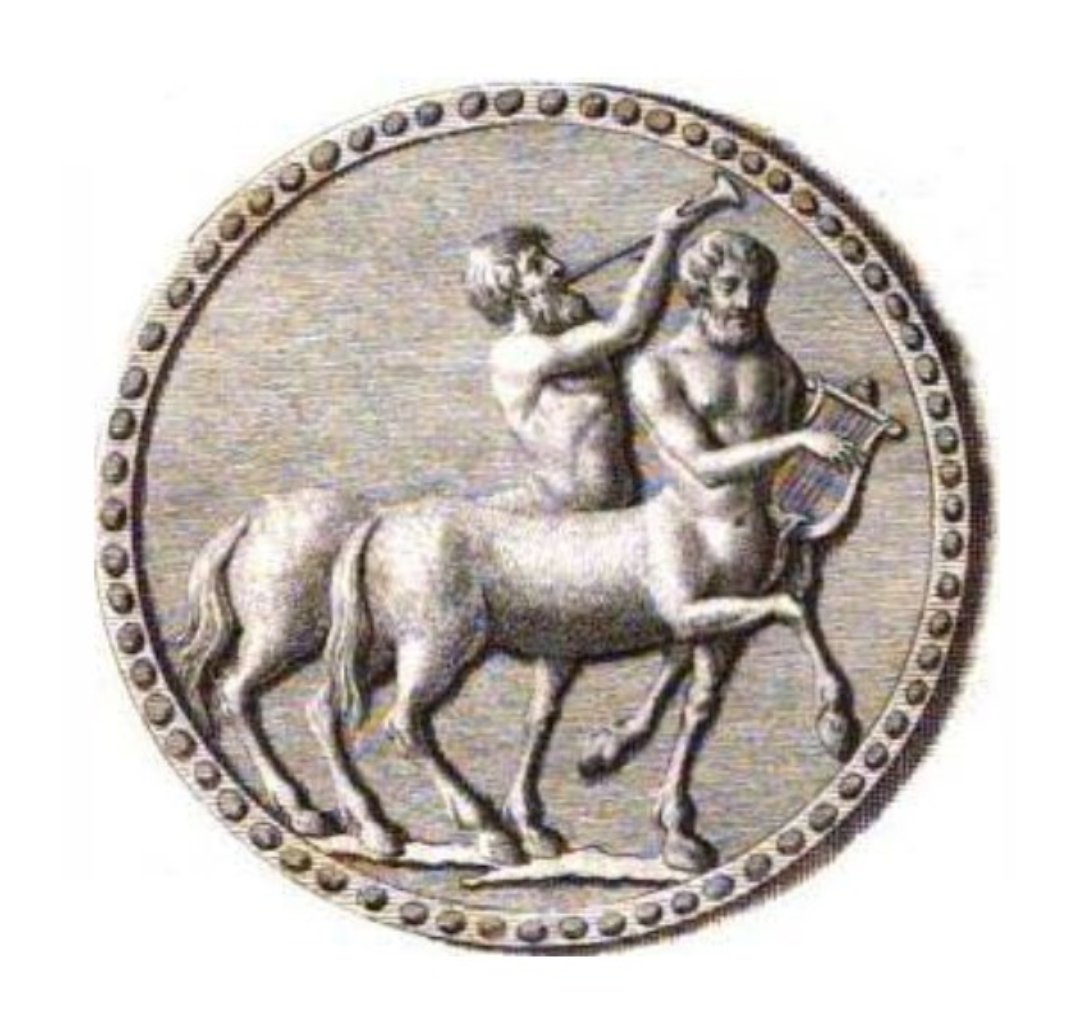
Published by Centaurus Press · Universitas Scholarium · All rights reserved.