

Abecedaria Press · Memorising for Latin
Part Fourteen
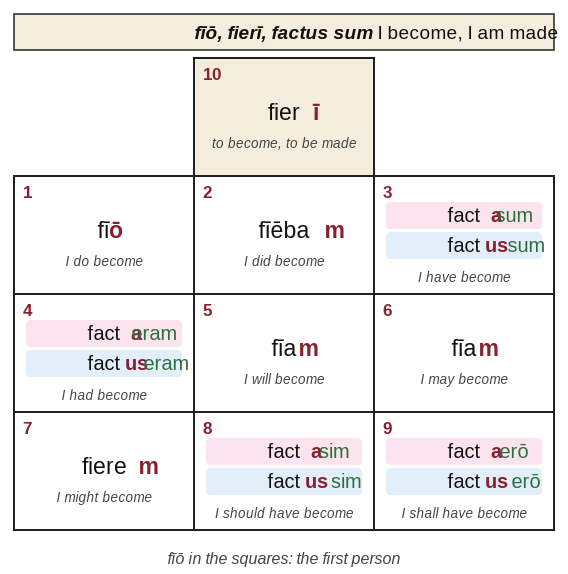
Fīō means "I become", and it also means "I am made", "I am done". It serves as the passive of faciō, I make, I do: faciō, I make; fīō, I am made.
Its own stem, fī-, is used only for the squares that are not perfect: 1, 2, 5, 6 and 7, and the infinitive fierī in square 10. For the perfect squares it borrows the participle of faciō, factus, with sum, exactly as the passive of amō uses amātus with sum. So here, as on the passive walls, a woman says facta sum, I have become (pink), and a man factus sum (blue).
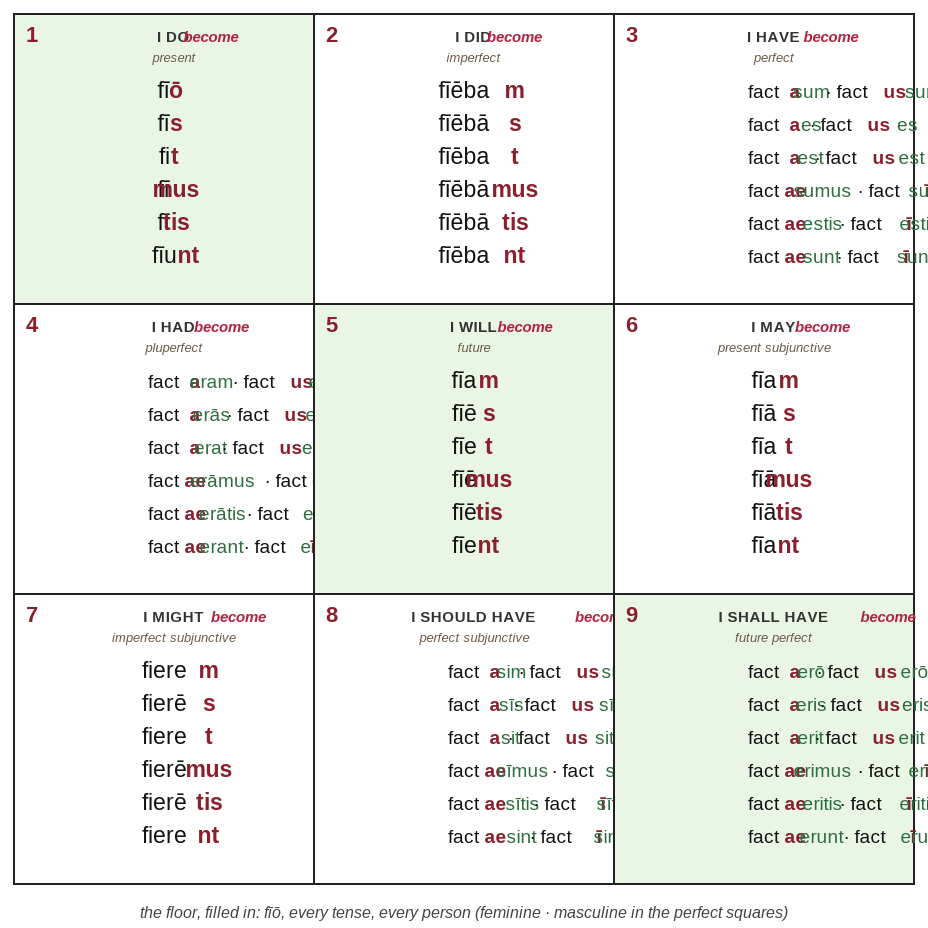
Things to notice:
That completes the irregular verbs. Next come the other conjugations: moneō (I warn), regō (I rule), capiō (I take) and audiō (I hear). Each goes into the same squares as amō, and you will find that you already know most of them.

Memorising for Latin — Book Three: Verbs · Evan Millner · Published by Abecedaria Press