

Abecedaria Press · Memorising for Latin
Part Fifteen
Moneō goes into exactly the same squares as amō. Every tense keeps its place, on the floor and on the three walls, and every square has the same six personal endings. What changes is only the part between the stem and the ending.
The dictionary gives four forms: moneō, monēre, monuī, monitum. You know where they live:
Look at square 10. Amāre ends in -āre; monēre ends in -ēre. That long ē is the mark of the second conjugation, just as the long ā is the mark of the first. The ceiling tells you which family a verb belongs to.
From here on there are no new memory sentences. With amō you have learned what each square means: square 2 is "I did", square 5 is "I will", square 9 is "I shall have", and so on. That is the real work, and it is done. A new verb is only a new set of forms to put into squares you already know. If you ever want a hook for a particular form, you know how to make one for yourself.
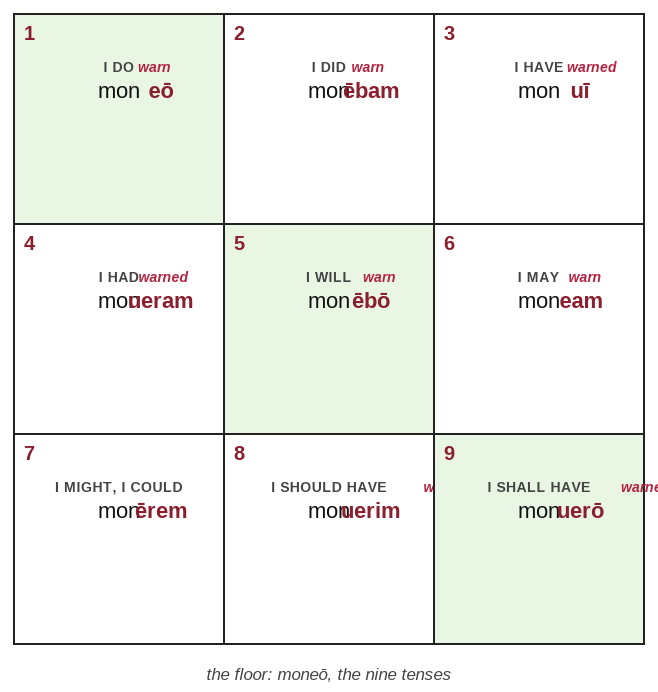
Put it beside amō, square by square:
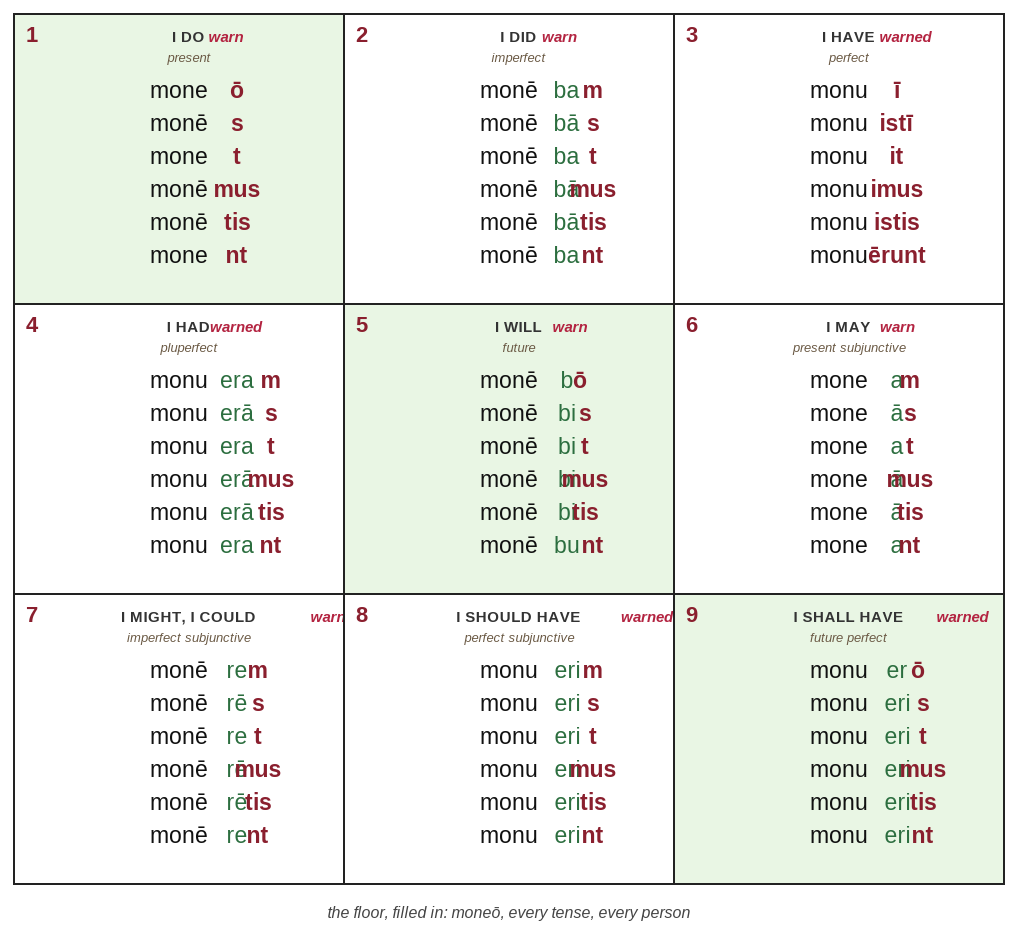
The six endings are the same as for amō: -ō or -m, -s, -t, -mus, -tis, -nt, with the perfect endings in square 3. Here is every person, with the tense sign in green and the ending in maroon:
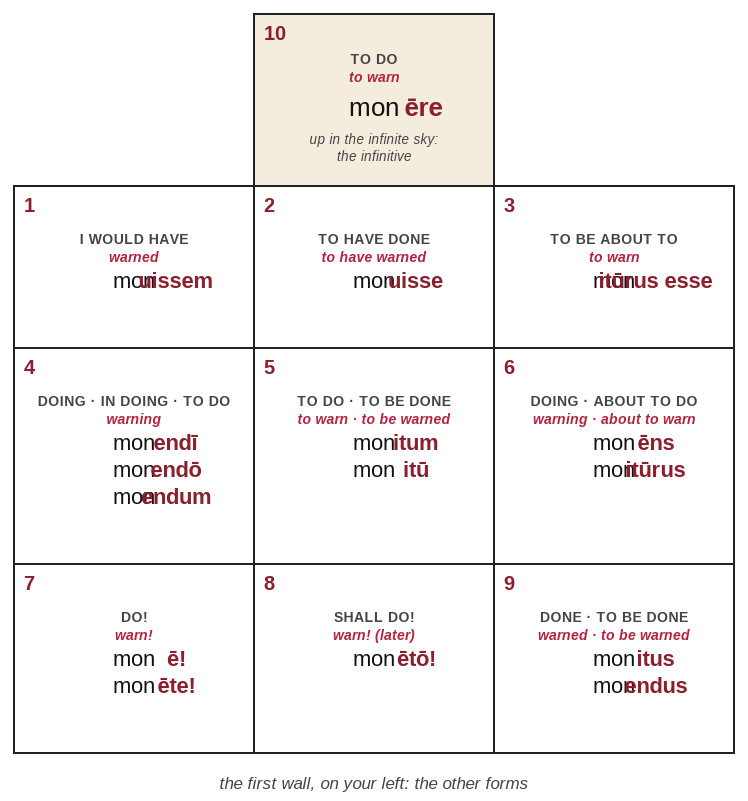
Square 10, on the ceiling, holds monēre. The first wall below it holds the other forms, each in the same square as for amō:
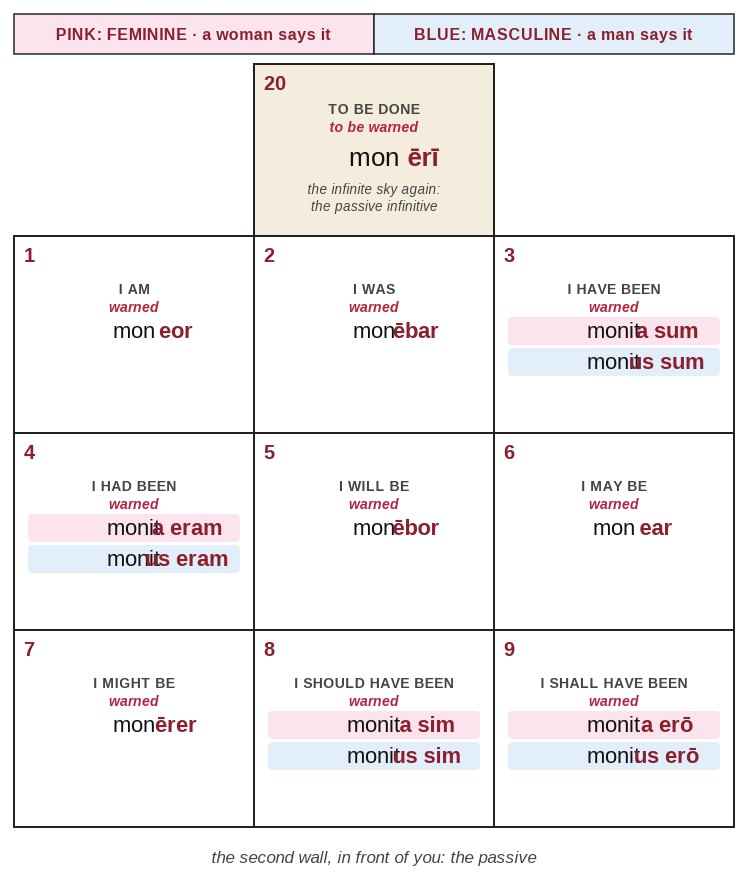
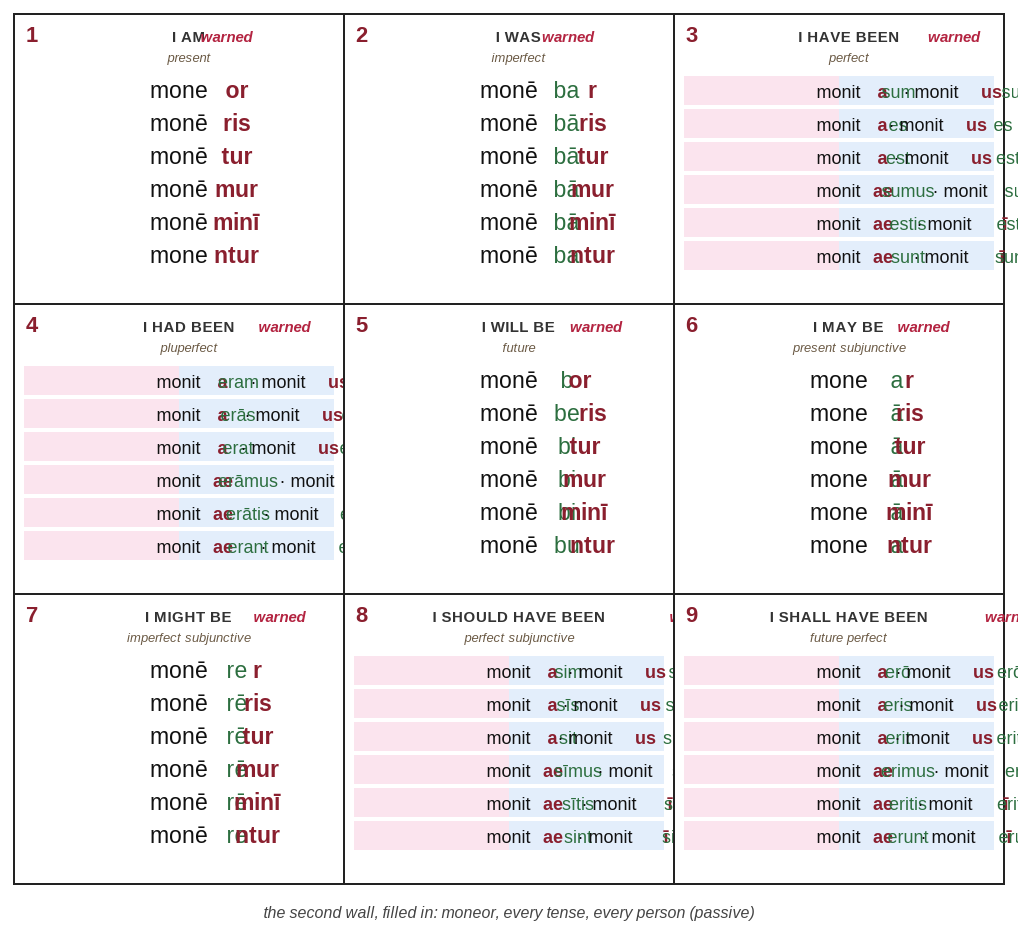
The passive of moneō goes on the second wall, square for square with the floor, with the passive infinitive monērī on the ceiling in square 20. The six passive endings are the same as for amō: -r or -or, -ris, -tur, -mur, -minī, -ntur.
In squares 3, 4, 8 and 9 the participle goes with sum, as for amō. As with sum as a helper, the pink form is what a woman says and the blue form what a man says: monita sum, I have been warned (a woman speaking); monitus sum, I have been warned (a man speaking).
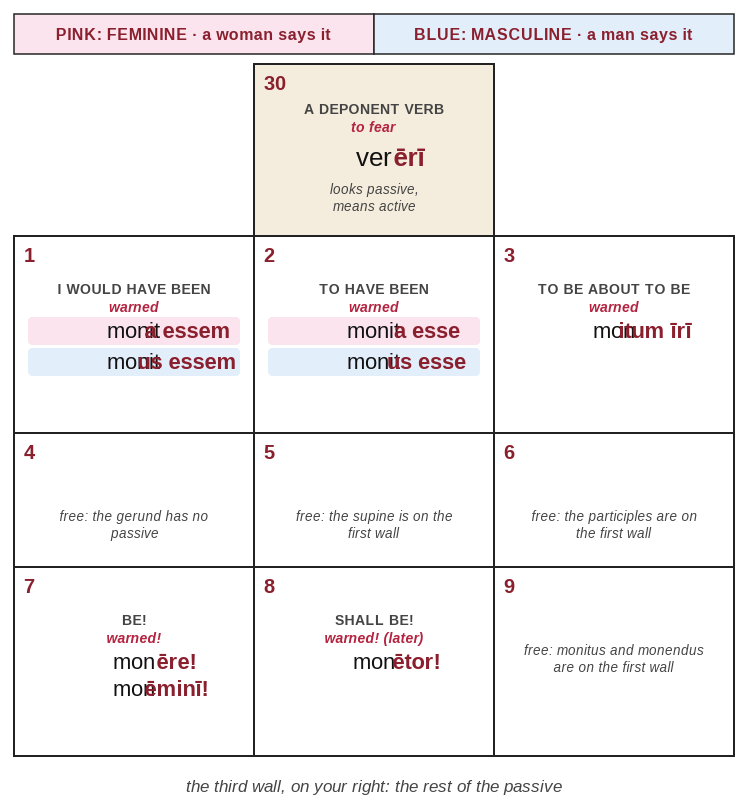
The third wall mirrors the first wall, as for amō: monita essem or monitus essem in square 1, monita esse or monitus esse in square 2, monitum īrī in square 3, monēre! and monēminī! in square 7, monētor! in square 8. Squares 4, 5, 6 and 9 stay free.
On the ceiling, in square 30, goes a deponent verb of the second conjugation: vereor, verērī, veritus sum, I fear, I respect. It looks passive and means active. English has kept it in revere and reverence.
A monitor is one who warns; a monument is a thing that reminds; and a premonition is a warning given beforehand.
Next comes the third conjugation: regō, I rule.

Memorising for Latin — Book Three: Verbs · Evan Millner · Published by Abecedaria Press