

Abecedaria Press · Memorising for Latin
Part Sixteen
Regō goes into the same squares as amō and moneō, with the same six endings in every square.
The dictionary gives four forms: regō, regere, rēxī, rēctum:
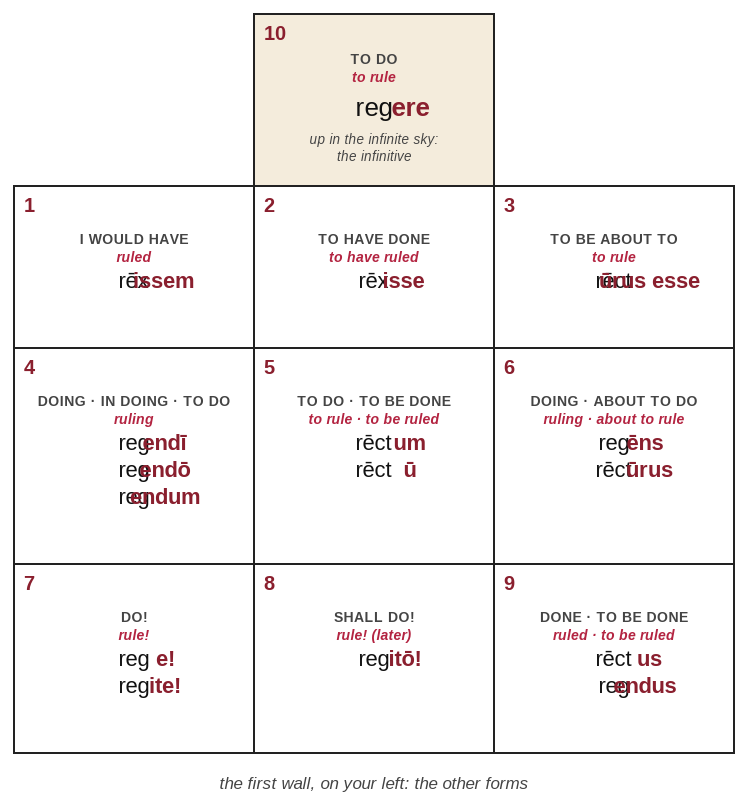
Look at square 10 again. Monēre has a long ē; regere has a short e. That short e is the mark of the third conjugation. On the page, the only difference between the two infinitives is the macron, the little line over the long vowel. This is one of the best reasons for always writing the macrons when you learn a verb.
The perfect rēxī is reg- and -s- joined: g and s together are written x. The third conjugation has many different kinds of perfect, so learn the perfect of each verb from the dictionary, together with square 1 and square 10.
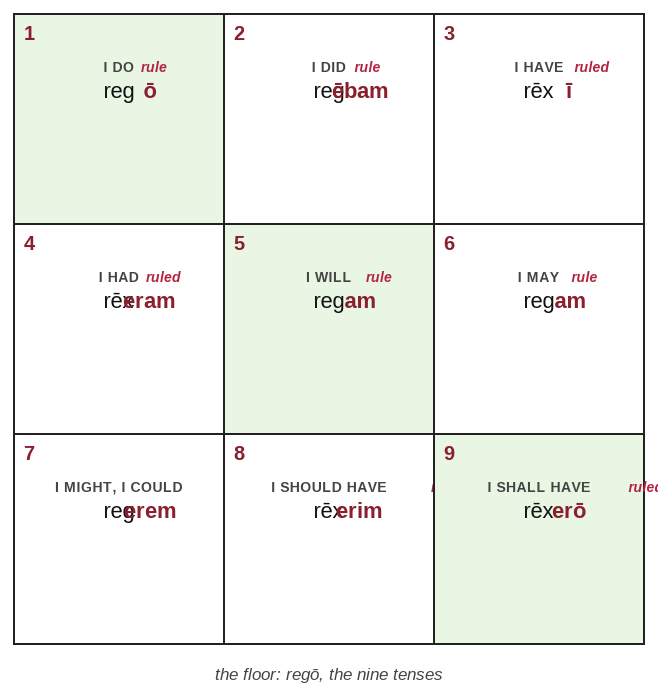
Things to notice:
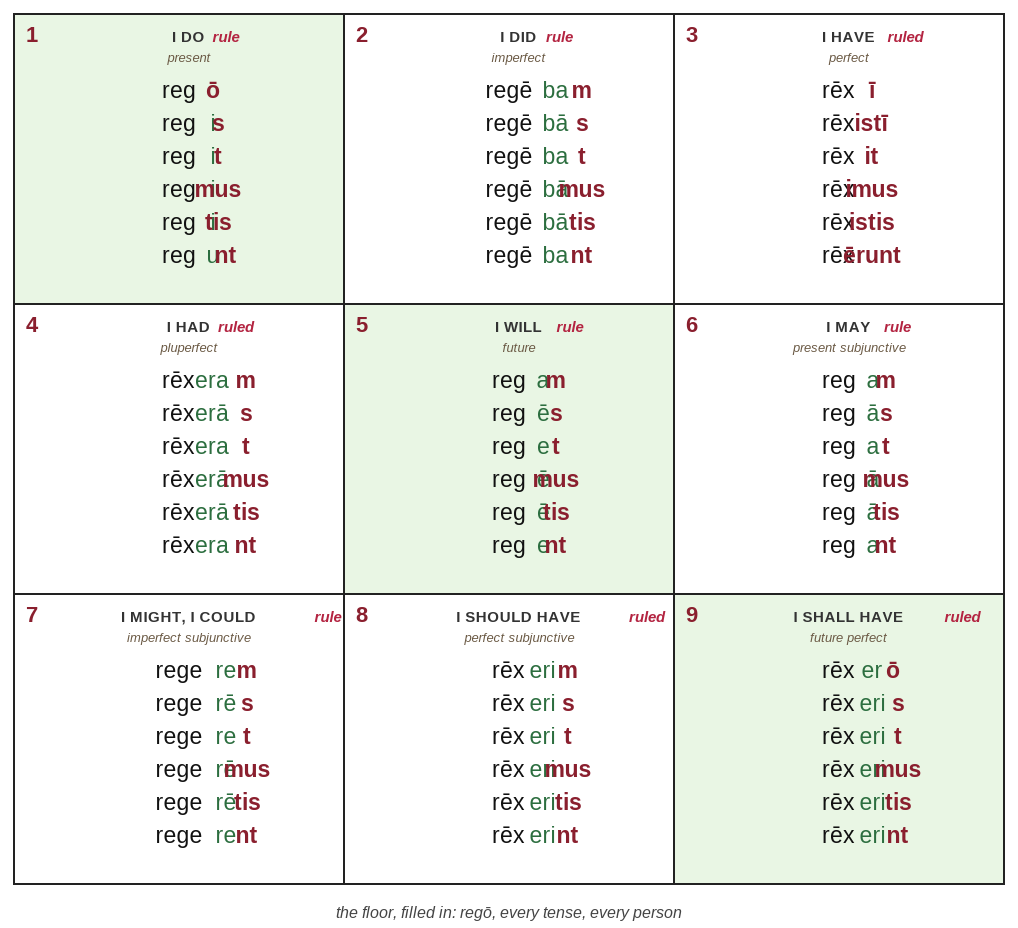
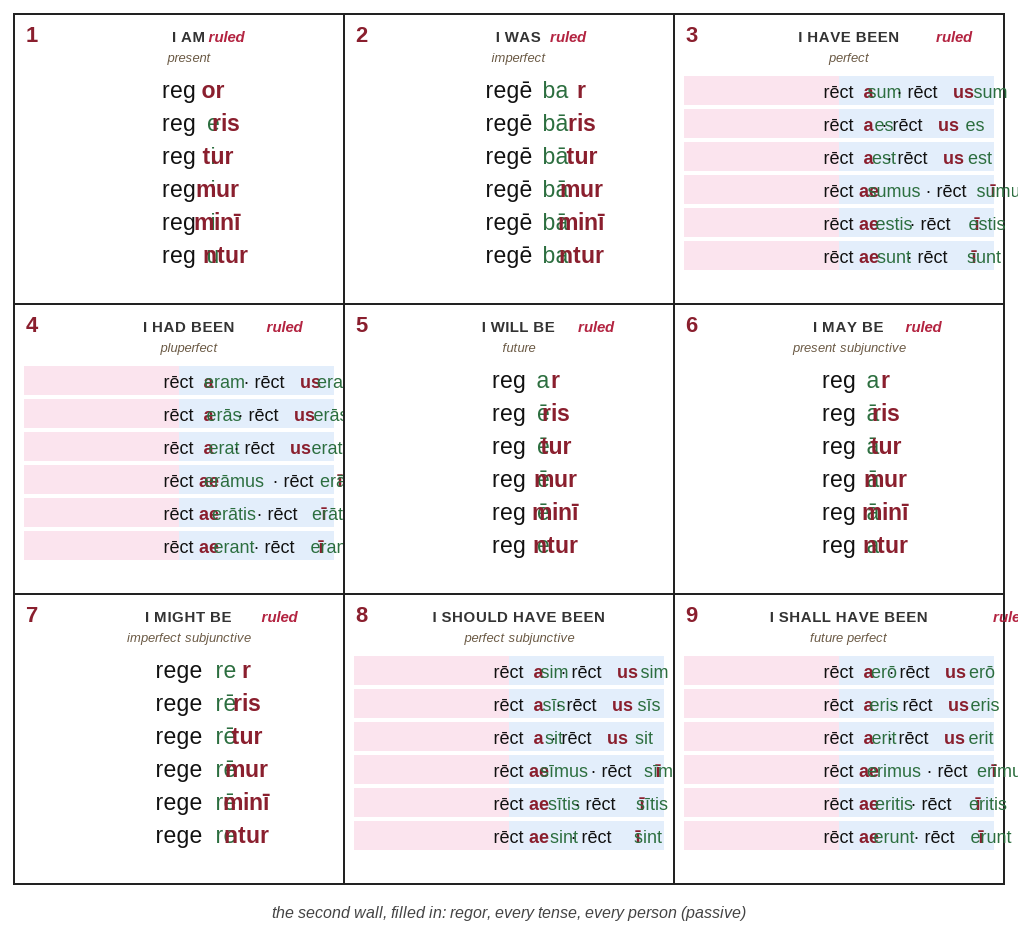
The passive infinitive in square 20 is very short: regī, to be ruled. On the second wall, as before, pink is what a woman says and blue what a man says: rēcta sum, rēctus sum.
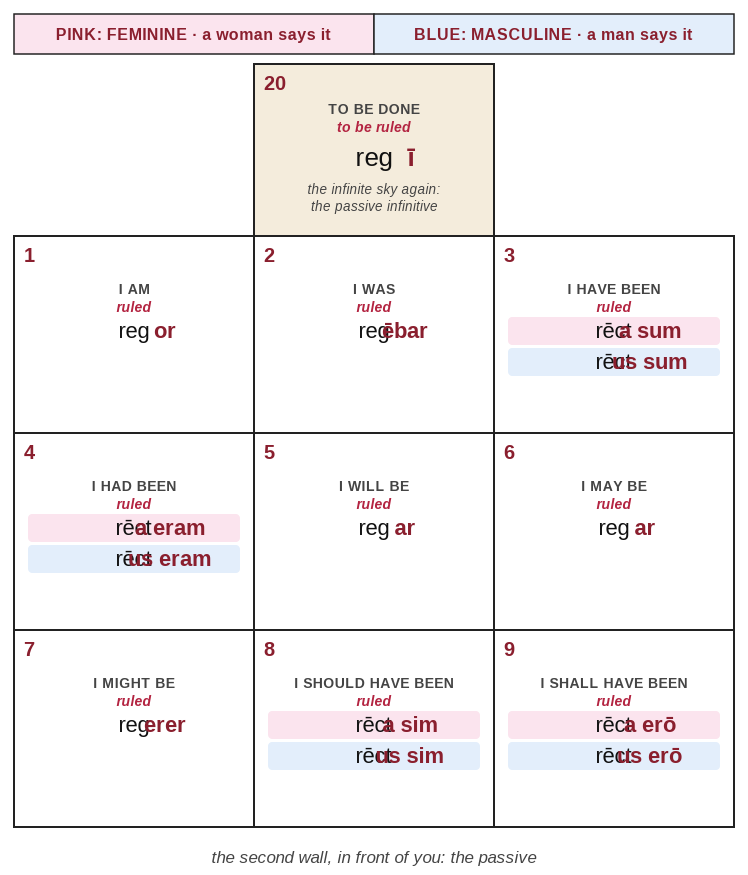
One pair to watch: regeris, you are ruled (square 1, short e) and regēris, you will be ruled (square 5, long ē). Again only the macron tells them apart. And squares 5 and 6 begin alike again: regar in both.
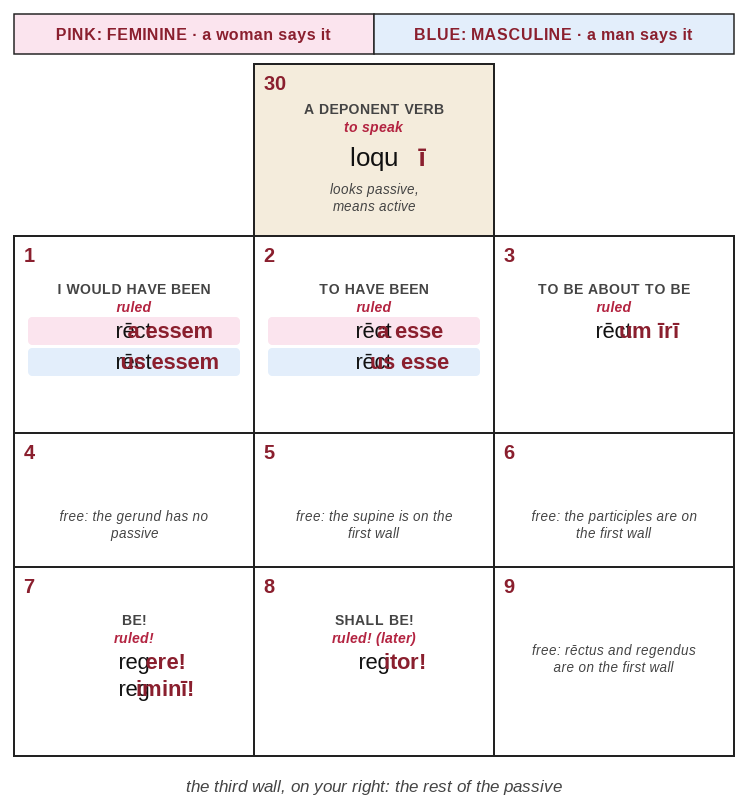
Rēcta essem or rēctus essem in square 1, rēcta esse or rēctus esse in square 2, rēctum īrī in square 3, regere! and regiminī! in square 7, regitor! in square 8.
On the ceiling, in square 30: a deponent of the third conjugation, loquor, loquī, locūtus sum, I speak. English has kept it in eloquent, loquacious and colloquial.
A regent rules; a regiment is a body under rule; and from rēctus, ruled, straight, come direct, correct and rector.
Next comes capiō, I take: a verb of the third conjugation with a little of the fourth.

Memorising for Latin — Book Three: Verbs · Evan Millner · Published by Abecedaria Press