

Abecedaria Press · Memorising for Latin
Part Seventeen
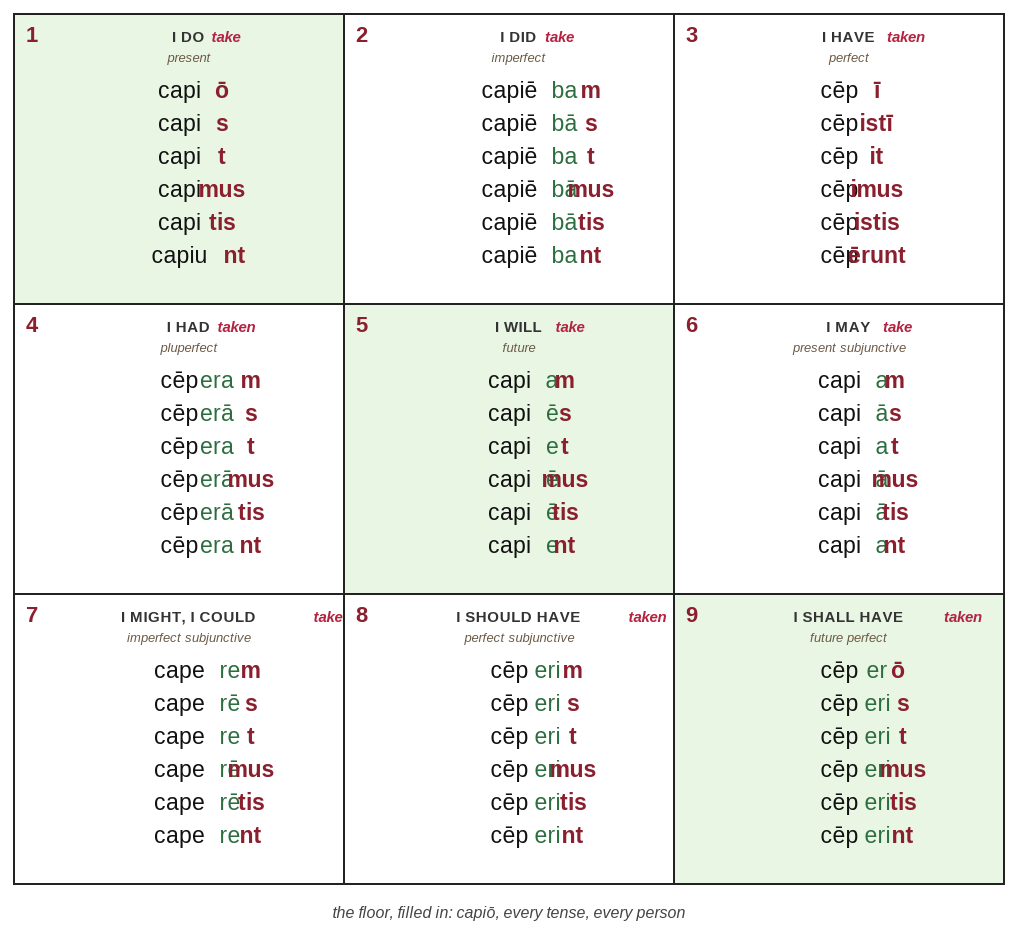
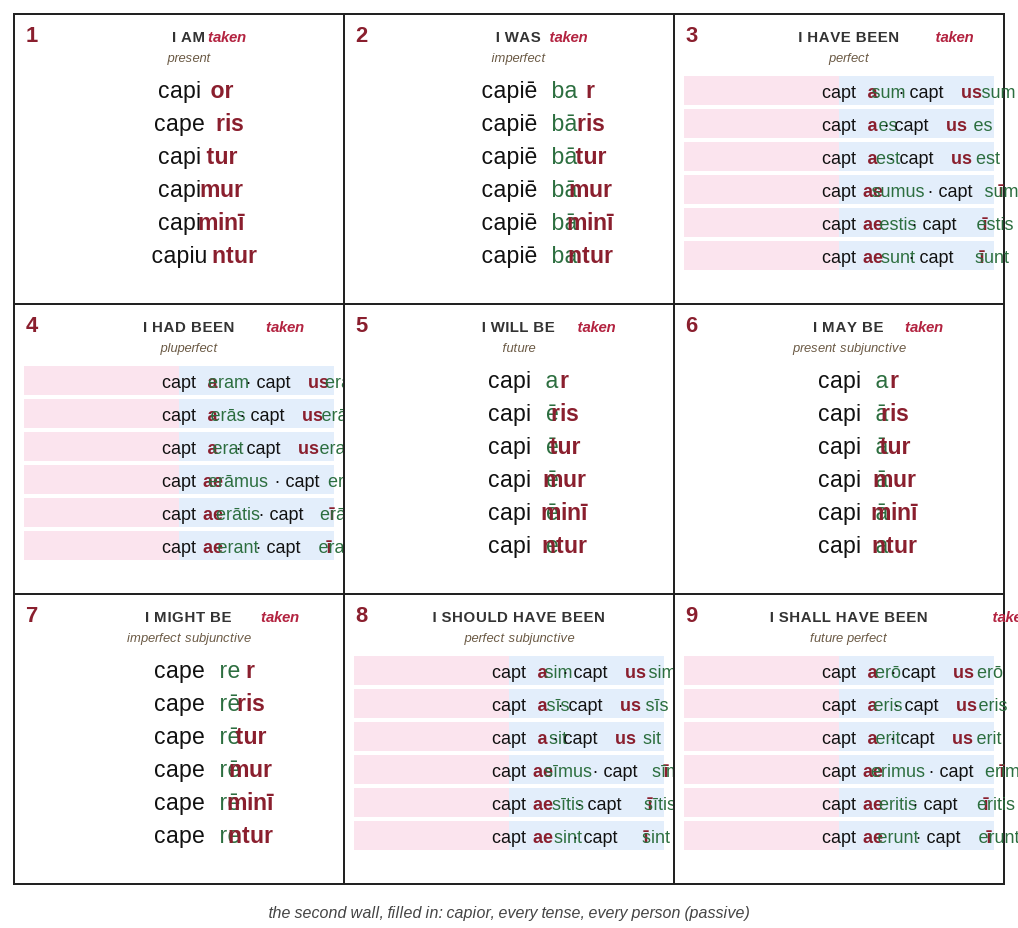
Capiō goes into the same squares, with the same six endings in every square.
The dictionary gives four forms: capiō, capere, cēpī, captum:
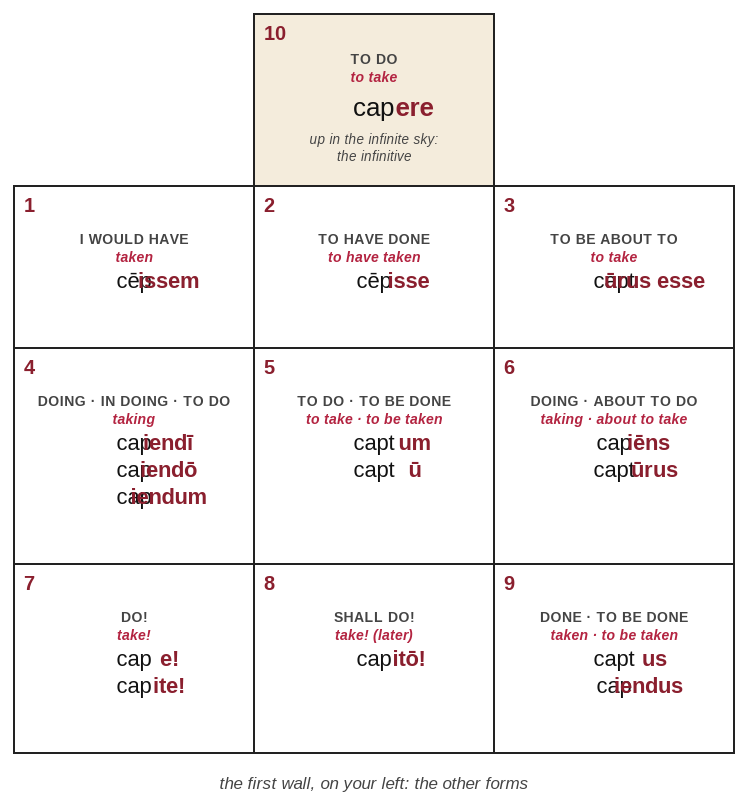
The infinitive in square 10, capere, has the short e of the third conjugation, like regere. So capiō belongs to the third conjugation. But square 1 ends in -iō, like audiō, the fourth conjugation, which comes next. Capiō is a mixture of the two.
Here is the whole rule. Wherever audiō has an i followed by another vowel, capiō has one too. Everywhere else, capiō goes like regō.
So capiō, capiunt, capiēbam, capiam, capiēns, capiendī, with i and a vowel, like audiō, audiunt, audiēbam, audiam. But capis, capit, capimus, capitis, capere, caperem, cape!, like regis, regit, regimus, regitis, regere, regerem, rege!.
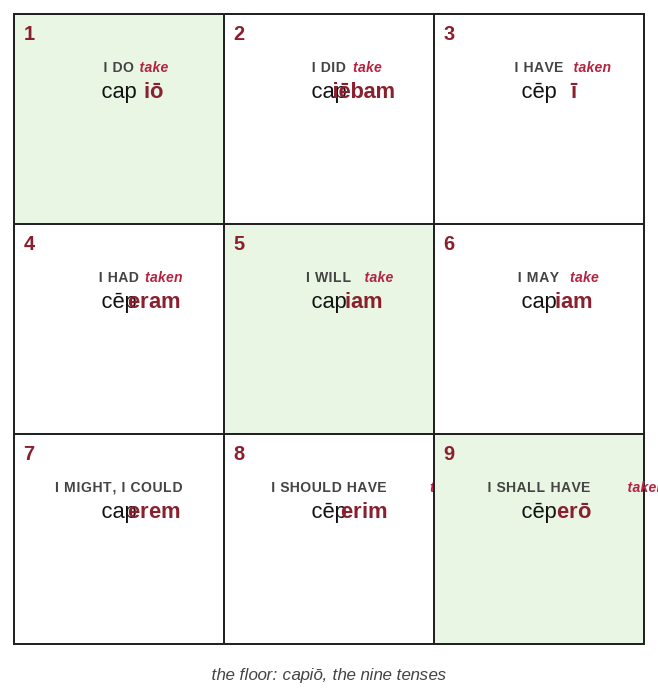
Things to notice:
The passive infinitive in square 20 is capī, like regī. On the second wall, pink is what a woman says and blue what a man says: capta sum, I have been taken (a woman); captus sum (a man).
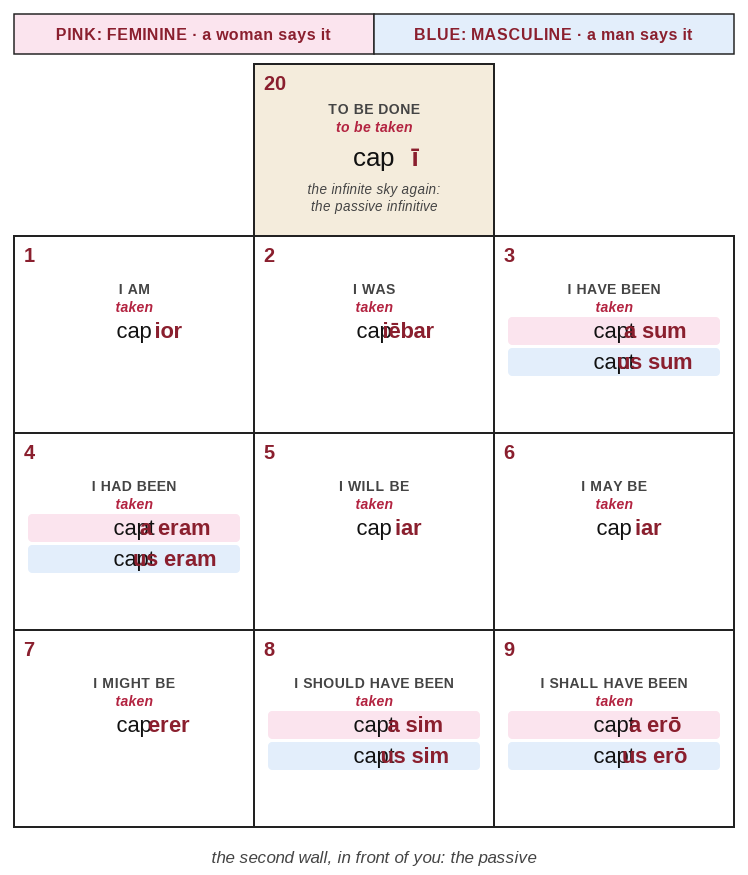
The rule still holds: capior, capiuntur, capiēbar, capiar, with i and a vowel; but caperis, capitur, caperer, like regeris, regitur, regerer.
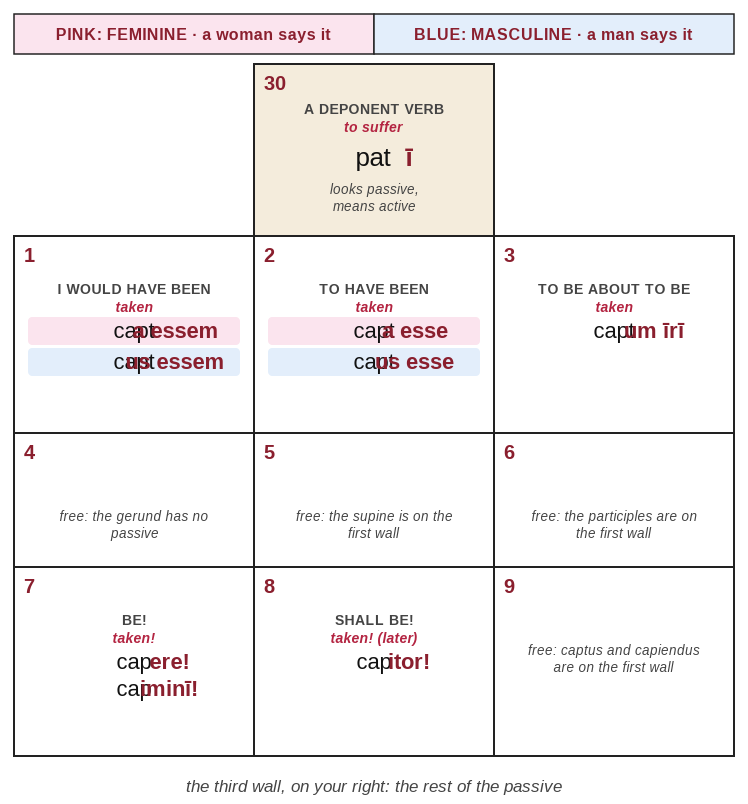
Capta essem or captus essem in square 1, capta esse or captus esse in square 2, captum īrī in square 3, capere! and capiminī! in square 7, capitor! in square 8.
On the ceiling, in square 30: a deponent of the same kind, patior, patī, passus sum, I suffer, I allow. English has kept it in patient and passion.
There are not many verbs of this kind, but they are very common: faciō, I make, I do; fugiō, I flee; iaciō, I throw; cupiō, I desire; rapiō, I seize; and the compounds of capiō, such as accipiō, I receive, and recipiō, I take back. They all follow the one rule above. (You have already met the passive of faciō among the irregular verbs: it is fīō.)
From captum come capture, captive and caption; from capāx, able to hold, capacity; and from the compound accipiō, accept.
Next comes the fourth conjugation: audiō, I hear.

Memorising for Latin — Book Three: Verbs · Evan Millner · Published by Abecedaria Press